
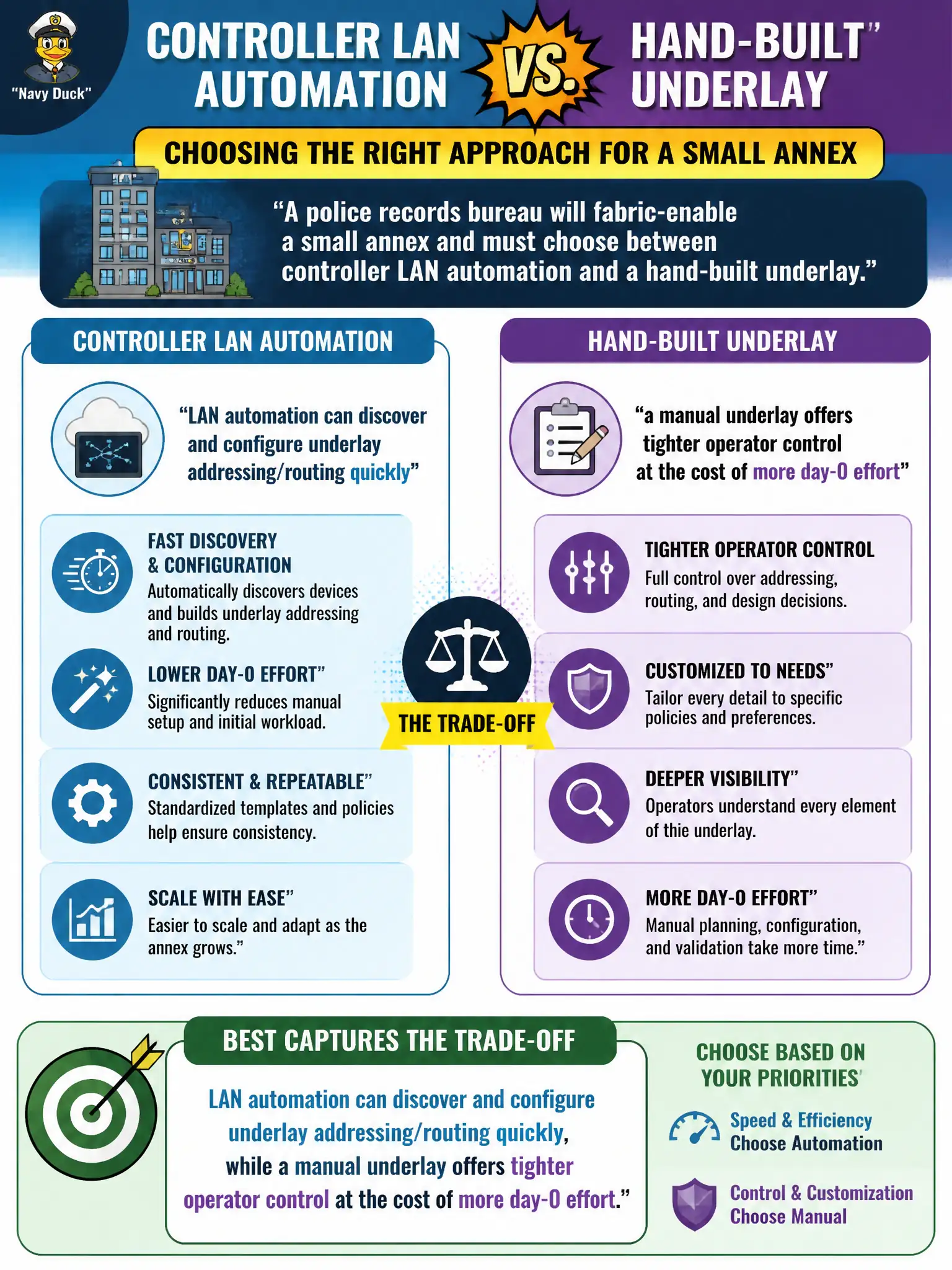
A police records bureau will fabric-enable a small annex and must choose between controller LAN automation and a hand-built underlay. Which statement best captures the trade-off?
Select an answer to reveal the explanation.
Short Explanation
LAN automation is the crew that paints parking lines and hangs signs for you; manual underlay is you with a measuring tape. Small annexes sometimes prefer the control of hand-built IP/IGP, while greenfield floors love the speed of controller-driven underlay. Either way, you still need a working underlay.
Full Explanation
When a police records bureau fabric-enables a small annex, LAN automation in Catalyst Center can discover and configure underlay addressing and routing quickly, while a manual underlay remains valid when teams need full declarative control of IP plans and IGP design. The correct comparison is speed-and-consistency of automation versus intentional hand-built underlays—not a false hardware or protocol monopoly.
Manual underlays forbidding IS-IS, or LAN automation requiring ACI spine-leaf only, misstates platform scope. SD-Access underlays commonly use IS-IS on Catalyst fabrics; ACI is a different architecture.
LAN automation eliminating any underlay routing protocol forever after Day 0 is false; the underlay still runs routing after provisioning.
Claiming hand-built underlays cannot support fabric borders while only LAN automation can seed border roles is incorrect; borders work on properly built manual underlays too.
Exam caveat: automation success still depends on discovery credentials, seed devices, and clean Layer-2/Layer-3 prerequisites—failed inventory blocks both paths.
Operational check: choose LAN automation or manual underlay deliberately for the annex, verify IS-IS/IP reachability among fabric roles, then provision overlay. Record the choice and IP plan in the police IT fabric workbook for auditors and future closet adds.