
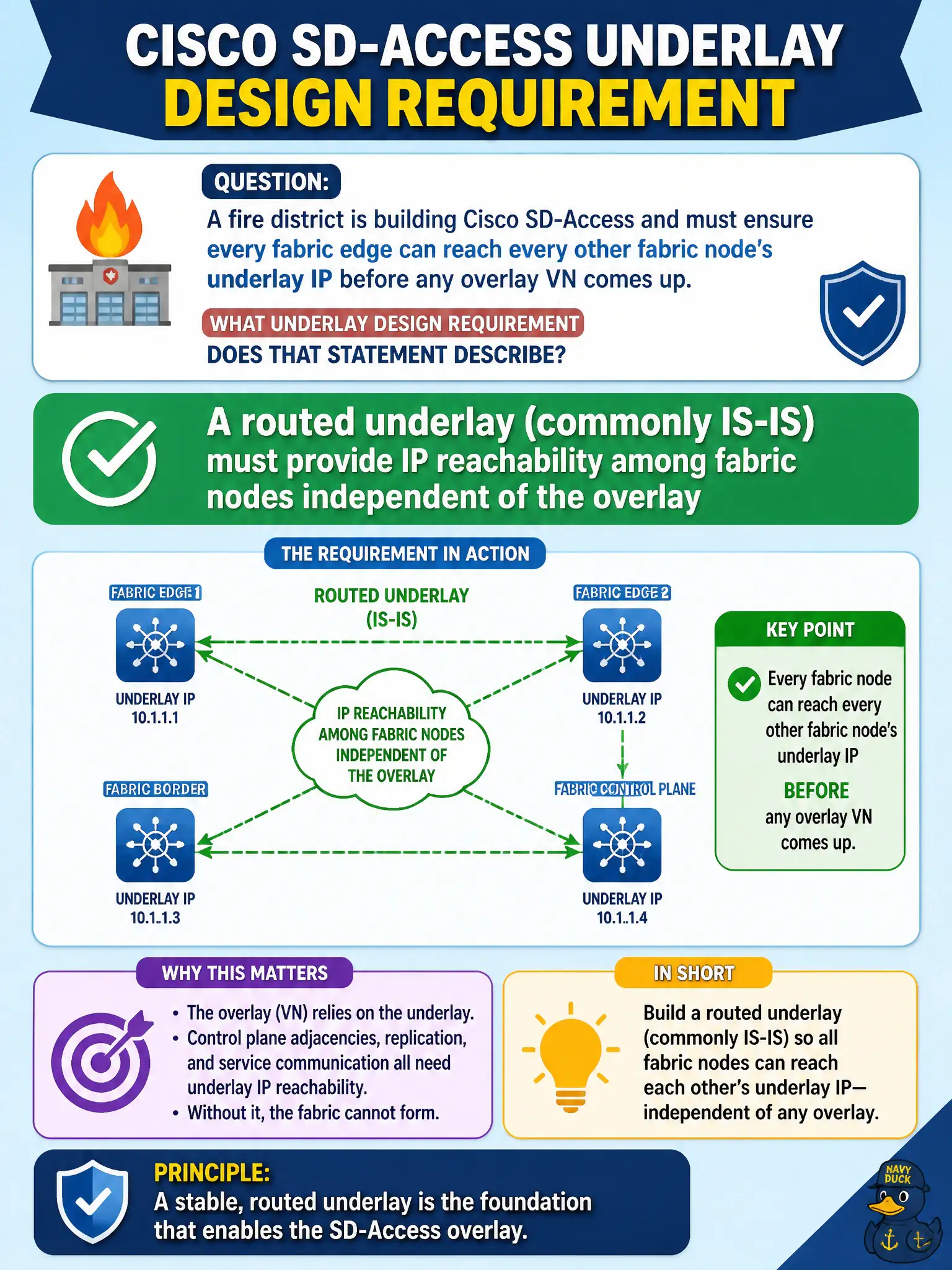
A fire district is building Cisco SD-Access and must ensure every fabric edge can reach every other fabric node’s underlay IP before any overlay VN comes up. What underlay design requirement does that statement describe?
Select an answer to reveal the explanation.
Short Explanation
The underlay is the paved roads; the overlay is the courier service riding on top. In SD-Access, every fabric node needs rock-solid IP reachability—often via IS-IS—before VXLAN/LISP magic matters. No roads, no overlay deliveries.
Full Explanation
Cisco SD-Access separates a routed underlay from the LISP/VXLAN overlay. For a fire district fabric, every fabric edge must reach every other fabric node over IP in the underlay—commonly with IS-IS—independent of overlay virtual networks. Without that underlay reachability, VXLAN tunnels and LISP mappings cannot form a working campus fabric for station and dispatch endpoints.
Overlay LISP publications replacing all underlay IGP adjacencies on access ports confuses control-plane mapping with underlay routing. LISP does not eliminate the need for underlay IP connectivity among fabric nodes.
Relying solely on flooding without unicast underlay routes between VXLAN VTEPs fails the unicast underlay model SD-Access expects for edge-to-edge encapsulation.
Claiming fabric edges only need Layer-2 adjacency to the border with no IP underlay contradicts the routed-underlay foundation of the fabric.
Exam caveat: underlay should remain simple and highly stable; do not merge complex overlay segmentation problems into the underlay IGP.
Operational check: from each edge loopback, verify IP reachability to other edges, borders, and control-plane nodes before enabling fabric overlay. Document underlay IGP and MTU assumptions in the fire-district SD-Access design so civic public-safety devices onboard onto a reachable underlay first.