
A municipal hospital campus must explain to leadership why both LISP and VXLAN appear in the SD-Access fabric story. Which division of roles is accurate?
Select an answer to reveal the explanation.
Short Explanation
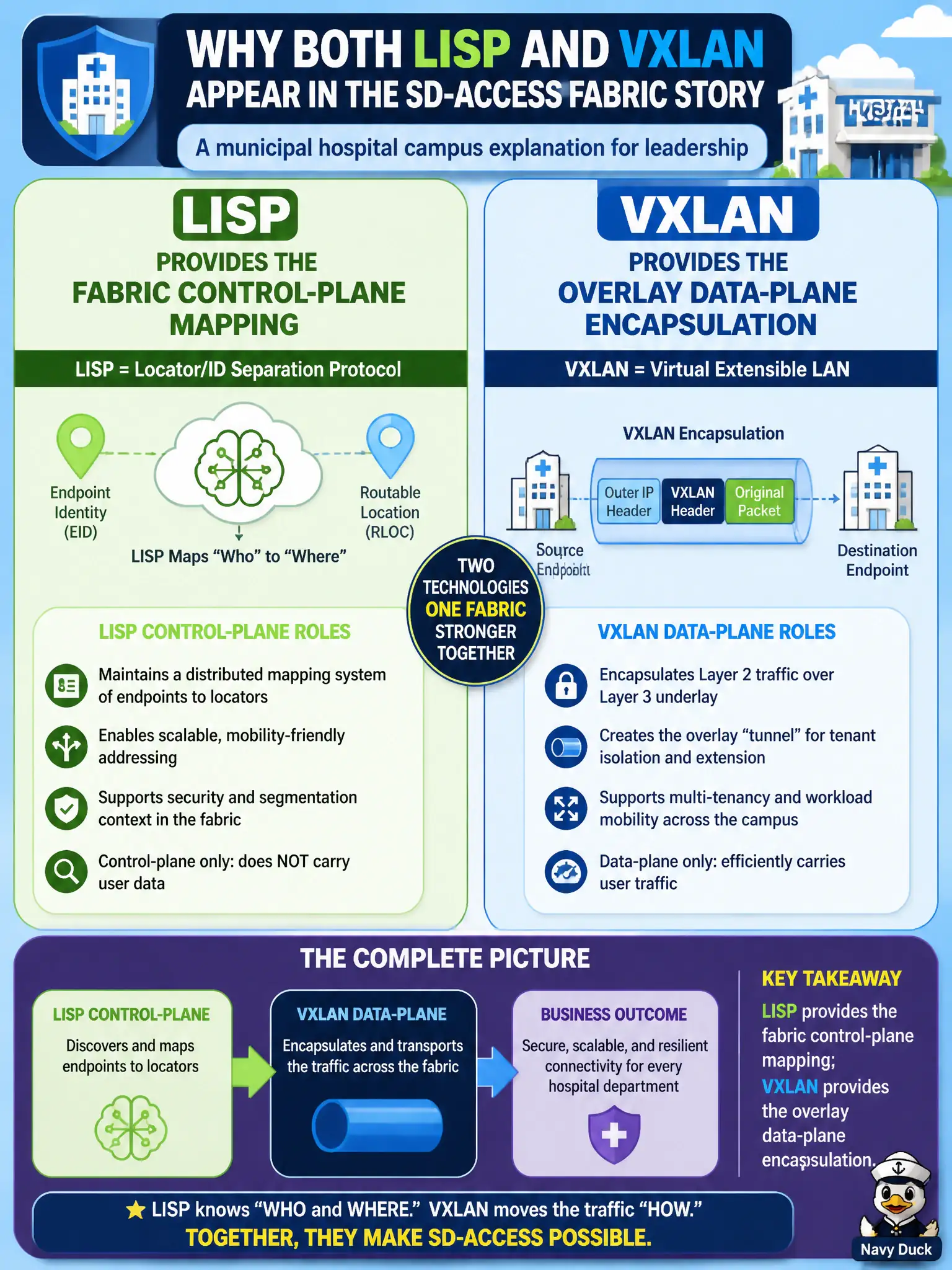
LISP is the phone book—“where does this endpoint live?”—and VXLAN is the shipping carton that wraps the frame across the underlay. SD-Access needs both: mappings in the control plane, encapsulation in the data plane. Mixing those jobs up confuses every design review.
Full Explanation
Leadership at a municipal hospital campus often asks why both LISP and VXLAN appear in SD-Access. The accurate split is that LISP provides the fabric control-plane mapping (EID-to-RLOC), while VXLAN provides the overlay data-plane encapsulation that carries user frames across the underlay. Together they separate identity/location mapping from transport encapsulation for clinical and guest virtual networks.
VXLAN replacing IS-IS in the underlay while LISP encrypts all WAN circuits mixes planes: IS-IS remains an underlay routing option, and LISP is not the WAN crypto service.
LISP carrying user data frames while VXLAN only advertises SGT policies to ISE reverses roles; VXLAN encapsulates data, LISP maps locations, and SGTs are a policy identity overlay.
Both protocols solely managing AAA and never forwarding campus traffic ignores that VXLAN forwards user traffic and LISP directs where that traffic is mapped.
Exam caveat: control-plane nodes host LISP map-server/resolver functions; edges/borders are VTEPs—do not conflate “LISP box” with “only device that encapsulates.”
Operational check: show LISP map-cache entries for a test endpoint and correlate with VXLAN encapsulation on the edge toward the RLOC. Explain the control/data split in the hospital architecture brief so executives do not treat the two protocols as duplicates.