
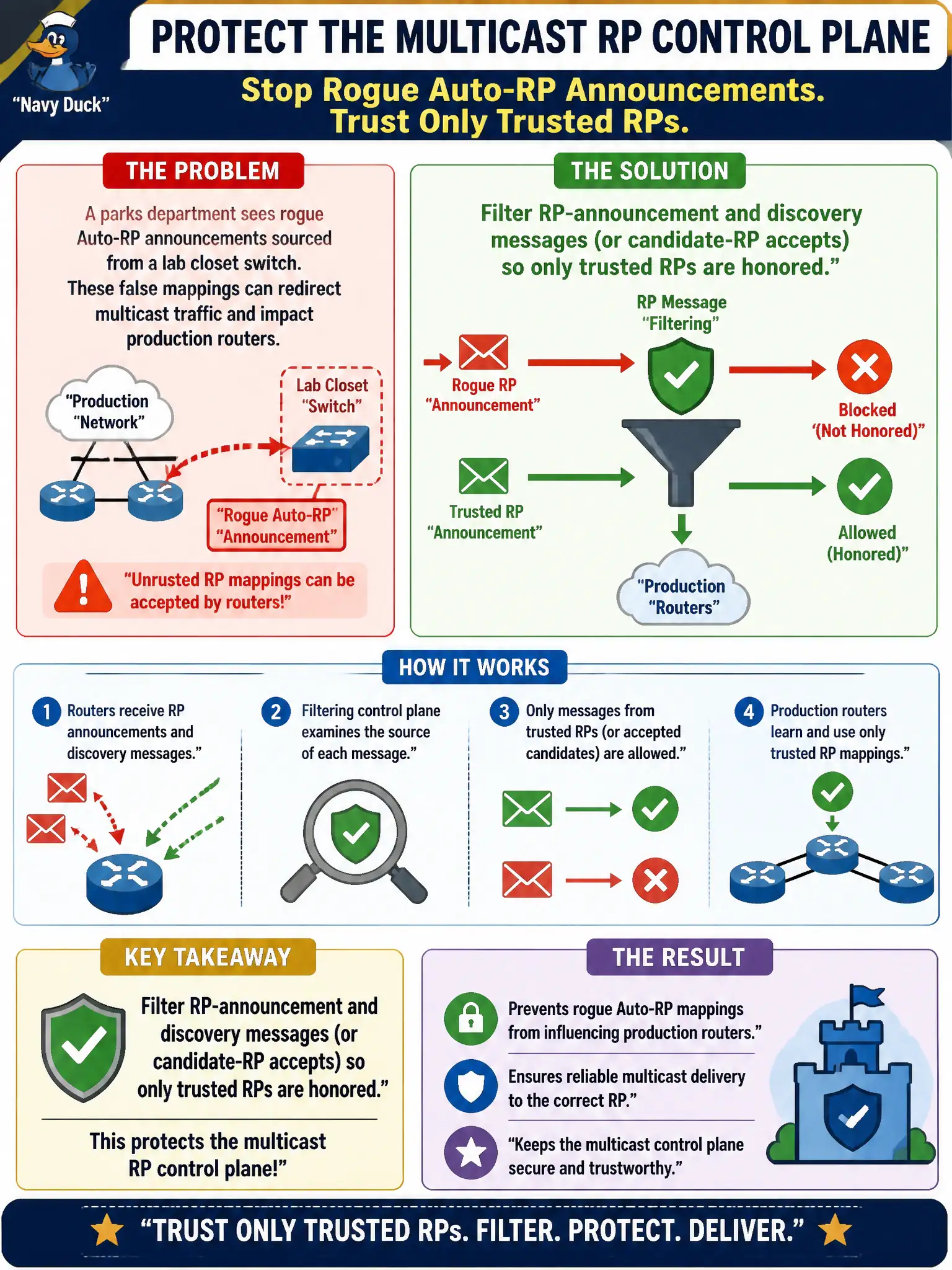
A parks department sees rogue Auto-RP announcements sourced from a lab closet switch and must stop those mappings from influencing production routers. Which control best protects the multicast RP control plane?
Select an answer to reveal the explanation.
Short Explanation
A lab switch yelling “I’m the RP!” is like a fake PA system in city hall. Filter Auto-RP (or BSR) announcements so only blessed routers get believed. Ignoring that control plane is how a closet steals your sparse-mode traffic.
Full Explanation
When a parks department sees rogue Auto-RP announcements from a lab closet switch, the control that protects the multicast RP control plane is filtering RP-announcement and discovery messages (or candidate-RP accepts) so only trusted RPs are honored. Auto-RP and BSR distribute mappings that routers may otherwise trust; without filters, a misconfigured lab device can become the effective RP and black-hole or hijack civic sparse-mode trees.
Lengthening PIM Hello timers so Auto-RP messages age out faster does not authenticate or filter RP advertisements and misuses neighbor timers for a mapping-security problem.
Moving every camera group into IGMPv1-only mode on access VLANs weakens receiver signaling and does nothing to stop rogue RP announcements in the PIM domain.
Disabling IGMP snooping on the closet switch to silence Auto-RP confuses L2 receiver optimization with RP control-plane protection; it will not reliably stop Auto-RP influence on routers.
Exam caveat: apply filters on interfaces facing untrusted closets and also constrain which candidate RPs are accepted globally; boundary plus accept-ACL defense in depth is safer than a single choke point.
Operational check: apply Auto-RP/BSR filters permitting only production RPs, source a rogue announcement in a lab VRF/VLAN, and confirm production routers ignore it. Record trusted RP addresses and filter ACLs in the parks multicast security baseline.