
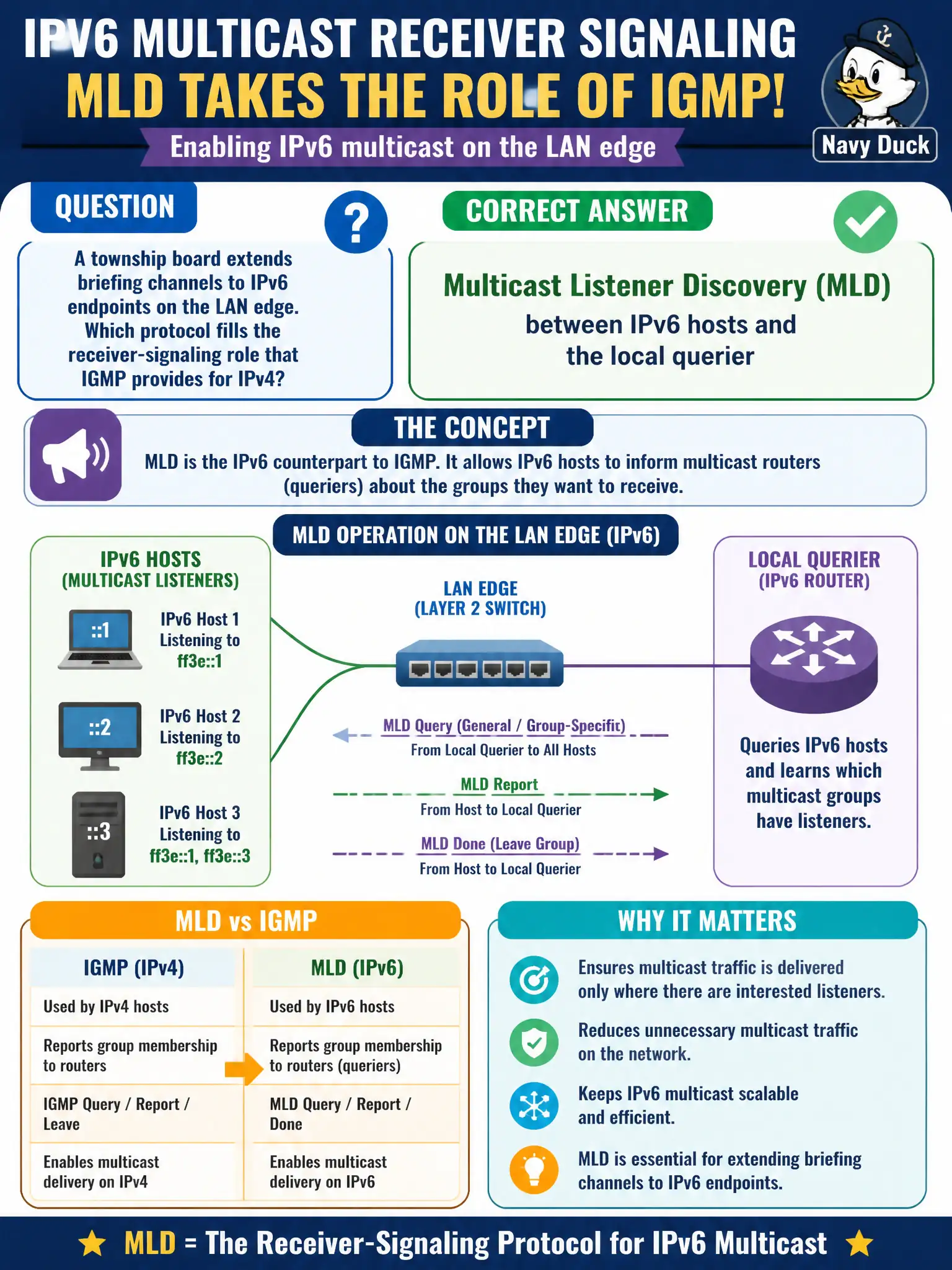
A township board extends briefing channels to IPv6 endpoints on the LAN edge. Which protocol fills the receiver-signaling role that IGMP provides for IPv4?
Select an answer to reveal the explanation.
Short Explanation
IPv6 still needs a way for desktops to say “tune me into this group.” That job belongs to MLD—same idea as IGMP, different address family. Neighbor Discovery and DHCP do other chores; they are not the membership protocol.
Full Explanation
When a township board extends briefing channels to IPv6 endpoints, Multicast Listener Discovery (MLD) fills the receiver-signaling role that IGMP provides for IPv4. MLD, carried in ICMPv6, lets hosts report multicast listener state to the local querier. MLDv1 roughly parallels IGMPv2 group membership; MLDv2 adds source filtering akin to IGMPv3—exactly what dual-stack civic briefing edges need.
ICMPv6 Neighbor Discovery alone without group membership messages handles address resolution and router discovery chores. ND is not the multicast listener membership protocol.
DHCPv6 relay options that embed PIM Register headers confuse address assignment/relay with host membership signaling and with first-hop Register behavior; that is not MLD.
IPv6 Router Advertisements with the M-bit set influence stateful address configuration signaling, not group join/leave semantics for briefing channels.
Exam caveat: MLD snooping is the L2 companion analogous to IGMP snooping; enabling MLD on routers without switch snooping can still flood the VLAN.
Operational check: on an IPv6 receiver VLAN, verify MLD queries/reports, confirm snooping state for the briefing group, and test MLDv2 source filters if SSM is in use. Update the township IPv6 multicast checklist so dual-stack rollouts do not forget MLD.