
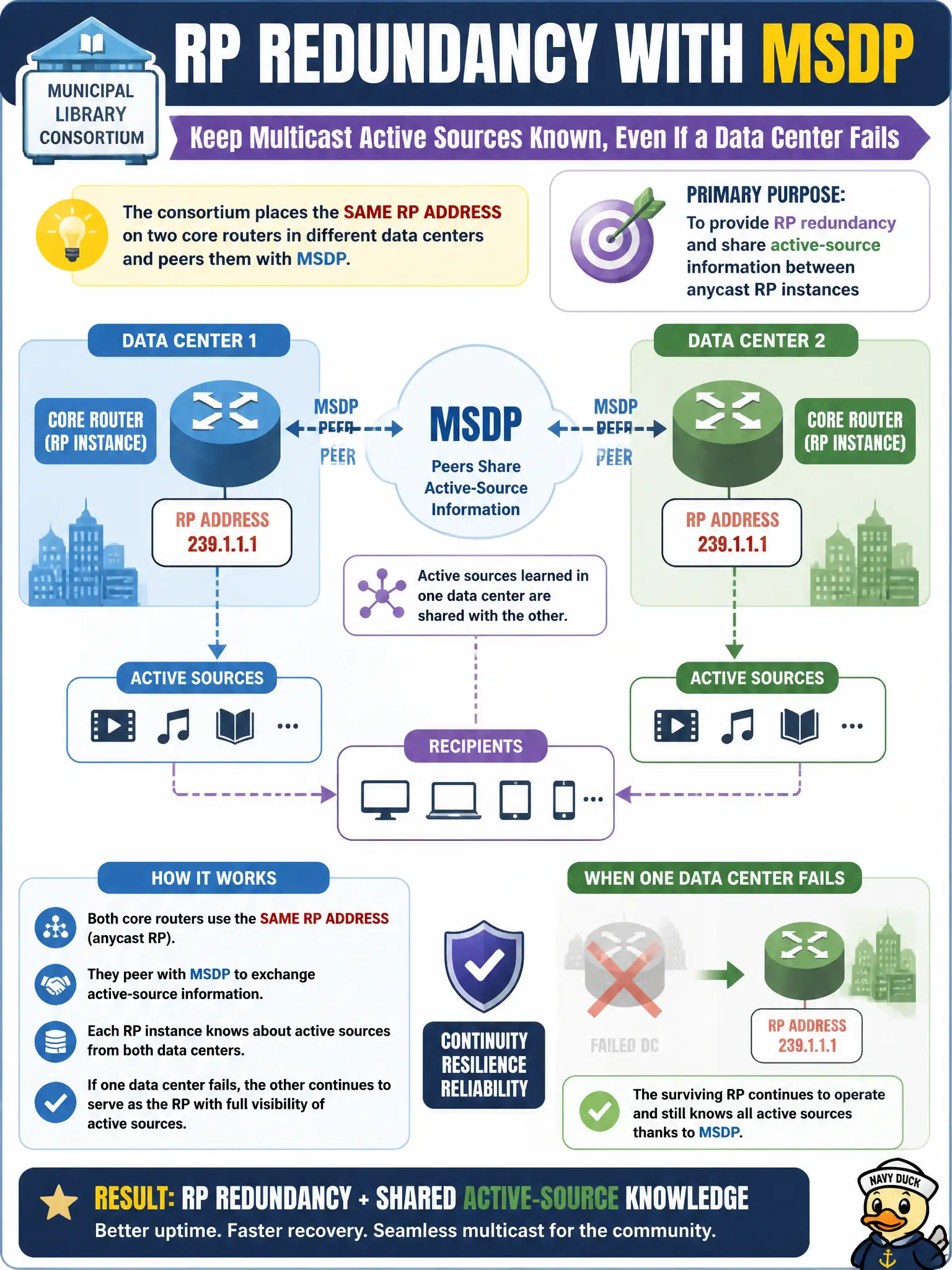
A municipal library consortium places the same RP address on two core routers in different data centers and peers them with MSDP so active sources remain known after one DC fails. What is the primary purpose of that design?
Select an answer to reveal the explanation.
Short Explanation
Anycast RP is two librarians sharing one desk number—receivers always find “the RP,” whichever building is up. MSDP is the note-passing so each RP learns which sources the other already saw. Together they keep sparse-mode joins working through a DC outage.
Full Explanation
A municipal library consortium that places the same RP address on two core routers in different data centers and peers them with MSDP is building anycast RP. The primary purpose is RP redundancy plus sharing of active-source information between anycast RP instances via MSDP Source-Active messages. Joins and Registers follow unicast routing to the nearest or surviving RP, while MSDP keeps each instance aware of sources registered at the other—preserving sparse-mode behavior through a DC failure.
Replacing all IGMP snooping tables with MSDP SA caches on access switches confuses distribution-layer RP redundancy with access-layer L2 interest learning. MSDP does not replace IGMP snooping on closet switches.
Converting every shared tree into a bidirectional PIM DF election on the WAN is a different multicast mode/design choice, not what anycast RP plus MSDP primarily provides.
Forcing SSM 232/8 groups to register with both RPs misstates SSM, which is not RP-Register centric the way ASM shared trees are.
Exam caveat: identical RP address alone is insufficient without MSDP (or equivalent SA sync) if sources can register at only one instance; also ensure IGP metrics prefer the intended anycast winners.
Operational check: shut one DC’s RP announcer in a maintenance window, confirm Joins move via unicast to the surviving anycast instance, and verify SA state via MSDP so active library encoders remain known. Document peerings and RP anycast IP in the consortium design pack.