
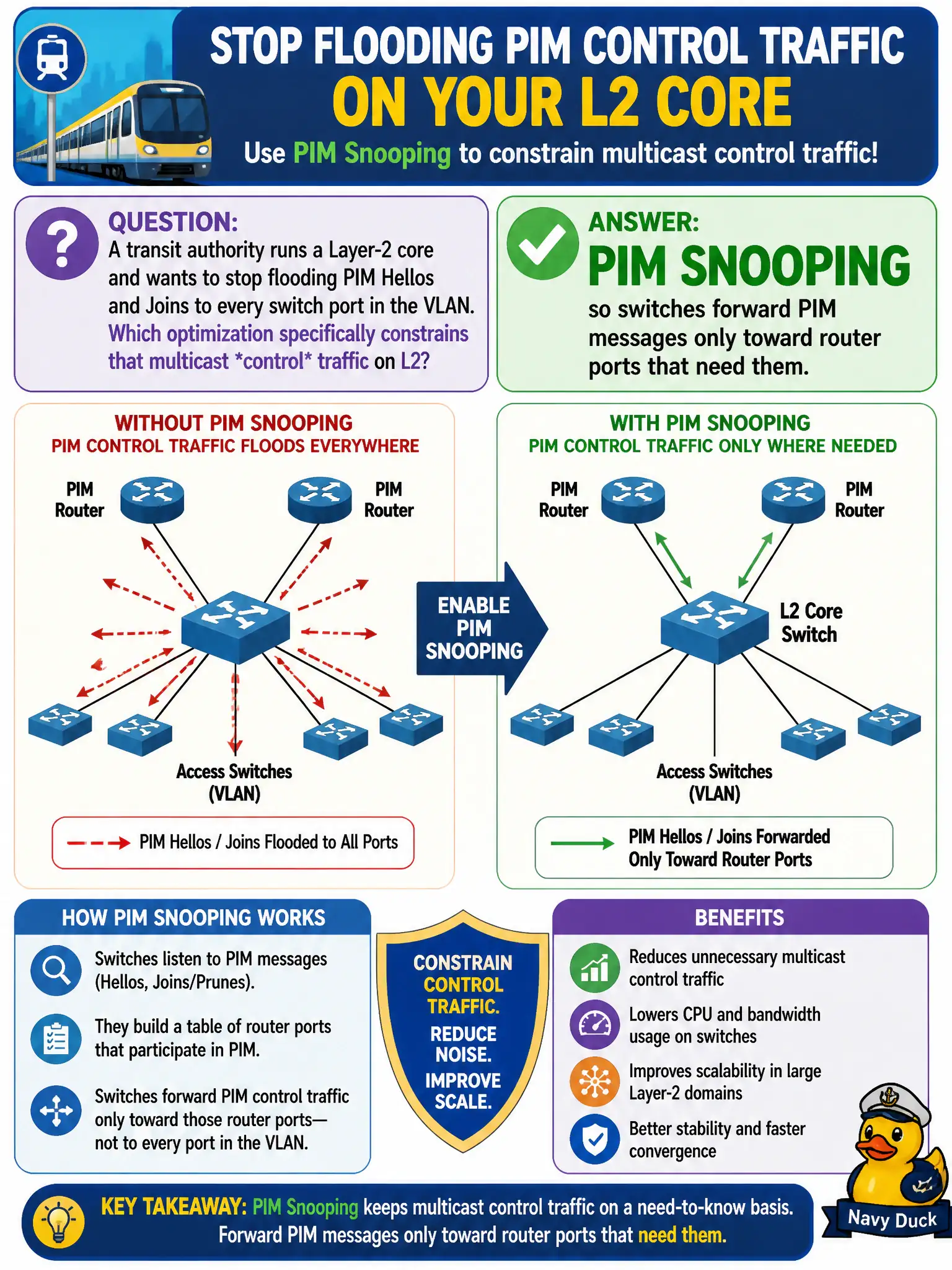
A transit authority runs a Layer-2 core and wants to stop flooding PIM Hellos and Joins to every switch port in the VLAN. Which optimization specifically constrains that multicast control traffic on L2?
Select an answer to reveal the explanation.
Short Explanation
IGMP snooping watches the audience; PIM snooping watches the stage crew radios. In a big L2 core, PIM messages can spam every port unless the switch learns where the real routers live and ships control packets only that way. That keeps the control plane from becoming its own flood storm.
Full Explanation
On a transit-authority Layer-2 core, PIM Hellos and Joins can flood every switch port unless constrained. PIM snooping specifically optimizes that multicast control traffic by learning multicast-router ports and forwarding PIM messages selectively toward ports that need them. It complements IGMP/MLD snooping, which focuses on receiver data-group interest, by targeting router control-plane distribution in large civic L2 domains where PIM can otherwise become its own flood storm.
Static ARP entries for every first-hop PIM router do not selectively forward PIM multicasts; they only pin IP-to-MAC bindings and create brittle operational debt unrelated to control-plane constraint.
Disabling Spanning Tree on ports facing multicast sources risks Layer-2 loops and still does not implement selective PIM message forwarding across the core VLAN.
IP Source Guard binding cameras to their access VLAN addresses a host IP/MAC binding security problem on access ports, not PIM Hello/Join flooding through a transit L2 core.
Exam caveat: PIM snooping support and mrouter-port learning behavior vary by platform; if router ports are learned incorrectly, Joins can be black-holed—validate on the exact switch code train before citywide enablement.
Operational check: enable PIM snooping in the L2 core VLANs, confirm PIM packets reach only learned mrouter ports with a capture or ACL counters, and stress a Join during peak operations. Record platform caveats and show-command baselines in the transit multicast L2 standard so future closet adds do not reintroduce control-plane flooding for public mobility services.