
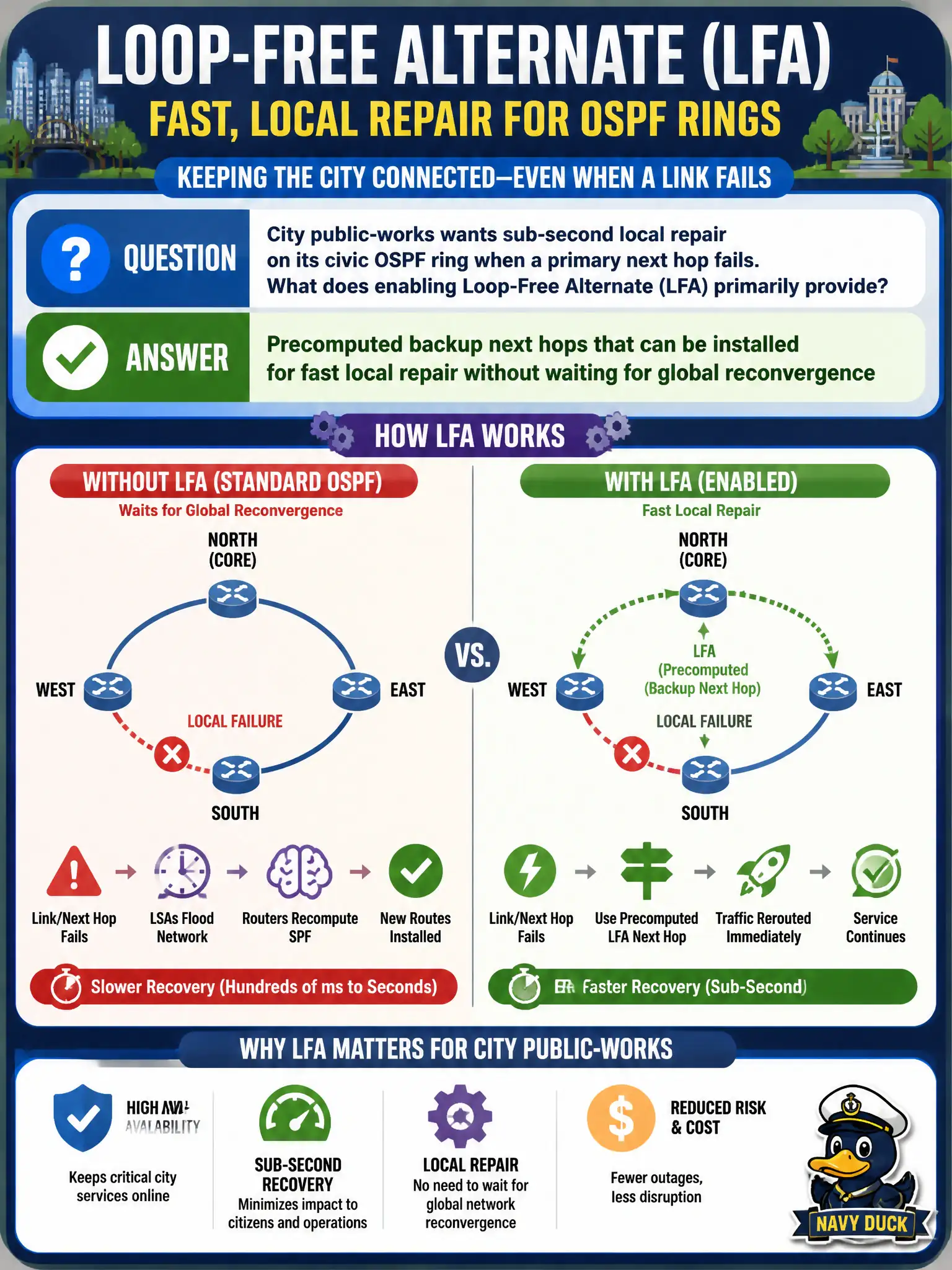
City public-works wants sub-second local repair on its civic OSPF ring when a primary next hop fails. What does enabling Loop-Free Alternate (LFA) primarily provide?
Select an answer to reveal the explanation.
Short Explanation
LFA is the spare tire already bolted under the civic ring truck. When the primary next hop blows, the router already knows a loop-free backup and can steer there without waiting for the whole map to recalculate. It’s local repair, not a brand-new routing protocol.
Full Explanation
OSPF Loop-Free Alternate (LFA) precomputes loop-free backup next hops so forwarding can switch locally after a failure with minimal packet loss. City public-works wanting sub-second local repair on its civic OSPF ring should enable LFA to install those precomputed backup next hops for fast local repair without waiting for global reconvergence. Global SPF still runs after the failure, but traffic need not wait for full domain reconvergence before using the backup against the failed primary next hop. That local-repair capability is the primary reason to enable LFA on resilient civic rings.
LFA is not a full SPF run that replaces the primary path before the link-down event is even detected. It does not automatically convert OSPF areas into MPLS TE tunnels for every prefix. It is not equal redistribution of all OSPF externals into BGP with local preference 200—an unrelated policy action that does not provide per-prefix fast local repair.
Exam caveat: not every topology yields an LFA for every prefix; remote LFA or TI-LFA may be required in harder rings, and platform support varies across civic fleets. Operational check: enable LFA where supported, verify backup next hops appear for ring prefixes, fail a primary next hop in a maintenance window, and measure local repair time versus waiting for full SPF alone.