
A municipal library consortium wants a smaller OSPF LSDB and less attack surface from transit link addresses, while still advertising router loopbacks for management. Which feature matches that goal?
Select an answer to reveal the explanation.
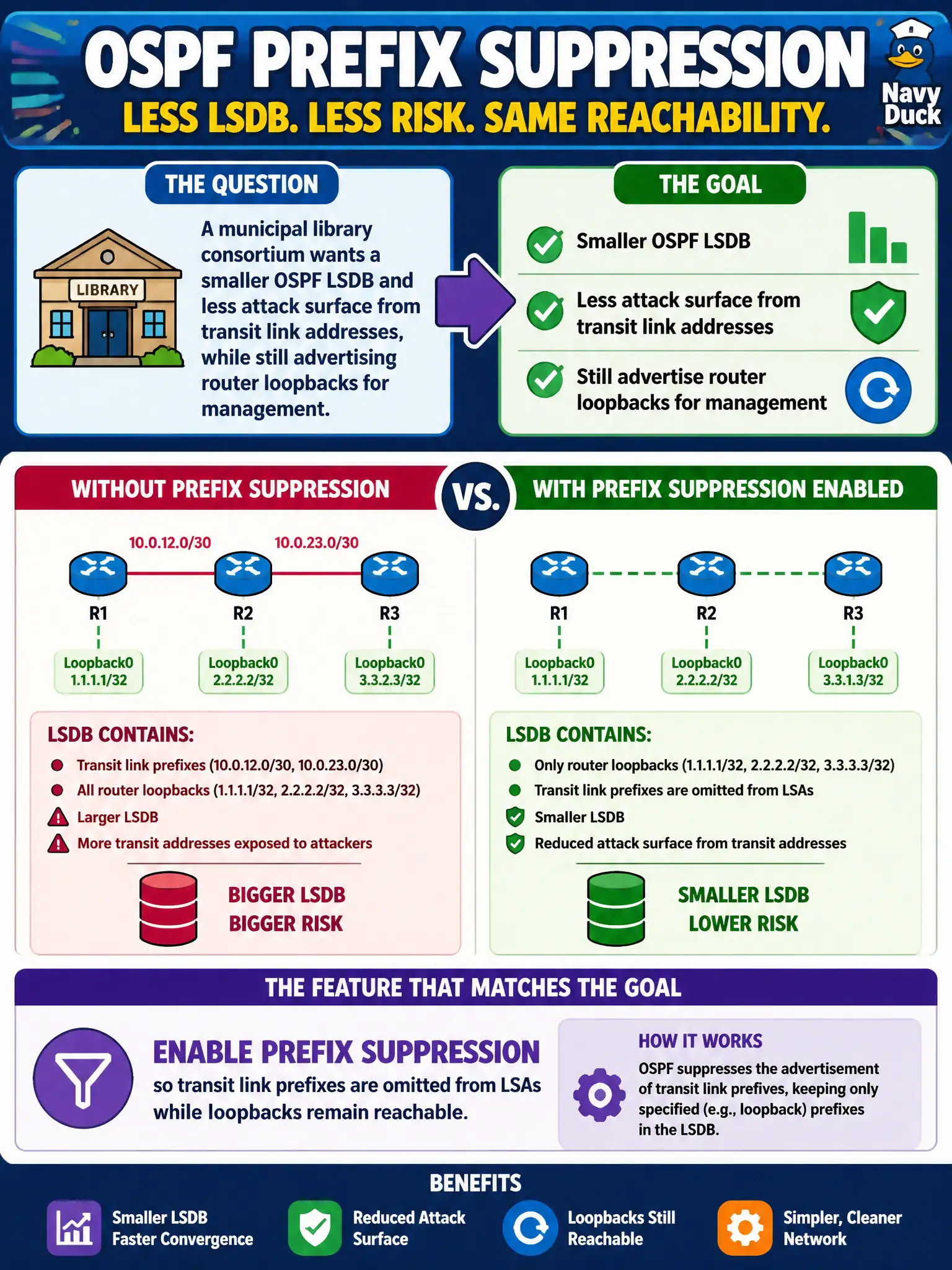
Short Explanation
Prefix suppression is like leaving the library’s street address off the public bulletin but still listing the main phone number (the loopback). Transit link IPs stop cluttering the LSDB; management reaches the routers via loopbacks. Smaller map, fewer juicy targets.
Full Explanation
OSPF prefix suppression removes transit network prefixes from router LSAs, shrinking LSDB size and reducing the set of addresses attackers can target, while loopback and stub prefixes used for reachability can still be advertised. A municipal library consortium wanting a smaller LSDB and less attack surface from transit link addresses, while still advertising router loopbacks for management, should enable prefix suppression so transit link prefixes are omitted while loopbacks remain reachable. Designers use it when link addresses are unnecessary for forwarding yet loopbacks must stay visible.
Filtering all Type-5 externals at every ABR regardless of area type is a different control and may break needed external reachability. Enabling OSPF stub routing so no prefixes of any kind are flooded overstates stub behavior and would break management reachability. Summarizing every /32 loopback into a default at the campus edge defeats explicit loopback reachability for management.
Exam caveat: ensure management and iBGP/IGP dependencies that relied on link addresses are moved to loopbacks before suppressing transit prefixes. Operational check: enable prefix suppression, confirm transit /30s disappear from the LSDB, ping router loopbacks successfully, and verify no critical forwarding depended on those link addresses.