
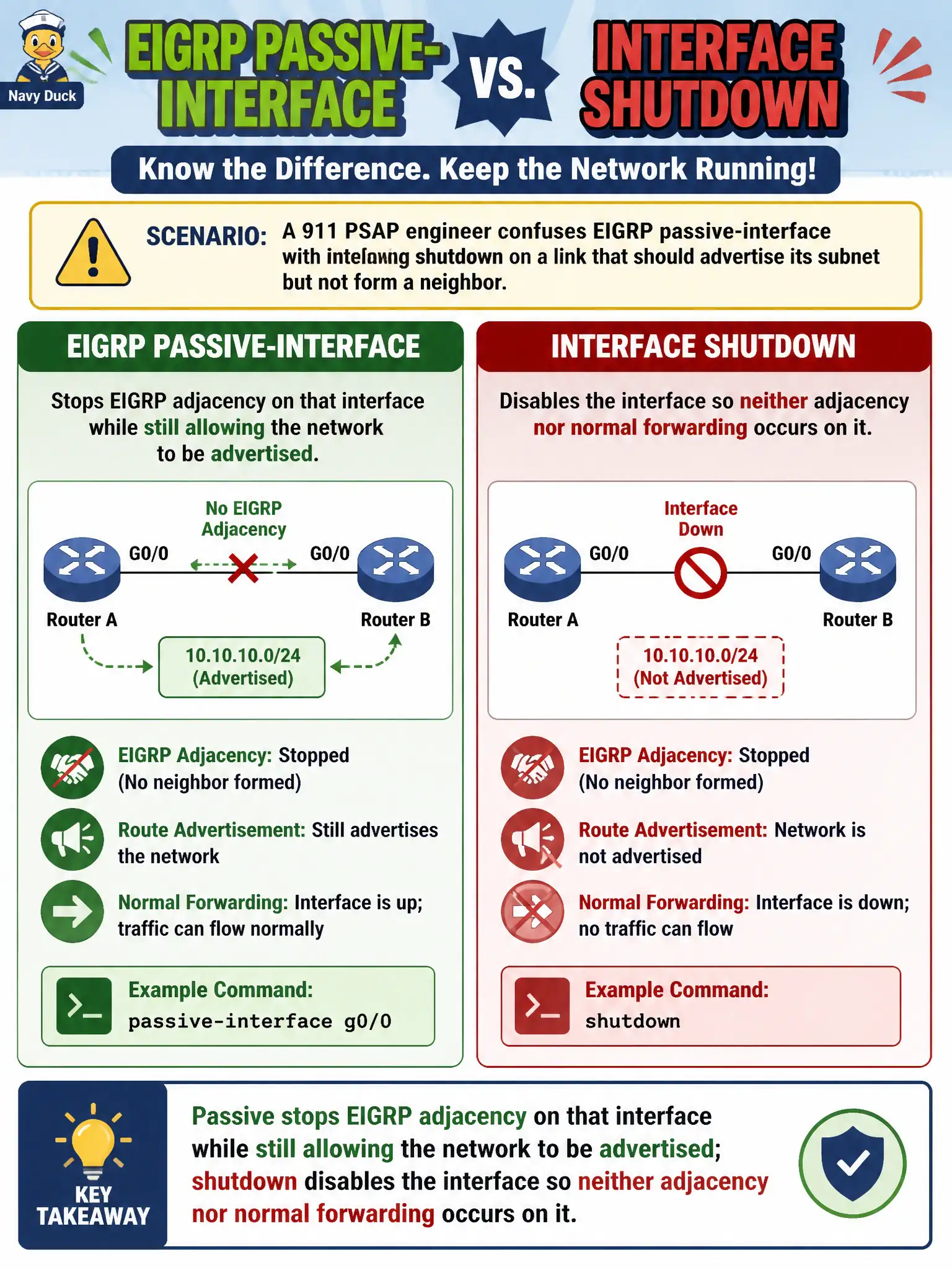
A 911 PSAP engineer confuses EIGRP passive-interface with interface shutdown on a link that should advertise its subnet but not form a neighbor. Which statement correctly contrasts the two?
Select an answer to reveal the explanation.
Short Explanation
Passive mutes the EIGRP conversation on that NIC but the subnet can still show up via other active interfaces. Shutdown kills the NIC—no hellos, no forwarding, lights out. For “advertise but don’t peer,” you want passive, not a hard shut.
Full Explanation
Passive-interface stops EIGRP adjacency on that interface while still allowing the connected network to be advertised from other active interfaces; interface shutdown disables the interface so neither adjacency nor normal forwarding occurs on it. A 911 PSAP engineer who needs to advertise a subnet without forming a neighbor on that link wants passive, not shutdown. The contrast matters when the link should remain up for data or monitoring but must not peer.
Shutdown and passive are not identical, and neither keeps hellos flowing while blocking IP forwarding in the way the distractor claims. Passive-interface does not block IPv4 data-plane forwarding while continuing full EIGRP adjacency—that reverses passive’s control-plane effect. Shutdown does not advertise the connected prefix more specifically than passive as a defining advantage; shutdown removes the interface from normal operation.
Exam caveat: if the subnet must be advertised but the interface is the only attachment, passive still allows advertisement via the EIGRP process from that connected route while preventing adjacency on it. Operational check: set passive on the target interface, confirm no neighbor forms there, confirm the subnet appears in EIGRP advertisements elsewhere, and contrast with shutdown where the interface is administratively down.