
An election office asks when EIGRP can fail over to a backup path without entering active query state. Which condition describes that loop-free backup?
Select an answer to reveal the explanation.
Short Explanation
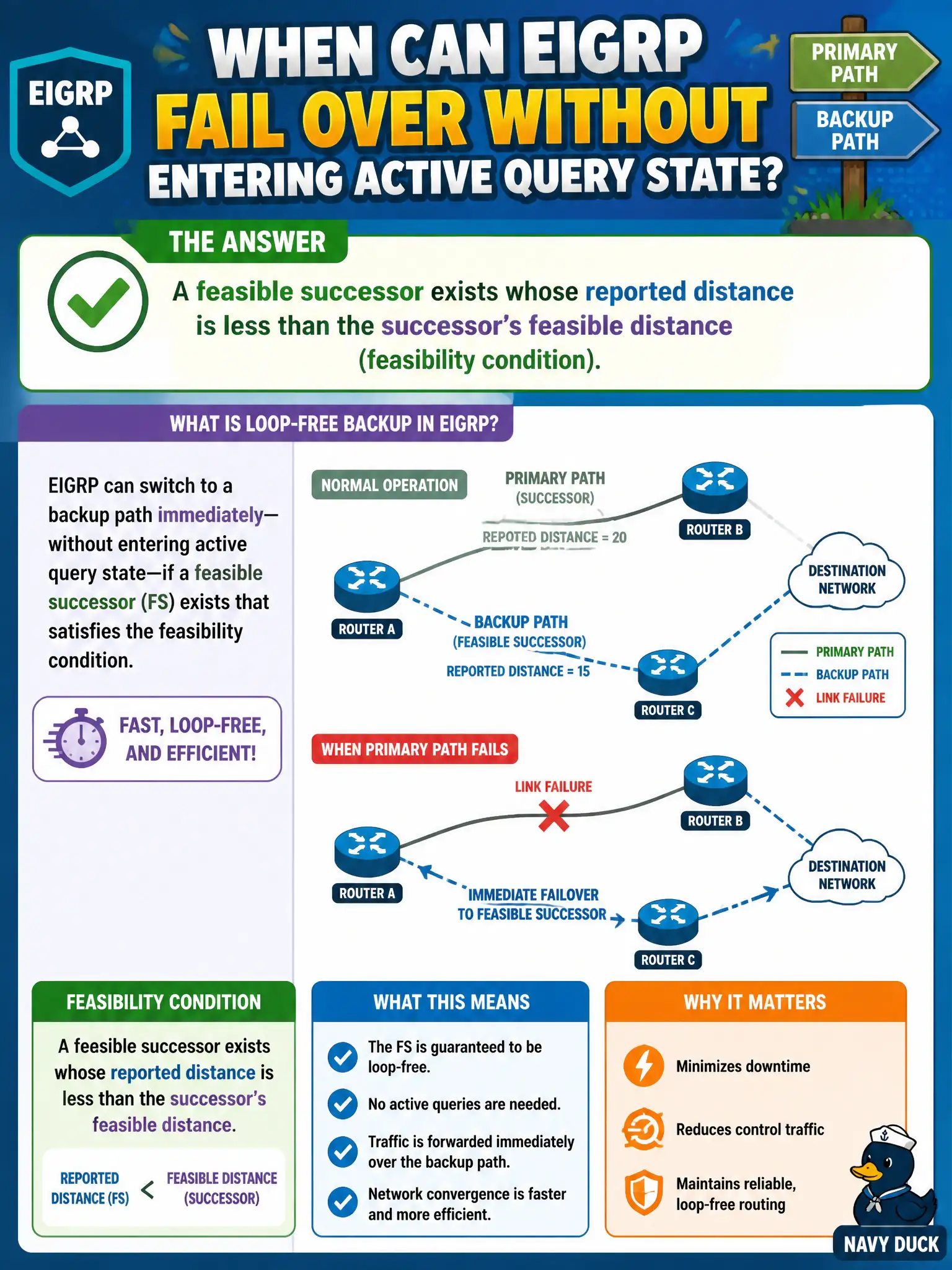
If a neighbor’s reported distance is still less than what you already trust as feasible distance, that neighbor is a pre-vetted spare—no county-wide query needed. That’s the feasible successor. Without it, EIGRP goes Active and starts asking around.
Full Explanation
A feasible successor is a loop-free backup that satisfies the feasibility condition: its reported distance is strictly less than the successor’s feasible distance. When an election office asks when EIGRP can fail over to a backup path without entering active query state, that FS condition is the answer—if a feasible successor exists, EIGRP can immediately use it when the successor fails. Queries are not mandatory when a feasible successor already exists in the topology table.
Any neighbor with a higher hop count than the successor does not automatically qualify; hop count alone does not define feasible-successor status under DUAL. A path does not become a feasible successor only after OSPF installs the same prefix as an E2 external. Claiming backups never exist and EIGRP must always query the AS before using an alternate ignores the core feasible-successor optimization that keeps many failovers local and silent.
Exam caveat: without an FS, loss of the successor drives the route active and queries propagate—design topologies and metrics so critical election-night prefixes have feasible successors where possible. Operational check: show ip eigrp topology, identify successors and feasible successors, fail the successor path in a lab, and confirm local switchover without prolonged active querying when an FS is present.