
A regional planning commission evaluates EIGRP IP FRR (single-hop) to pre-arm a backup next hop for a civic core link. What is the core idea of this fast-reroute approach?
Select an answer to reveal the explanation.
Short Explanation
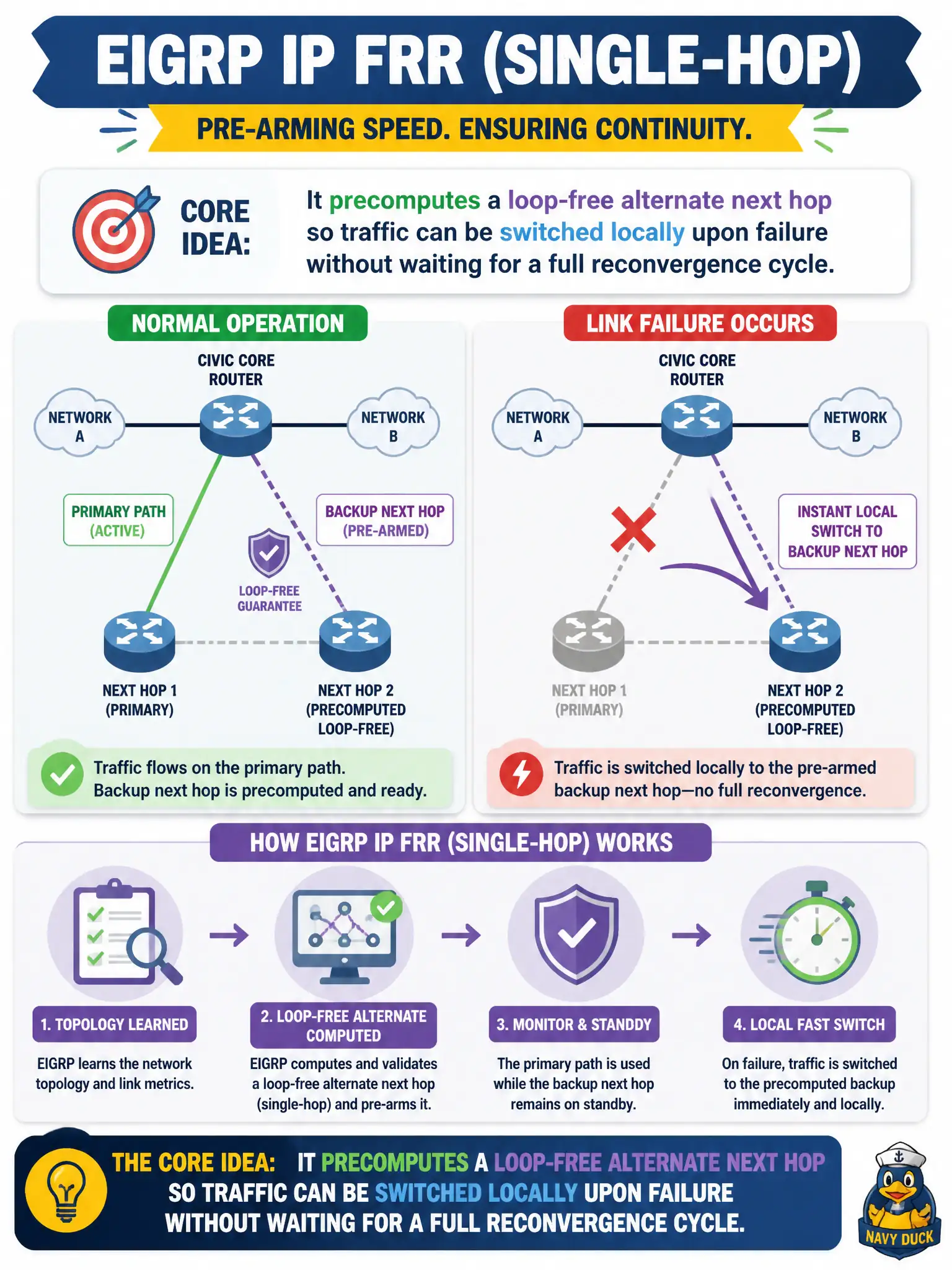
IP FRR is packing a spare chute before you jump—the backup next hop is already chosen. When the primary link snaps, forwarding pivots locally instead of waiting for the whole DUAL meeting. Faster protection, same EIGRP neighborhood.
Full Explanation
EIGRP IP FRR / LFA-style protection pre-installs a loop-free alternate next hop so data-plane failover can occur immediately on local failure detection, before complete control-plane reconvergence. A regional planning commission evaluating EIGRP IP FRR (single-hop) for a civic core link is adopting that idea: precompute a loop-free alternate so traffic switches locally upon failure without waiting for a full DUAL reconvergence cycle. Single-hop scope targets directly connected backup next hops in the civic core where topology allows.
FRR does not replace EIGRP with MPLS TE tunnels that ignore IGP topology by definition. It does not delay SPF and DUAL indefinitely so operators can patch links manually—that would increase outage duration. It does not double hello timers to ensure backups are only used after minutes of downtime; that would slow detection, the opposite of FRR intent.
Exam caveat: a valid loop-free alternate must exist topologically; not every prefix has an LFA, and FRR complements rather than eliminates eventual reconvergence and repair of the primary. Operational check: enable IP FRR where the platform supports it, verify backup next hops are armed for critical prefixes, fail the primary core link in a maintenance window, and measure traffic restoration versus non-FRR baselines.