
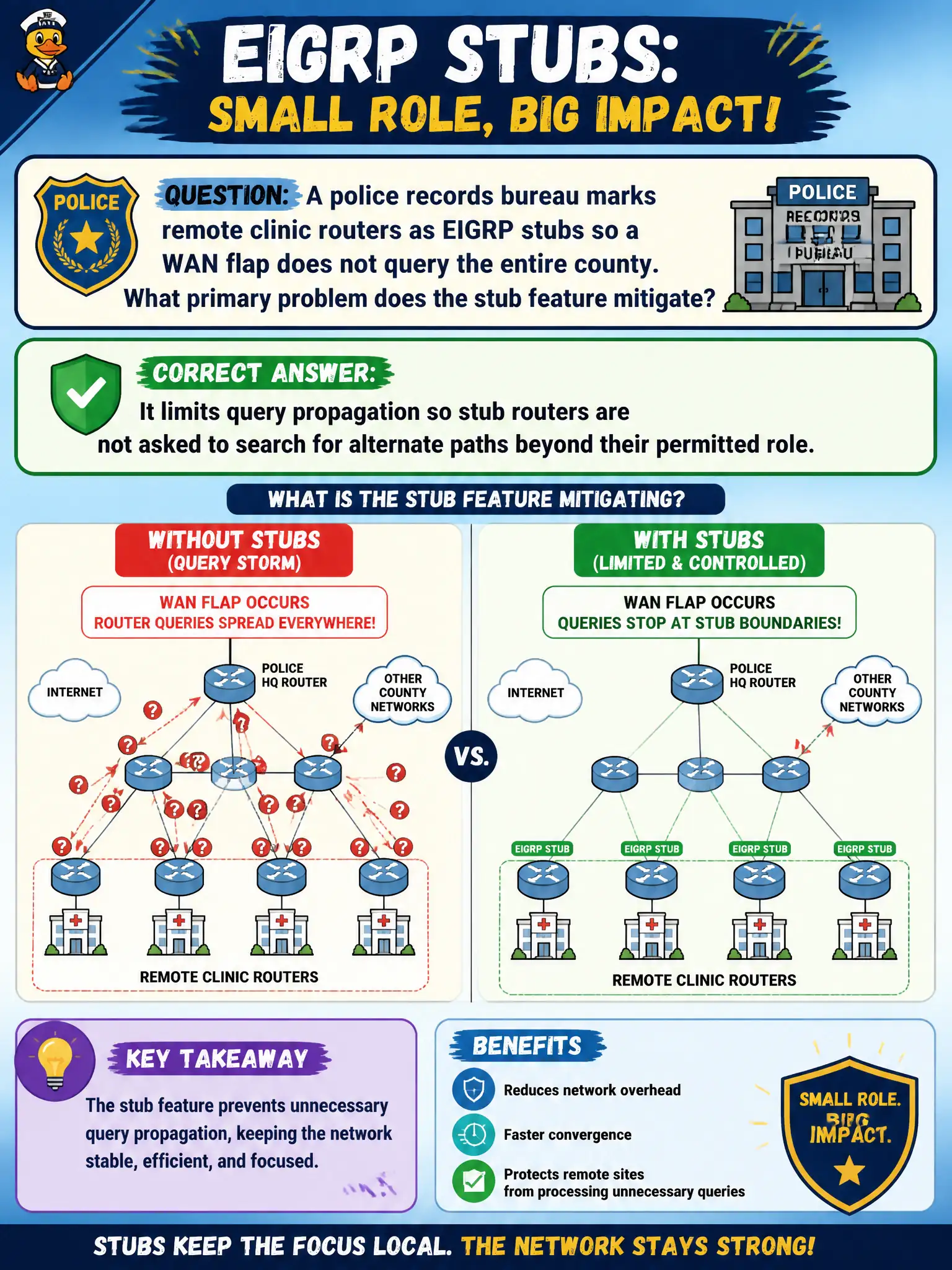
A police records bureau marks remote clinic routers as EIGRP stubs so a WAN flap does not query the entire county. What primary problem does the stub feature mitigate?
Select an answer to reveal the explanation.
Short Explanation
When the WAN hiccups, EIGRP can start a county-wide scavenger hunt asking every router “got a backup?” Stub sites reply “don’t ask me—I’m a leaf.” That shrinks the query storm. Stubs are about query boundaries, not free encryption or becoming everyone’s backup.
Full Explanation
EIGRP stub routing constrains which queries a router answers and which route types it advertises, creating query boundaries that improve stability when remote sites flap. A police records bureau marking remote clinic routers as stubs so a WAN flap does not query the entire county primarily mitigates query propagation: stub routers are not asked to search for alternate paths beyond their permitted role. Marking clinics stub is a standard scale-and-stability pattern for spoke-heavy municipal WANs where WAN flaps would otherwise fan queries through every remote site.
Stub does not encrypt stub-site user traffic whenever the WAN flaps—that confuses control-plane query scope with data-plane encryption. It does not force every remote clinic to become the county’s feasible successor. It does not convert clinic links to OSPF totally stubby areas automatically; EIGRP stub is not an OSPF area migration feature.
Exam caveat: hubs must not be configured as stubs; stubs that need to advertise redistributed or summary exceptions may require leak-maps so critical prefixes still escape. Operational check: mark clinics stub, flap a WAN link in a controlled test window, confirm query scope no longer fans through every clinic, and verify clinics still learn needed core routes via hub advertisements.