
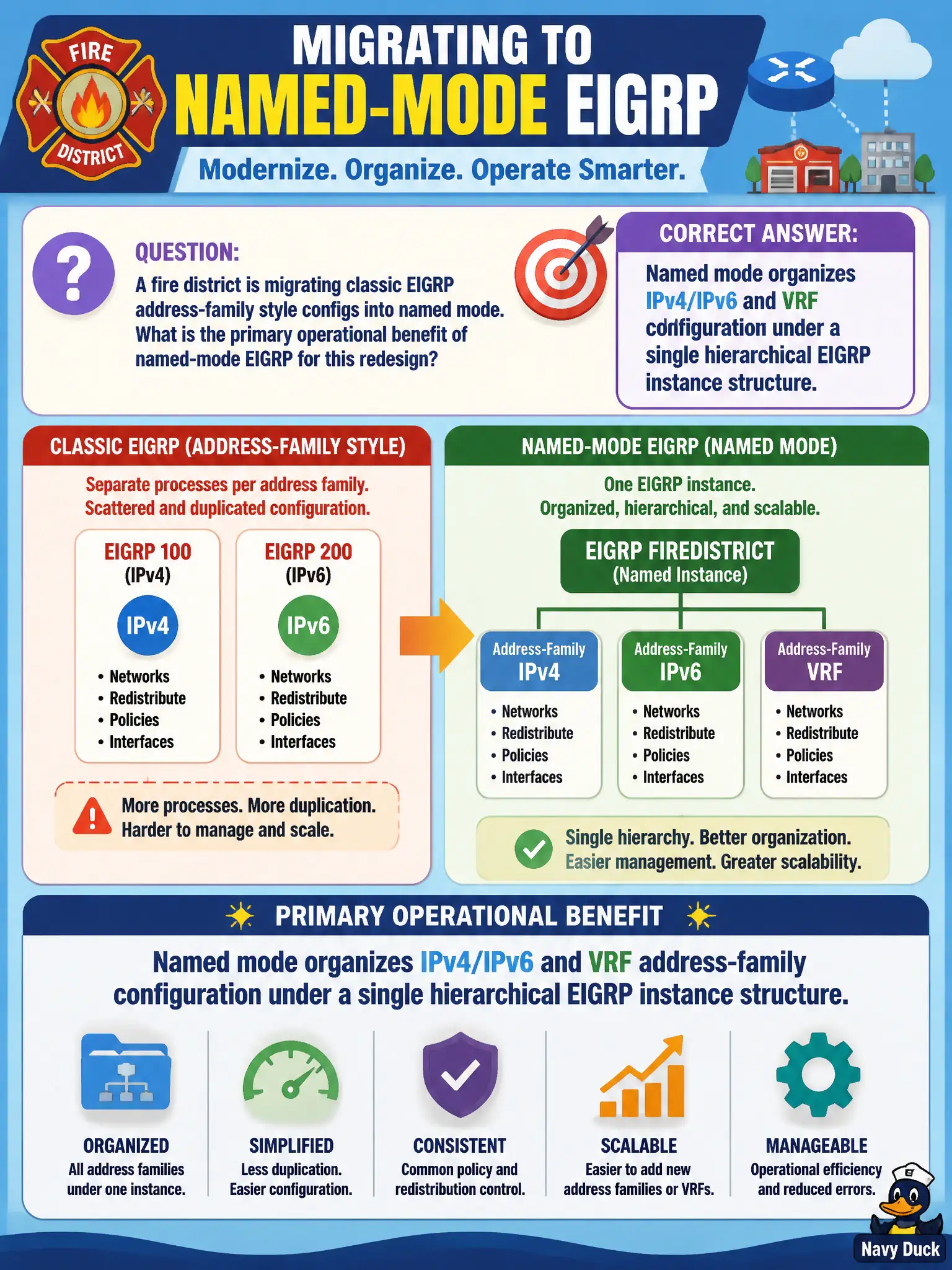
A fire district is migrating classic EIGRP address-family style configs into named mode. What is the primary operational benefit of named-mode EIGRP for this redesign?
Select an answer to reveal the explanation.
Short Explanation
Named mode is the tidy filing cabinet: one EIGRP “process name,” then neat address-family drawers for IPv4, IPv6, and VRFs. Same routing brain, cleaner structure for the fire district’s migration. It doesn’t invent free encryption or throw away stubs.
Full Explanation
Named-mode EIGRP consolidates classic per-address-family configuration into a hierarchical instance with address-family stanzas, improving consistency for IPv4/IPv6 and VRF designs. A fire district migrating classic configs into named mode gains that operational clarity and structured AF management under a single EIGRP instance structure. Neighbors still require matching autonomous-system or process identity for adjacency; named mode reorganizes configuration for maintainability, it does not invent new adjacency mathematics or remove classic controls.
Named mode does not remove the need for autonomous-system consistency between neighbors—mismatched AS numbers still prevent peering. It does not encrypt all user data-plane traffic automatically; it is a control-plane configuration model, not a crypto feature. It does not disable stub routing and query scoping permanently; those stability controls remain available and important on spoke-heavy municipal WANs.
Exam caveat: classic and named mode can interoperate carefully, but mixed styles increase operational risk—prefer completing the migration with matching address-family and authentication placement. Operational check: convert a lab pair first, confirm adjacency and topology parity with classic mode, validate stub, summary, and offset features under named mode, then migrate fire-district production routers with a documented rollback plan.