
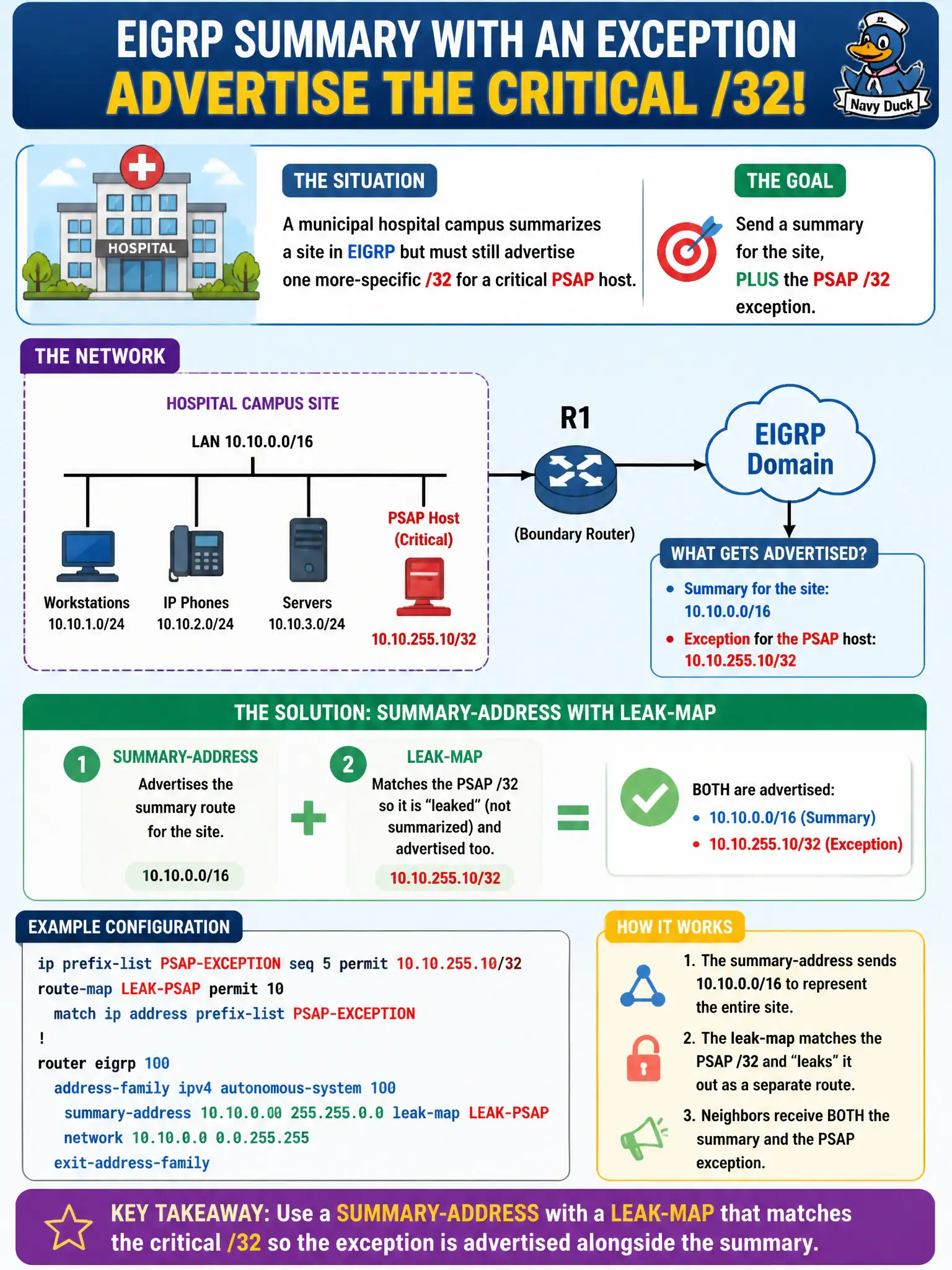
A municipal hospital campus summarizes a site in EIGRP but must still advertise one more-specific /32 for a critical PSAP host. Which feature combination best achieves that exception?
Select an answer to reveal the explanation.
Short Explanation
Summaries hide the neighborhood map, but the PSAP house still needs its own driveway sign. A leak-map punches that one more-specific through while keeping the big summary. Killing all summaries or mixing in OSPF types is the wrong hammer.
Full Explanation
EIGRP summary-address can be paired with a leak-map to advertise selected more-specific prefixes in addition to the summary. A municipal hospital campus that summarizes a site but must still advertise one more-specific /32 for a critical PSAP host should use summary-address with a leak-map matching that /32 so the exception is advertised alongside the summary. That preserves summarization benefits for topology scale while ensuring the PSAP endpoint remains reachable via longest-match forwarding from the rest of the civic network.
Disabling all summarization and relying on default routes only at every edge abandons the scalability goal and is not a surgical exception for one host. Raising the PSAP host’s administrative distance above 255 so it cannot be suppressed misuses AD and is not a valid advertisement-exception pattern. Configuring the PSAP /32 as an OSPF external type-2 inside the EIGRP process mixes protocols incorrectly and does not create an EIGRP leak.
Exam caveat: the leak-map must match the exact prefixes to leak, and downstream peers must not filter them away contrary to design. Operational check: advertise the summary, confirm the PSAP /32 also appears on upstream routers, withdraw the /32 from the leak-map in a lab and observe it disappear under the summary only, then restore the leak for production.