
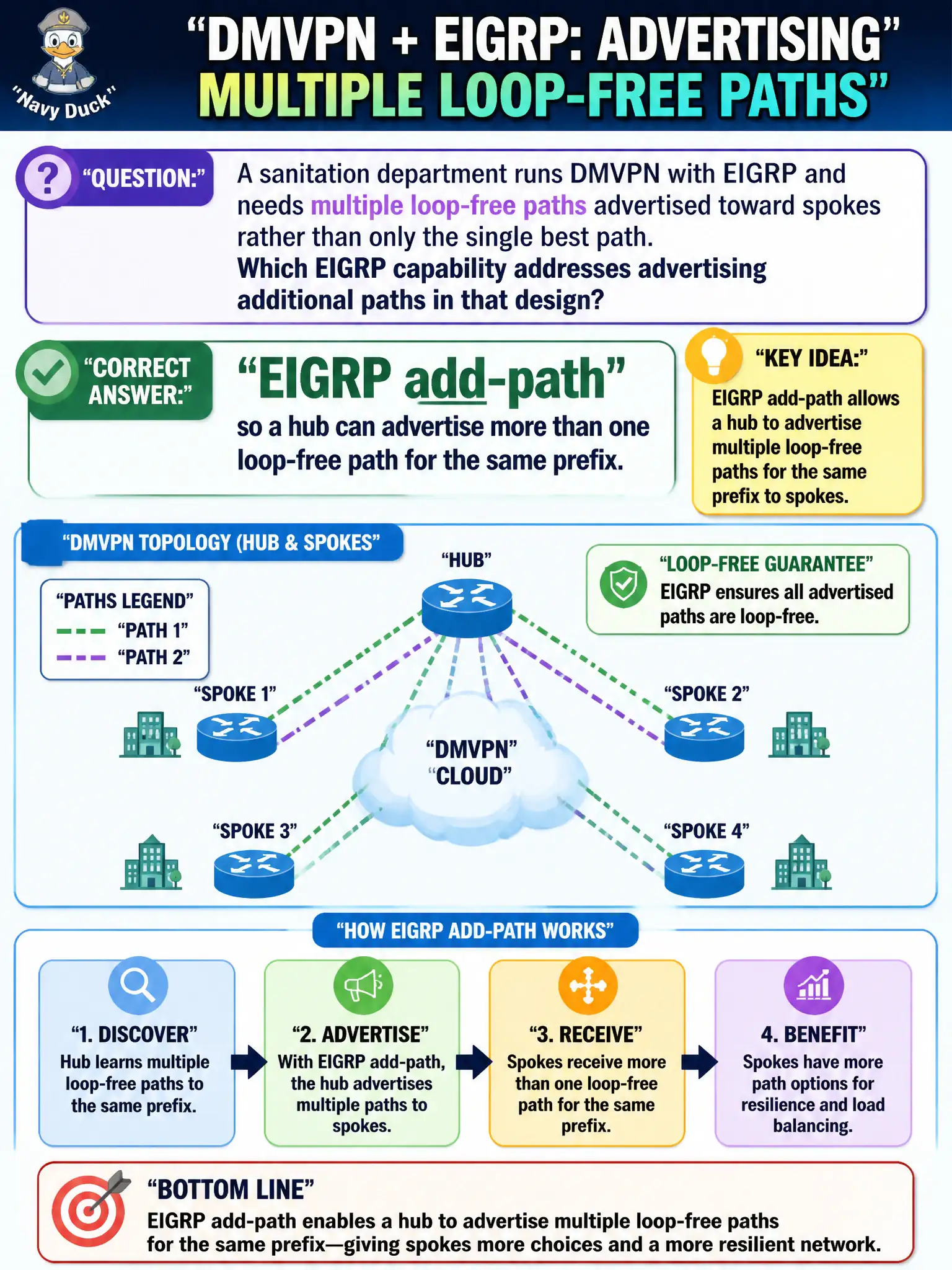
A sanitation department runs DMVPN with EIGRP and needs multiple loop-free paths advertised toward spokes rather than only the single best path. Which EIGRP capability addresses advertising additional paths in that design?
Select an answer to reveal the explanation.
Short Explanation
Normal EIGRP is a one-trophy sport—it tells neighbors about the winner. Add-path lets the hub hand out extra loop-free medals so DMVPN spokes see more than one way home. That’s the tool when “only the best path advertised” is the bottleneck.
Full Explanation
EIGRP add-path enables advertisement of multiple loop-free paths for a prefix, which is valuable on DMVPN hubs where spokes benefit from additional path information beyond a single best path. A sanitation department running DMVPN with EIGRP that needs multiple loop-free paths advertised toward spokes should use add-path so the hub can advertise more than one loop-free path for the same prefix. The feature targets controlled multi-path advertisement within EIGRP.
OSPF sham-links inside each DMVPN tunnel overlay are an MPLS VPN / OSPF backdoor concept, not the EIGRP multi-path advertisement tool. BGP confederations applied to the EIGRP process ID mix unrelated technologies. Disabling split horizon only on LAN interfaces at the spokes does not replace add-path’s hub advertisement behavior for multiple paths.
Exam caveat: add-path still advertises loop-free paths under EIGRP rules; it is not a license to advertise arbitrary loops, and platform support/configuration details matter on the hub. Operational check: enable add-path on the hub AF, verify spokes learn multiple paths for the test prefix, confirm failover behavior when one path fails, and monitor hub scale when many spokes consume extra path information.