
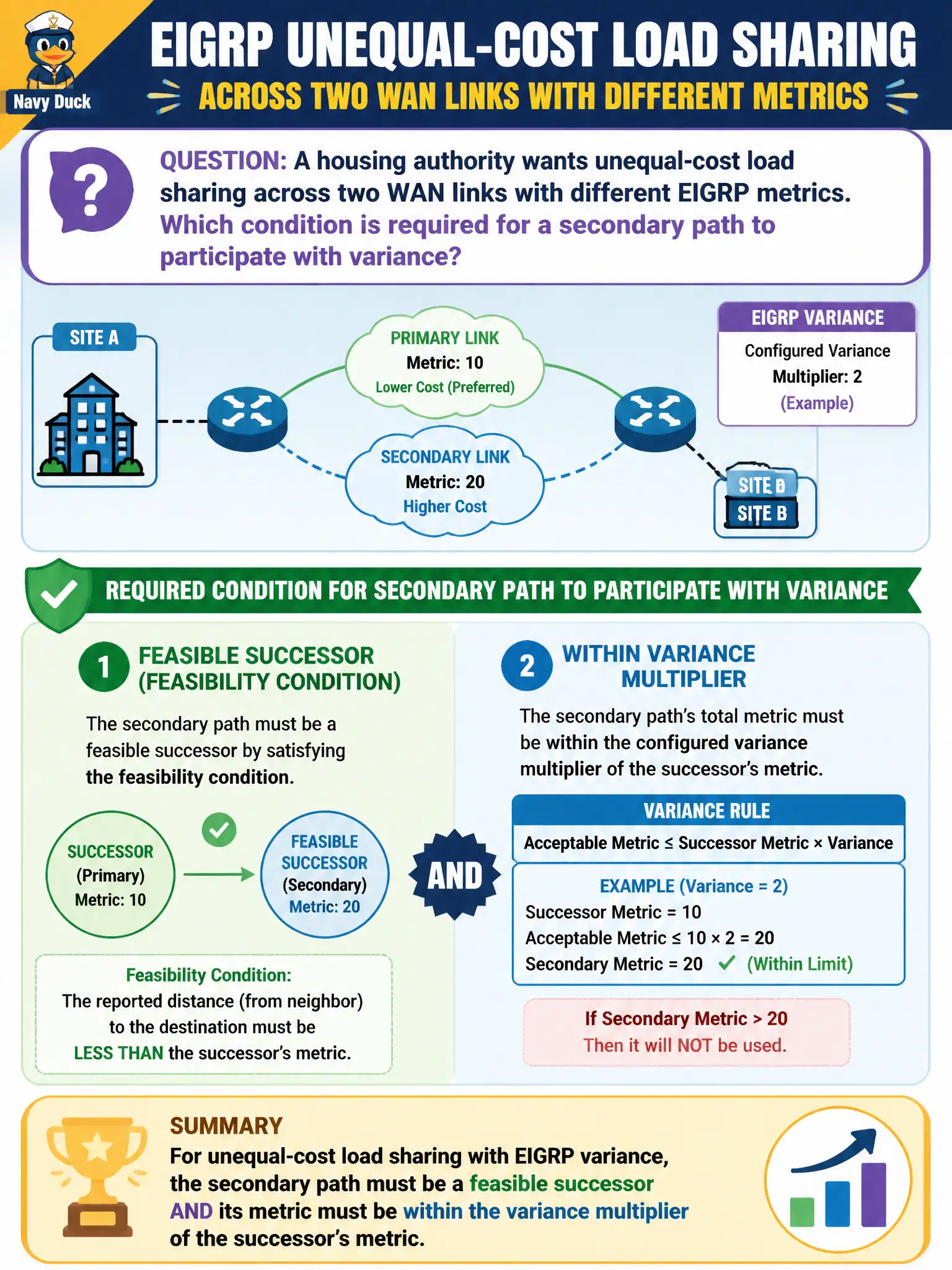
A housing authority wants unequal-cost load sharing across two WAN links with different EIGRP metrics. Which condition is required for a secondary path to participate with variance?
Select an answer to reveal the explanation.
Short Explanation
Variance isn’t a free-for-all—the backup path still has to pass the feasible-successor test and sit inside your variance window. That keeps load-sharing loop-free. Variance of 1 or random looped paths won’t magically balance unequal WANs.
Full Explanation
EIGRP unequal-cost load balancing requires candidates that meet the feasibility condition (feasible successors) and whose metrics lie within the successor metric multiplied by variance. A housing authority wanting unequal-cost sharing across two WAN links must ensure the secondary path is a feasible successor and falls within the configured variance multiplier of the successor’s metric. Variance 1 yields equal-cost behavior only; looped or non-FS paths are not eligible.
Allowing any looped path as long as variance is 1 is wrong on both counts—variance 1 does not enable unequal sharing, and looped paths fail the feasibility condition. Variance does not install backups only for OSPF intra-area routes redistributed into EIGRP; the feature is native to EIGRP path selection. Claiming the secondary needs a worse reported distance than the local feasible distance with no other checks reverses the feasibility condition.
Exam caveat: feasibility requires reported distance strictly less than the successor’s feasible distance; without an FS, variance cannot safely install the backup for sharing. Operational check: show topology for FS status, set variance appropriately, confirm both paths install and share traffic as expected, and avoid variance values so large they invite suboptimal pinning without real FS protection.