
A port authority must stop a sensitive /32 in a justice VRF from leaving via EIGRP while keeping the EIGRP adjacency up. Which approach best meets that requirement?
Select an answer to reveal the explanation.
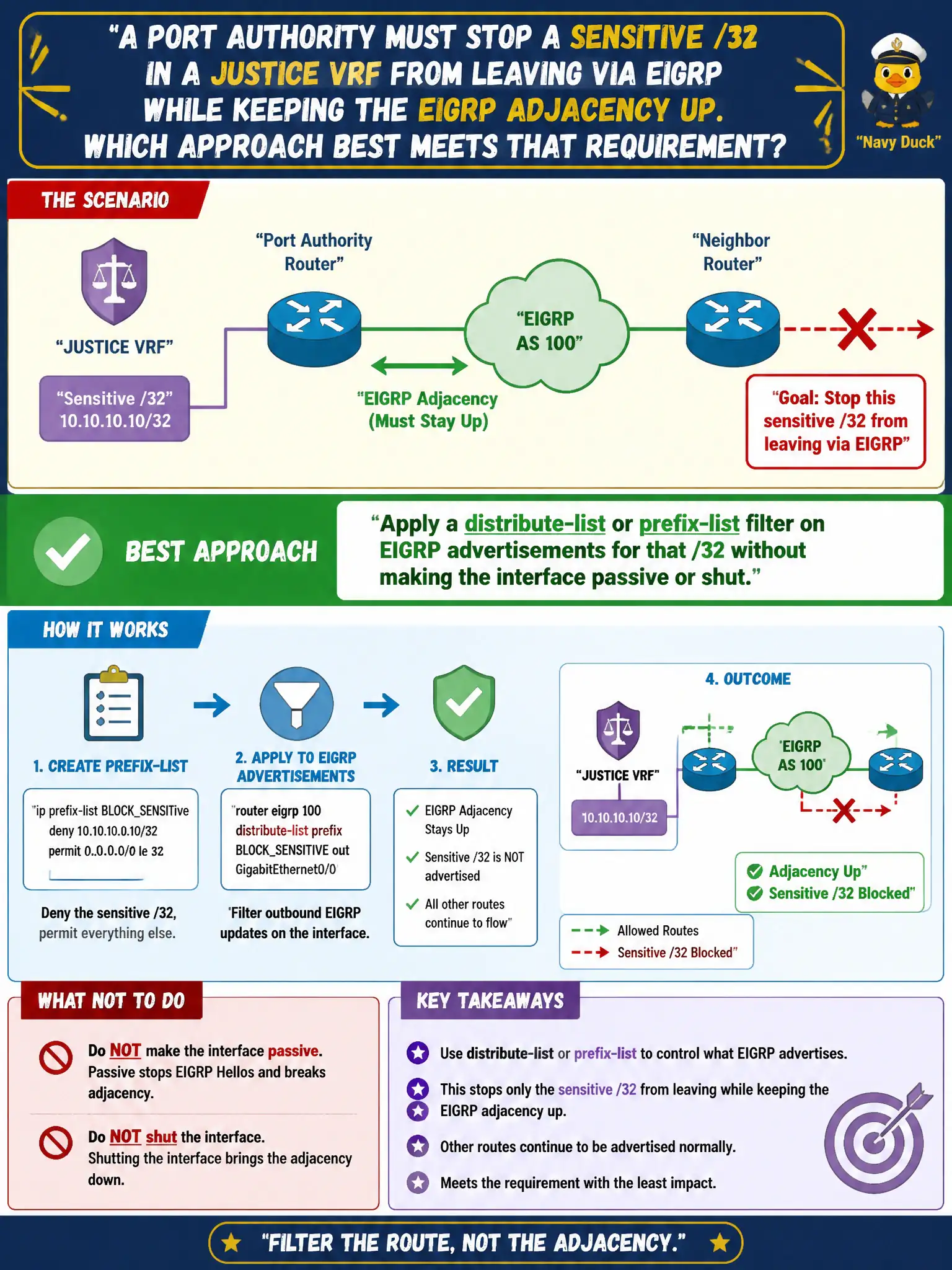
Short Explanation
You want the handshake to stay warm but one secret address to stay home. Prefix or distribute filters trim what you advertise without killing hellos. Shutting the link or going fully passive is how you lose the neighbor along with the prefix.
Full Explanation
EIGRP filtering with distribute-lists or prefix-lists can suppress specific prefixes while leaving adjacency intact. A port authority that must stop a sensitive /32 in a justice VRF from leaving via EIGRP while keeping the neighbor up should apply such a filter on EIGRP advertisements for that /32 without making the interface passive or shut. Filtering is the correct enterprise-infrastructure pattern for selective advertisement control when the adjacency itself must remain healthy for other prefixes.
Shutting down the EIGRP-facing interface stops all prefixes and hellos—collateral damage far beyond one /32 and an outage-sized hammer for a policy problem. Configuring passive-interface default globally and never activating interfaces prevents needed adjacencies campus-wide and is not a surgical filter. Clearing the neighbor with a soft reset every time the /32 appears is operational noise and does not implement durable advertisement policy.
Exam caveat: apply the filter in the correct direction (outbound toward peers that must not learn the /32) and remember VRF-aware EIGRP needs the filter under the correct address-family. Operational check: confirm adjacency remains up, verify the /32 is absent from the peer’s topology table, ensure other justice prefixes still advertise as required, and record the prefix-list in change control for auditors.