
A school district accidentally redistributes the same Internet prefixes into OSPF that edge routers already learn via eBGP. Operators want the BGP-learned paths to remain preferred in the RIB. Which statement best explains the default administrative-distance behavior they should verify?
Select an answer to reveal the explanation.
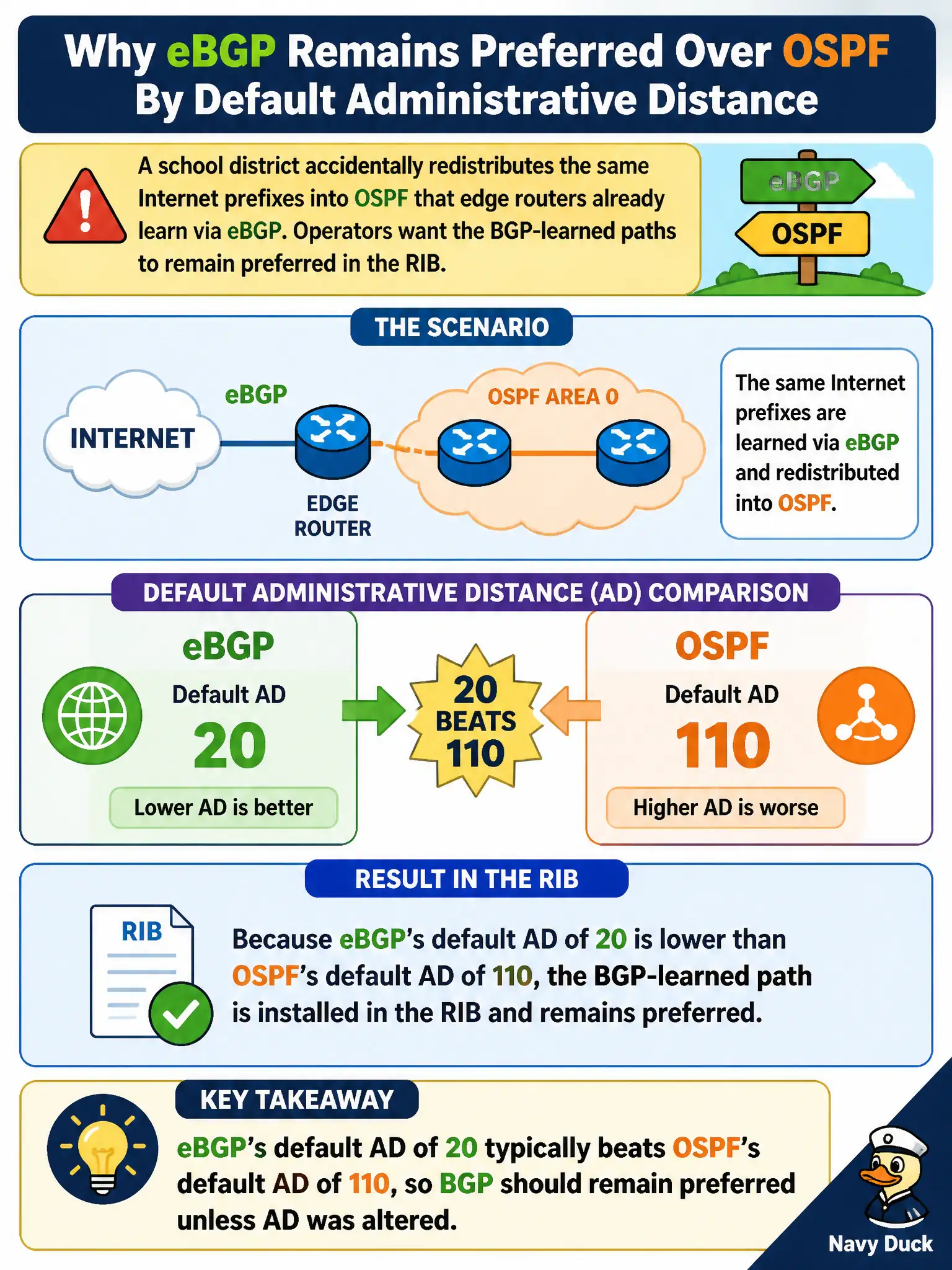
Short Explanation
Default AD is the tie-breaker referee when two protocols shout the same prefix. eBGP’s twenty usually beats OSPF’s one-ten, so the Internet path from BGP should win—unless someone rewrote the scores. Check AD before chasing weird redistribution ghosts.
Full Explanation
When identical prefixes arrive from multiple sources, Cisco IOS selects by administrative distance before comparing metrics within a protocol. Default eBGP AD (20) is preferred over OSPF (110), so when a school district accidentally redistributes the same Internet prefixes into OSPF that edge routers already learn via eBGP, BGP-learned Internet routes normally remain installed unless AD or redistribution policy was changed. Operators should verify that default AD behavior still holds.
Claiming OSPF external routes always beat eBGP because OSPF AD is lower reverses the defaults. Asserting both sources share identical AD so the oldest route always wins is false—AD differs and decides first. Saying only longest-match length matters and AD is ignored when two protocols offer the exact same prefix misunderstands RIB source selection for identical prefixes.
Exam caveat: redistribution can create surprising suboptimal paths even when AD prefers BGP; still filter what enters OSPF so the IGP is not polluted with Internet scale. Operational check: show ip route for a test Internet prefix (expect BGP AD 20), confirm OSPF has an external copy if redistributed, verify no AD tuning inverted preference, and remove accidental redistribution.