
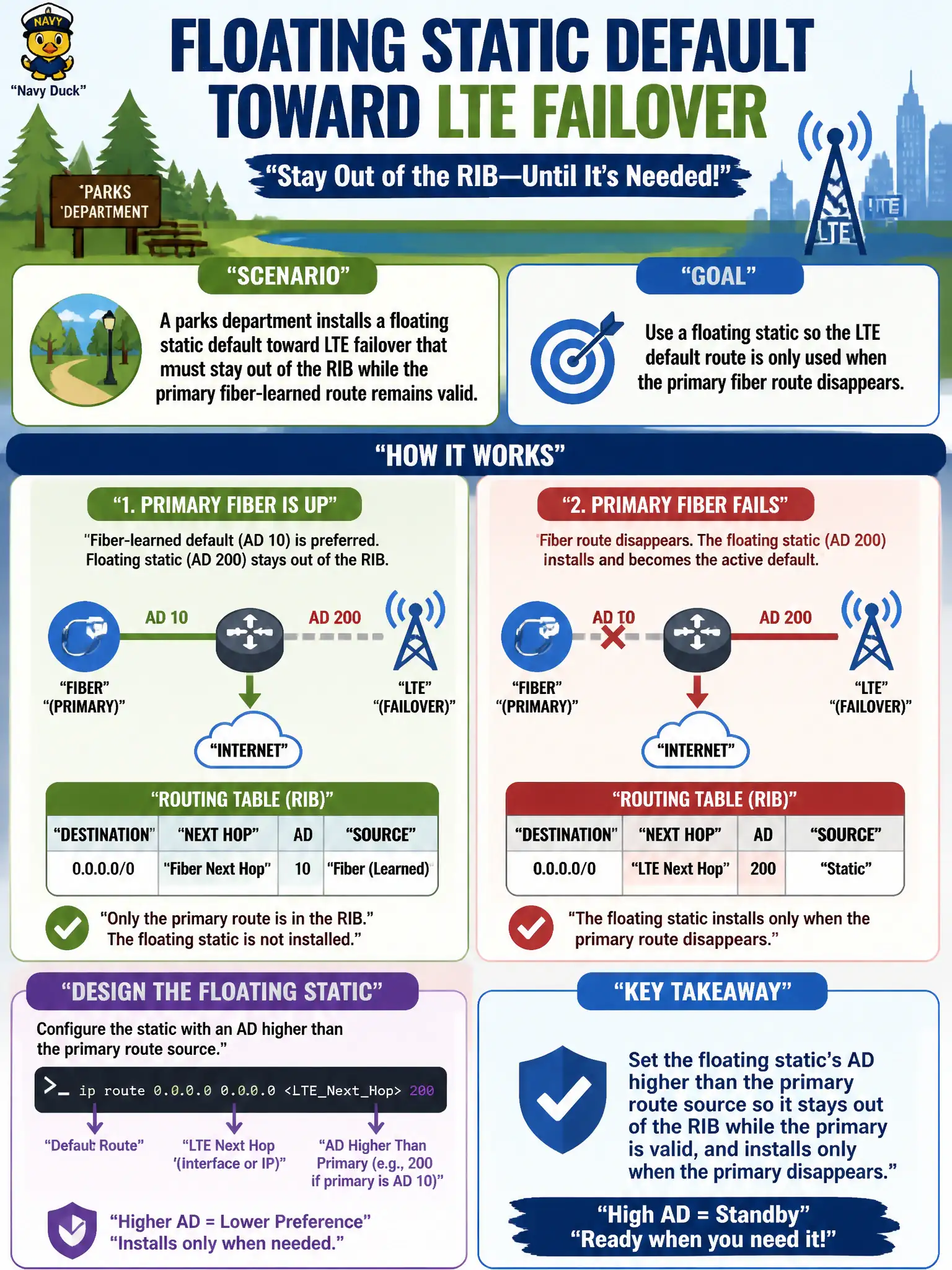
A parks department installs a floating static default toward LTE failover that must stay out of the RIB while the primary fiber-learned route remains valid. How should the floating static be designed?
Select an answer to reveal the explanation.
Short Explanation
A floating static is the spare tire bolted under the truck—present, but not rolling until the good tire is gone. Give it a worse (higher) AD than fiber’s route and it stays dormant. Lower AD would make LTE the daily driver, which nobody wants.
Full Explanation
A floating static uses a deliberately worse administrative distance than the preferred dynamic or primary static route so it remains inactive until the primary is withdrawn. A parks department installing a floating static default toward LTE failover must configure that static with an AD higher than the fiber-learned primary so LTE installs only when the primary disappears. Tracking can refine withdrawal conditions, but the core pattern is higher AD than the winning primary source.
Setting the static’s AD lower than the primary so LTE always preempts fiber defeats failover intent and makes LTE preferred. Advertising the LTE static into the IGP with a better metric than fiber likewise promotes backup over primary. Binding the static to a tracking object that forces it permanent regardless of fiber state contradicts floating behavior—tracking should withdraw or demote when primary is healthy, not force permanence.
Exam caveat: choose an AD that sits between the primary source and any routes you must not override; document the values. Operational check: with fiber up, confirm only the primary default is in the RIB; shut fiber or fail tracking; confirm LTE floating default installs; restore fiber and confirm LTE leaves the RIB.