
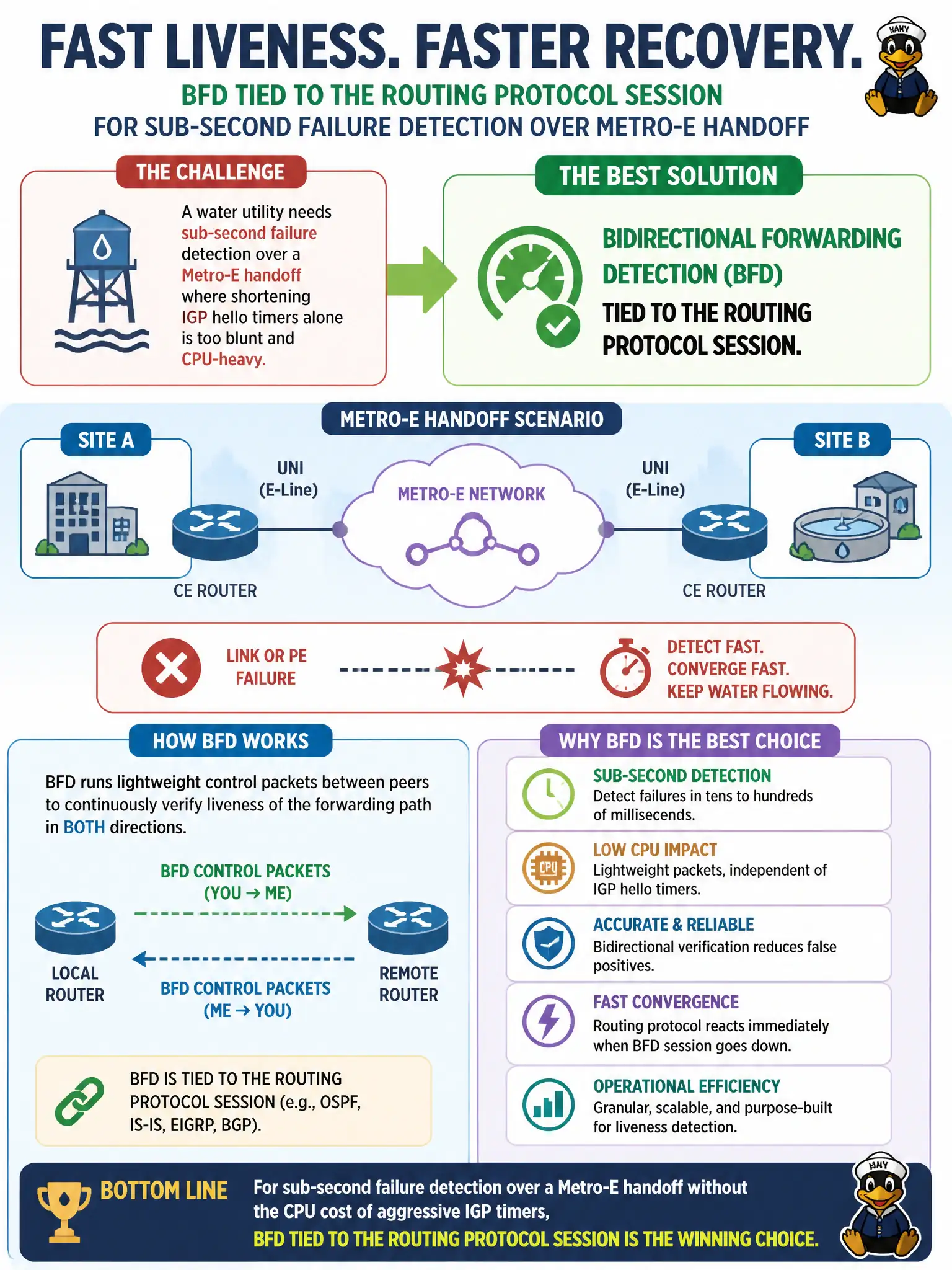
A water utility needs sub-second failure detection over a Metro-E handoff where shortening IGP hello timers alone is too blunt and CPU-heavy. Which mechanism best provides fast liveness detection for the routing adjacency?
Select an answer to reveal the explanation.
Short Explanation
BFD is the smoke detector that screams in milliseconds while the IGP is still sipping coffee on its hello schedule. You keep sane protocol timers and let BFD watch the pipe. When the Metro-E dies, routing gets the nudge almost immediately.
Full Explanation
BFD provides lightweight, rapid failure detection independent of aggressive hello tuning and can notify IGP sessions to tear down or fail over quickly. For a water utility needing sub-second detection over a Metro-E handoff where shortening IGP hello timers alone is too blunt and CPU-heavy, BFD tied to the routing protocol session is the standard enterprise-infrastructure pattern for fast liveness detection on the adjacency. Hellos remain for protocol state; BFD becomes the sharp failure detector.
Increasing OSPF SPF throttle timers delays reaction to flaps rather than accelerating detection—useful for damping instability, but the opposite of fast liveness on the Metro-E handoff. Disabling CDP and LLDP on Metro-E interfaces reduces discovery chatter but does not create sub-second routing failure detection for the IGP session. Raising IGP administrative distance so alternate paths install first changes source preference in the RIB, not failure-detection speed on the primary adjacency.
Exam caveat: BFD timers must match at both ends and be supported across the Metro-E path; overly aggressive timers on lossy links can false-positive and flap the session. Operational check: enable BFD on the Metro-E interfaces with the IGP client registered, verify BFD sessions are up, fail the handoff and measure detection and failover time versus hello-only baselines, and monitor CPU during the test window.