
A municipal library consortium summarizes many branch /24s into a /16 toward the core to shrink the civic RIB. What trade-off must designers respect?
Select an answer to reveal the explanation.
Short Explanation
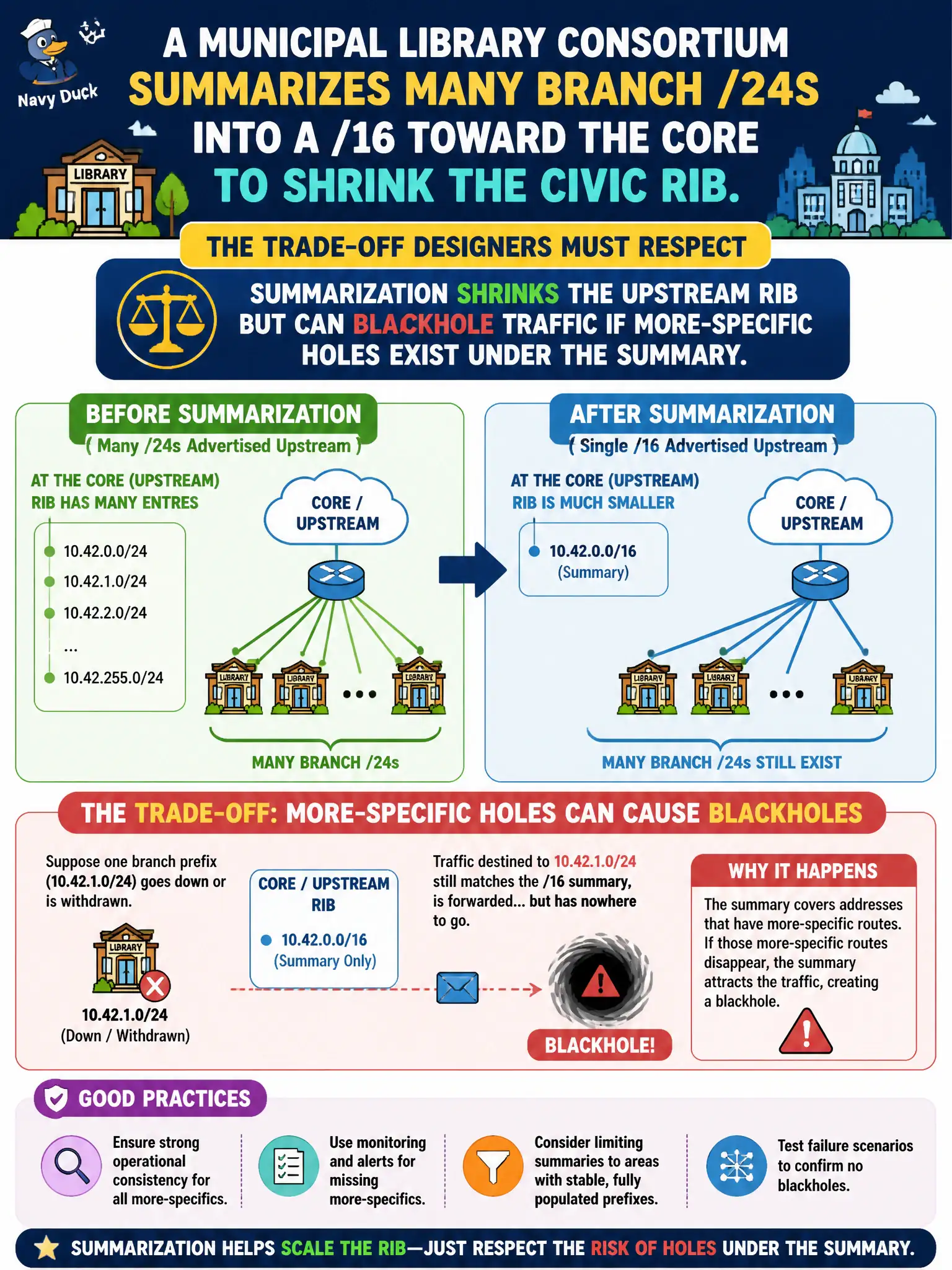
Summarization is packing branch streets into one zip-code sign for the core. The map gets smaller—great—unless a missing side street still falls under that zip and packets fall into a hole. Advertise a summary only when coverage (or Null0 anchoring) matches reality.
Full Explanation
Manual summarization aggregates more-specific prefixes into a shorter mask so upstream routers carry fewer routes. A municipal library consortium summarizing many branch /24s into a /16 toward the core shrinks the civic RIB, but if some constituent prefixes are missing or unreachable while the summary remains, traffic for those holes can be blackholed toward the summarizing router. Null0 anchors and careful addressing plans mitigate that risk—designers must respect the coverage trade-off.
Claiming summaries always install as host routes and cannot reduce RIB size is false. Asserting a /16 summary requires MPLS L3VPN before the core will accept it invents an MPLS dependency that ordinary IGP/BGP summarization does not have. Saying manual summarization disables CEF until every /24 is redistributed again is incorrect operational folklore.
Exam caveat: advertise summaries only when the summarizing router can reach or deliberately discard components; discontinuous addressing under a summary is a classic blackhole. Operational check: verify all /24s covered by the /16 are reachable or Null0-anchored, withdraw one /24 in a test and observe whether the summary still attracts blackhole traffic, and prefer summarization boundaries that match real topology.