
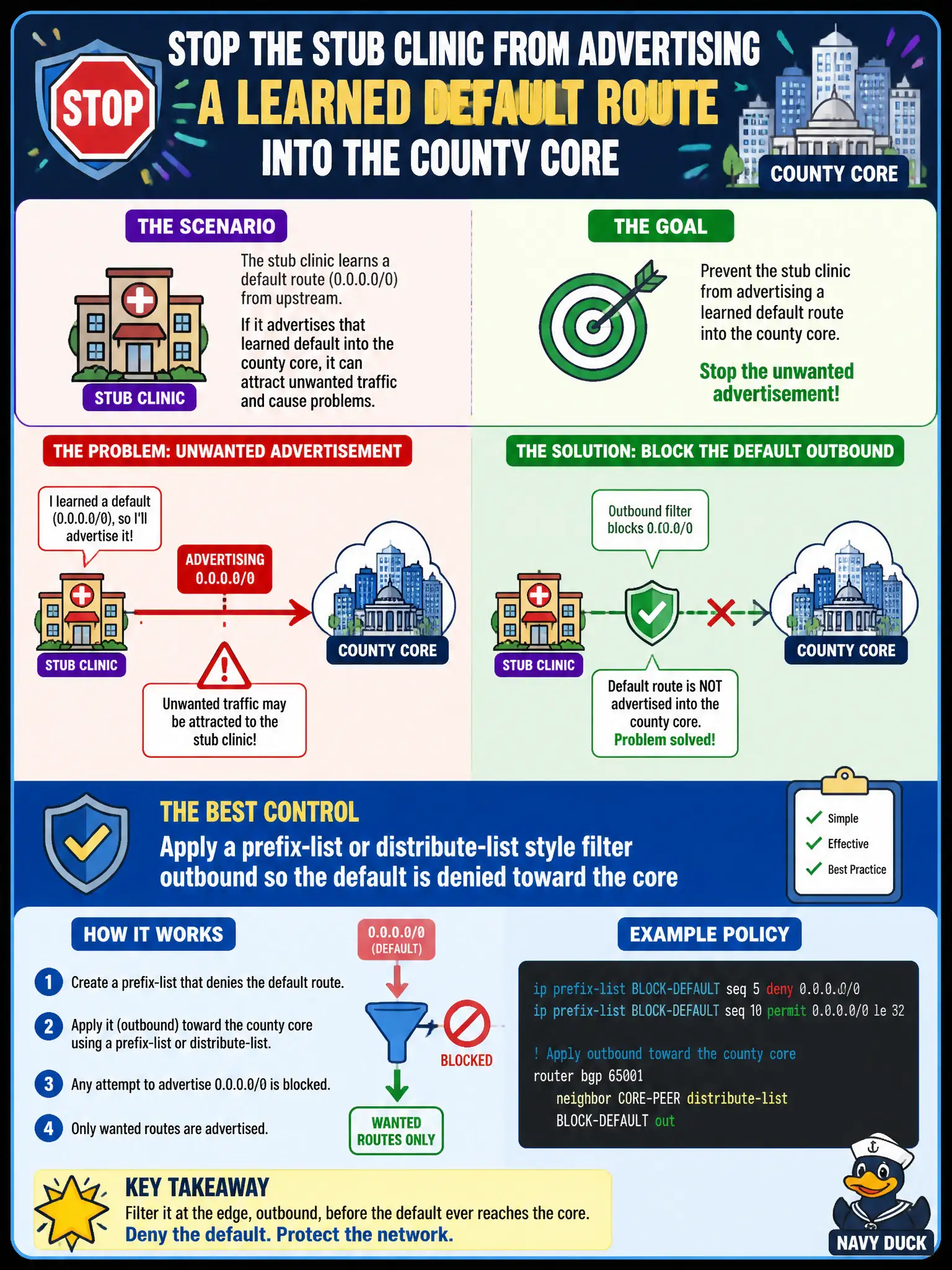
City public-works must stop a stub clinic from advertising a learned default route into the county core. Which control best prevents that unwanted advertisement?
Select an answer to reveal the explanation.
Short Explanation
Filters are the tollbooth facing the clinic: defaults don’t get a ticket into the county core. Prefix-lists or distribute-lists on the advertisement path stop the leak at the border. Speeding hellos or flipping VTP won’t police routes.
Full Explanation
Route filtering with prefix-lists, distribute-lists, or route-maps prevents a stub from advertising unwanted prefixes such as a default into the core. City public-works stopping a stub clinic from advertising a learned default into the county core should apply an outbound filter that denies the default toward the core. Filtering belongs on the redistribution or routing-update path between clinic and core, often combined with stub-area or EIGRP-stub design for defense in depth.
Lowering the clinic’s OSPF hello timer so defaults expire before they propagate misunderstands hellos—they affect adjacency liveliness, not prefix policy. Enabling PortFast on the clinic WAN router’s LAN ports does not block IP route advertisements. Converting the core to VTP client mode to ignore defaults from stubs confuses VLAN database sync with IP routing policy.
Exam caveat: filter both directions as needed; inbound filters on the core and outbound filters on the clinic are complementary, and stub area types reduce but may not alone stop every redistribution mistake. Operational check: inject a default at the clinic in a lab, confirm the filter denies it toward the core, verify legitimate clinic prefixes still advertise, and document the prefix-list in change control.