
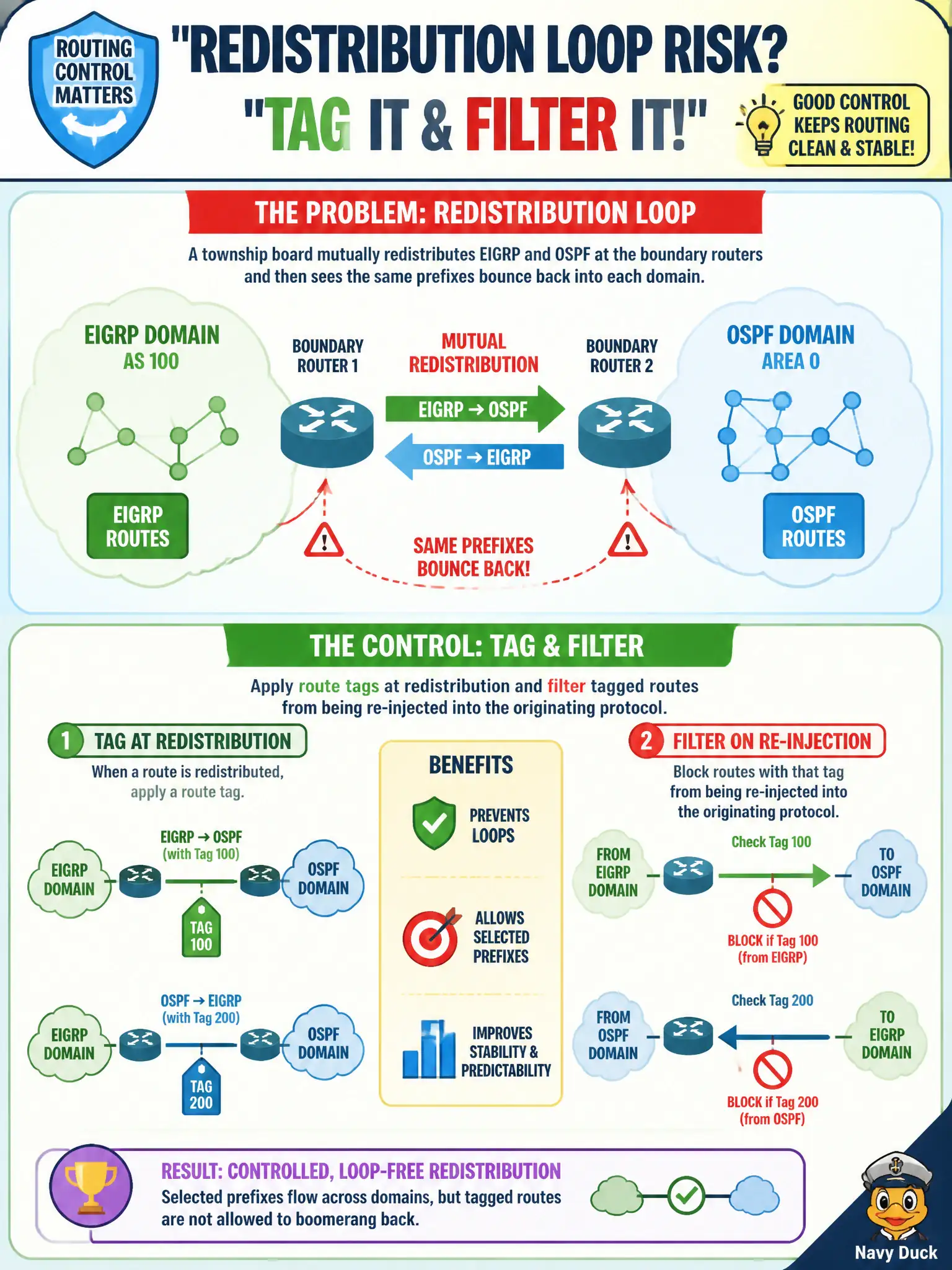
A township board mutually redistributes EIGRP and OSPF at the boundary routers and then sees the same prefixes bounce back into each domain. Which control best reduces redistribution loop risk while still allowing selected prefixes to pass?
Select an answer to reveal the explanation.
Short Explanation
Think of painted cargo crates: once you stamp a box leaving the OSPF warehouse, you refuse that same stamp when it tries to walk back in from EIGRP. Tags plus a filter stop the bounce without shutting the dock. Mutual redistribution without that stamp-and-block game is how loops sneak in.
Full Explanation
Mutual redistribution between EIGRP and OSPF can re-advertise a prefix back into its originating domain unless the boundary marks and filters those routes. Tagging at redistribution and denying tagged prefixes on the reverse path is the classic loop-prevention pattern while still permitting intentional, untagged or differently tagged prefixes. A township board seeing prefixes bounce between domains should apply that tag-and-filter control at the boundary routers.
Disabling all route tags and relying only on higher OSPF costs on boundary links does not provide selective, protocol-aware loop prevention and can still allow feedback loops. Redistributing every prefix both ways with no filters maximizes loop and suboptimal-path risk. Replacing mutual redistribution with floating static defaults pointed at every boundary interface abandons dynamic exchange and does not scale as a selective pass-through design.
Exam caveat: tags must be set on the redistribute statement and matched on the opposite redistribute; inconsistent tagging across multiple boundary routers recreates loops. Operational check: tag EIGRP-originated prefixes when entering OSPF and deny those tags when redistributing OSPF back to EIGRP (and vice versa), then traceroute a test prefix to confirm it does not yo-yo across the boundary.