
A tax assessor extends one VLAN across multiple buildings on trunks and asks when that pattern becomes an operational smell. What is the core concern?
Select an answer to reveal the explanation.
Short Explanation
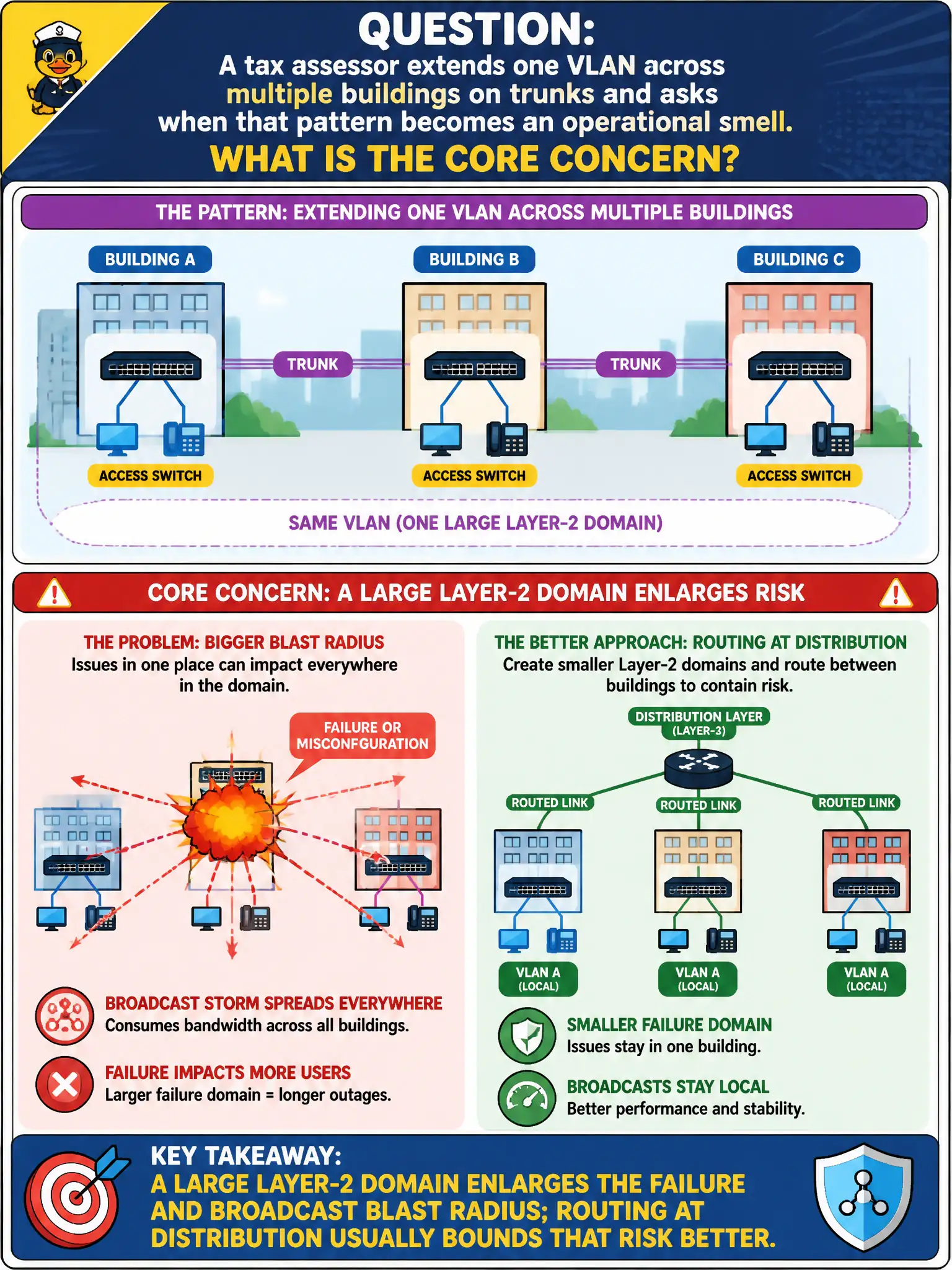
One VLAN stretched across buildings is one big fishbowl—every broadcast and loop splash hits everyone. Trunks make the stretch easy; they don’t make the blast radius small. When the assessor’s domain feels fragile, route between buildings instead of bridging everything.
Full Explanation
Extending a single VLAN across multiple buildings on trunks creates a wide Layer-2 failure domain: broadcasts, unknown unicasts, STP events, and loops propagate farther. For a tax assessor’s multi-building stretch, that enlarged blast radius is the core operational smell. Trunks are the transport that makes the stretch easy; they are not a cure for the risk. A common enterprise remedy is to terminate VLANs at distribution or building edge and route between sites so failures stay local.
Claiming trunks cannot carry more than one VLAN between buildings is false—802.1Q trunks exist precisely to carry multiple VLANs. Asserting 802.1Q tags expire after crossing a second switch hop invents a hop-count myth that does not apply to VLAN tags. Saying VTP transparent mode forbids multi-building VLANs by standard confuses VTP participation with topology design; transparent mode does not prohibit extended VLANs.
Exam caveat: some designs intentionally extend L2 for clustering or legacy apps, but they require extreme loop discipline, storm control, and clear ownership—default civic advice remains route at distribution. Operational check: inventory which VLANs span buildings, measure broadcast domain size, prefer L3 boundaries between buildings, and validate that a loop or storm in one building cannot take down the assessor’s entire campus VLAN.