
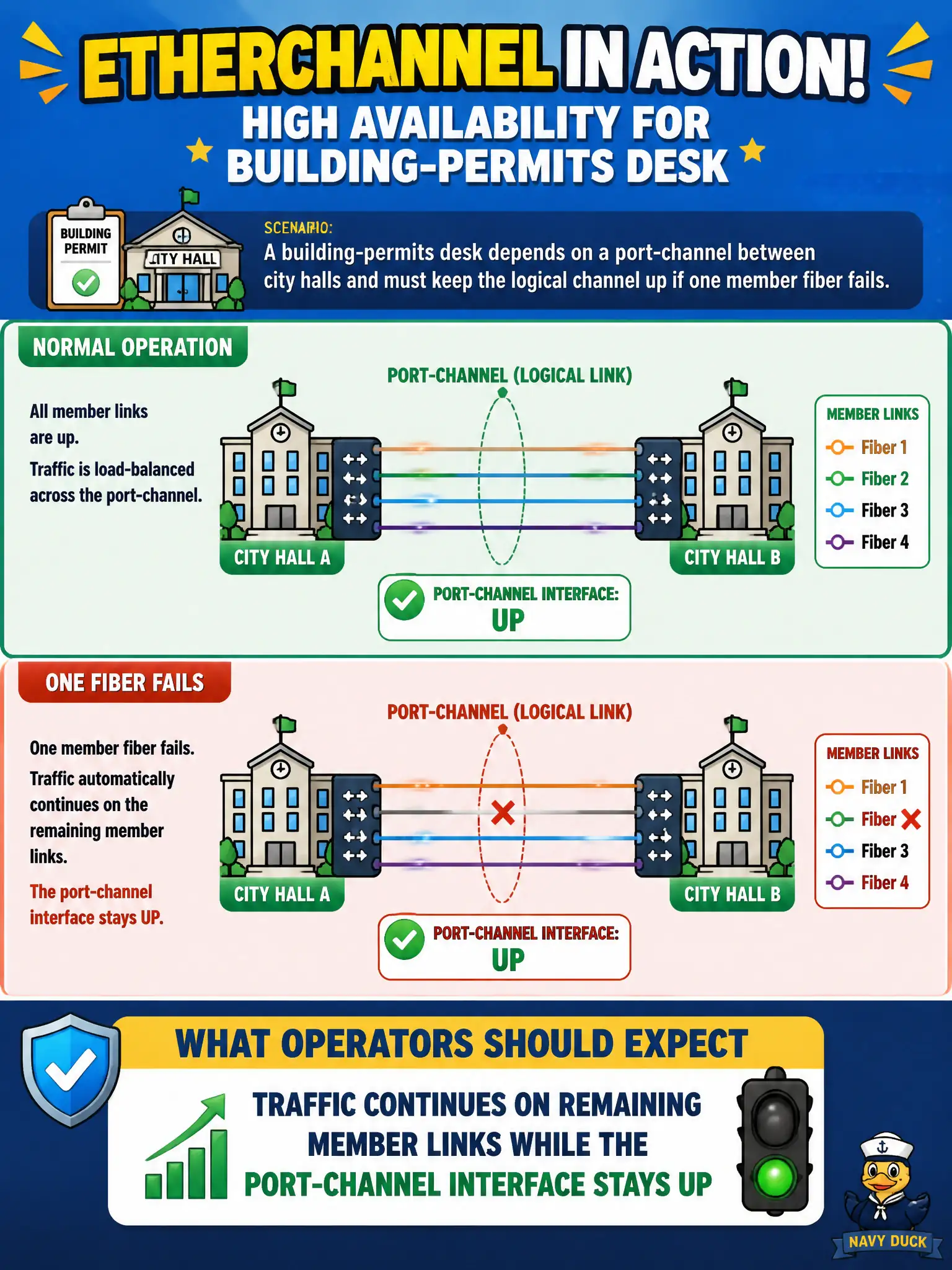
A building-permits desk depends on a port-channel between city halls and must keep the logical channel up if one member fiber fails. What behavior should operators expect from a correctly formed EtherChannel?
Select an answer to reveal the explanation.
Short Explanation
A healthy EtherChannel is a braided rope—cut one strand and the braid still holds. Remaining members keep the logical link up while hash moves flows onto survivors. That’s why the permits desk bundles fiber between halls instead of betting on one strand.
Full Explanation
A properly formed EtherChannel remains up when at least one member is operational, and traffic is redistributed across surviving links according to the load-balance algorithm. For a building-permits desk depending on a port-channel between city halls, operators should expect the logical port-channel interface to stay up after a single member fiber failure while remaining members continue forwarding. That is the core high-availability behavior of a correctly formed bundle.
Claiming the entire port-channel always goes down if any single member fails confuses member loss with logical-interface failure; a multi-member channel is designed to survive partial loss. Asserting STP must be disabled or the channel cannot survive a member loss is false—STP runs on the port-channel interface and remains required for loop prevention. Saying only LACP passive-passive bundles keep forwarding after a fiber cut misstates LACP: passive-passive typically fails to negotiate a bundle at all, and survival after a cut depends on remaining members, not that invalid pairing.
Exam caveat: minimum-links configuration can intentionally take the port-channel down if too few members remain; know whether that policy is configured. Operational check: fail one member in a maintenance window, confirm the port-channel stays up, verify traffic and STP state on the logical interface, and document member diversity so one fiber cut leaves capacity online.