
An election office sees access ports errdisabled after link-flap events during a stadium Wi-Fi surge and wants a controlled return to service. Which operational approach fits?
Select an answer to reveal the explanation.
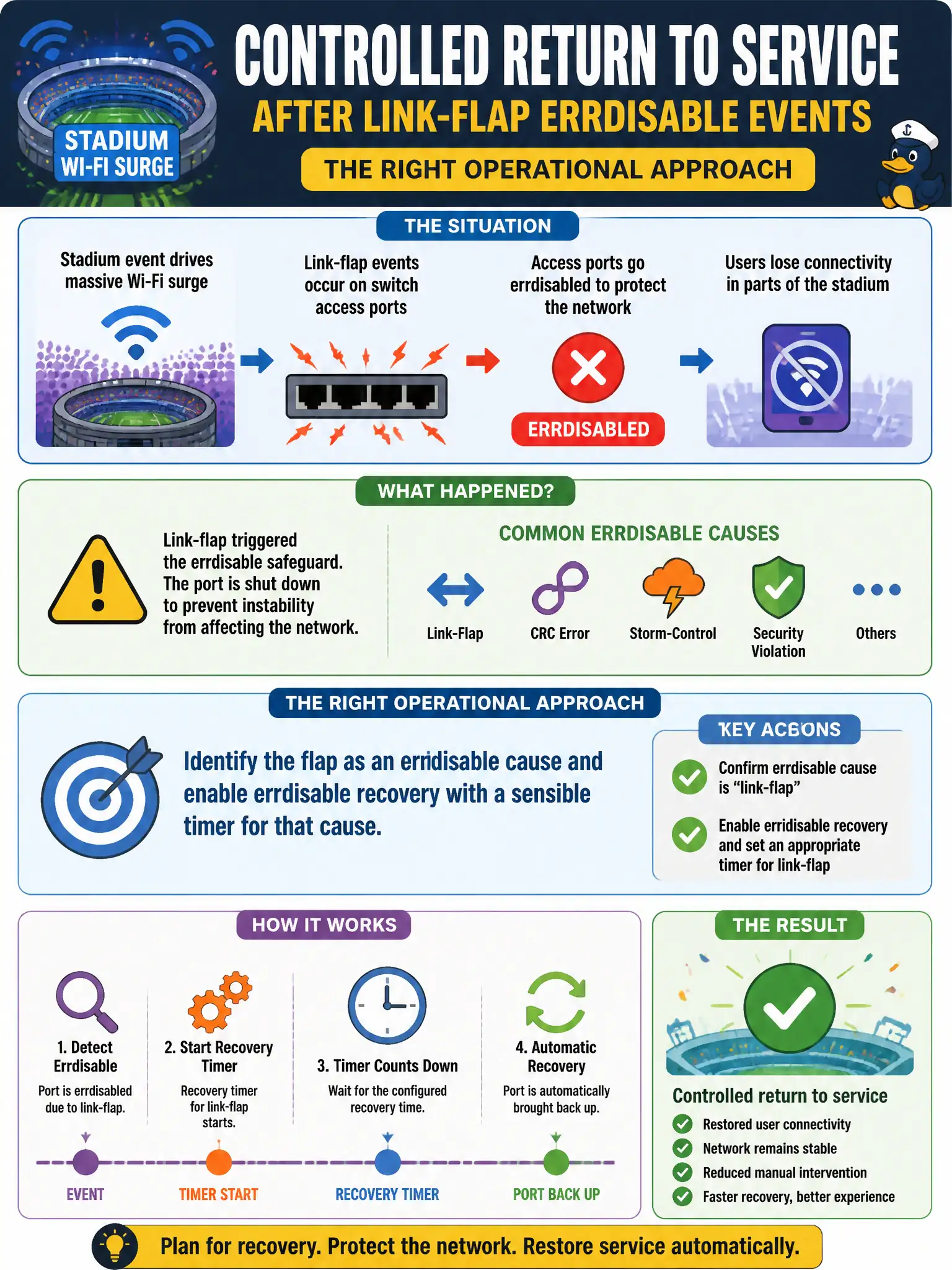
Short Explanation
Errdisable is the switch slamming a noisy door shut after too many flaps. Recovery is the timed reopen once the stadium surge settles—not pretending flaps never happened. Tune recovery for the flap cause so ops get stability without truck rolls for every event.
Full Explanation
Catalyst ports can enter errdisable for causes such as link flap, BPDU guard, and UDLD. When an election office sees access ports errdisabled after link-flap events during a stadium Wi-Fi surge, operators should confirm the cause, address underlying physical or storm issues when possible, and enable errdisable recovery for the flap cause with a sensible interval so ports re-enable automatically in a controlled way. That is the operational approach for a controlled return to service without pretending flaps never happened.
Ignoring errdisable and raising STP max-age so flaps never matter does not address flap-driven errdisable and weakens STP timing for unrelated reasons. Replacing every access switch because errdisable cannot be recovered without RMA is false—errdisable is a software protective state, not a hardware death sentence. Disabling UDLD forever so link state changes never trigger protection removes a valuable unidirectional-link safeguard and still may not stop flap errdisable from other causes.
Exam caveat: recovery timers should be long enough for instability to settle but short enough for service restoration; always fix chronic physical problems rather than relying on endless auto-recovery. Operational check: show errdisable recovery and interface status, enable recovery for link-flap with a documented interval, verify a port returns after the timer, and correlate flaps with cabling, NICs, or storm control during the stadium surge.