
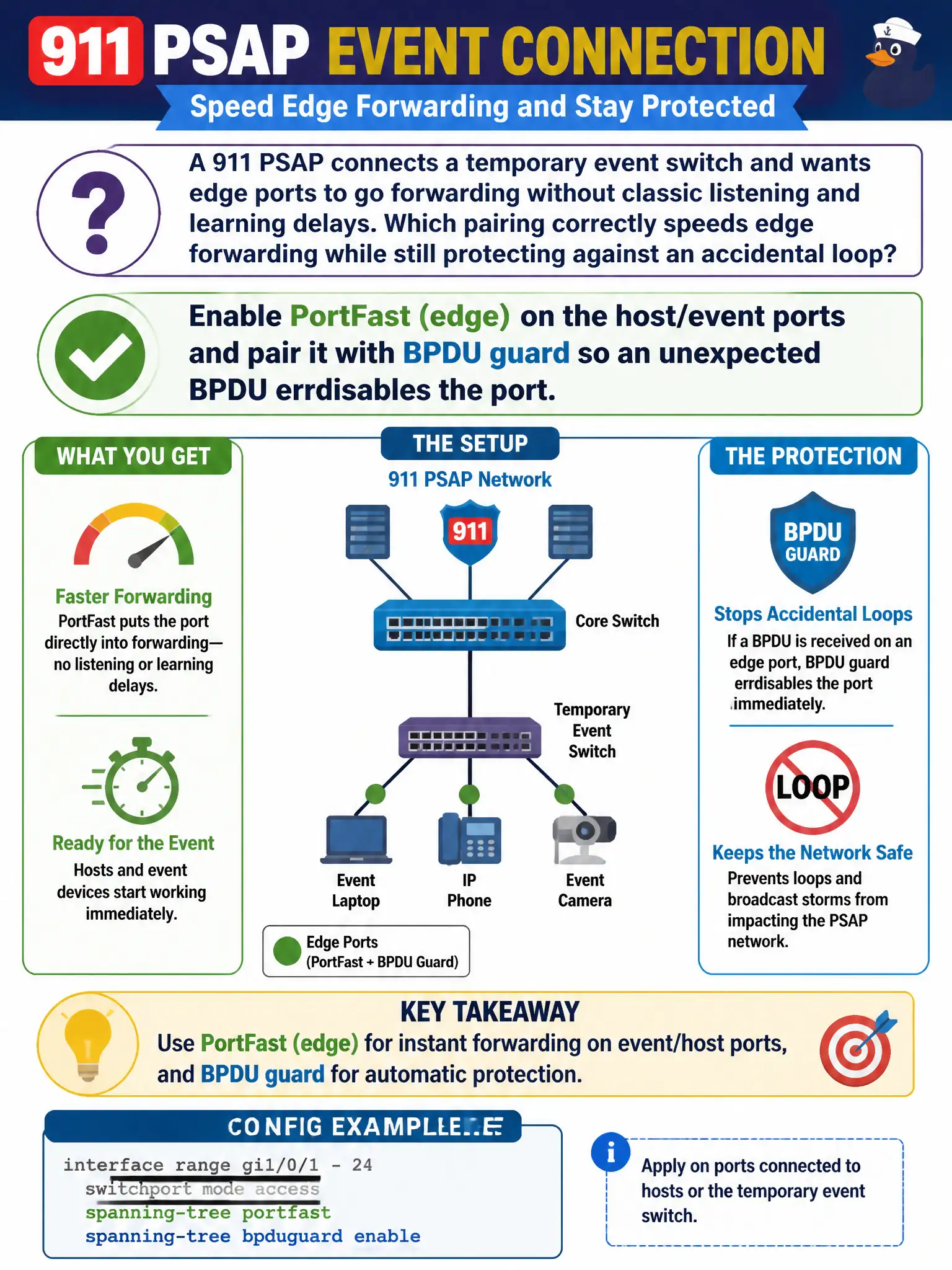
A 911 PSAP connects a temporary event switch and wants edge ports to go forwarding without classic listening and learning delays. Which pairing correctly speeds edge forwarding while still protecting against an accidental loop?
Select an answer to reveal the explanation.
Short Explanation
PortFast is the express lane into forwarding for ports that should only see PCs or a temporary event switch edge. BPDU guard is the emergency brake if a switch shows up where a host belongs. Use them together at a PSAP temp drop—speed without gambling on a loop.
Full Explanation
PortFast (edge-port) behavior moves eligible access ports into forwarding without waiting through classic listening and learning, which suits host and temporary event connections at a 911 PSAP. Pairing PortFast with BPDU guard ensures that if a switch is plugged in and BPDUs appear, the port errdisables instead of silently participating in STP and risking a loop. That pairing correctly speeds edge forwarding while still protecting against an accidental loop.
Disabling STP globally so every port forwards immediately removes loop protection entirely—an unacceptable risk even for temporary event gear. Root guard alone does not skip listening and learning on edge ports by design; it protects root election on designated ports facing switches. Setting the port to trunk mode with VTP client does not cancel STP timers on edge ports and is the wrong tool for host-edge acceleration.
Exam caveat: PortFast belongs on true edge ports, not on links that should see switches; BPDU guard is the safety net when that assumption fails. Operational check: enable PortFast and BPDU guard on event/host ports, verify immediate forwarding for a PC, connect a test switch and confirm errdisable on BPDU, and document recovery procedures for the PSAP event staff.