
A regional planning commission needs a predictable STP root for the civic core and must stop a rogue closet switch from winning root. Which feature specifically guards against superior BPDUs on a designated port toward that closet?
Select an answer to reveal the explanation.
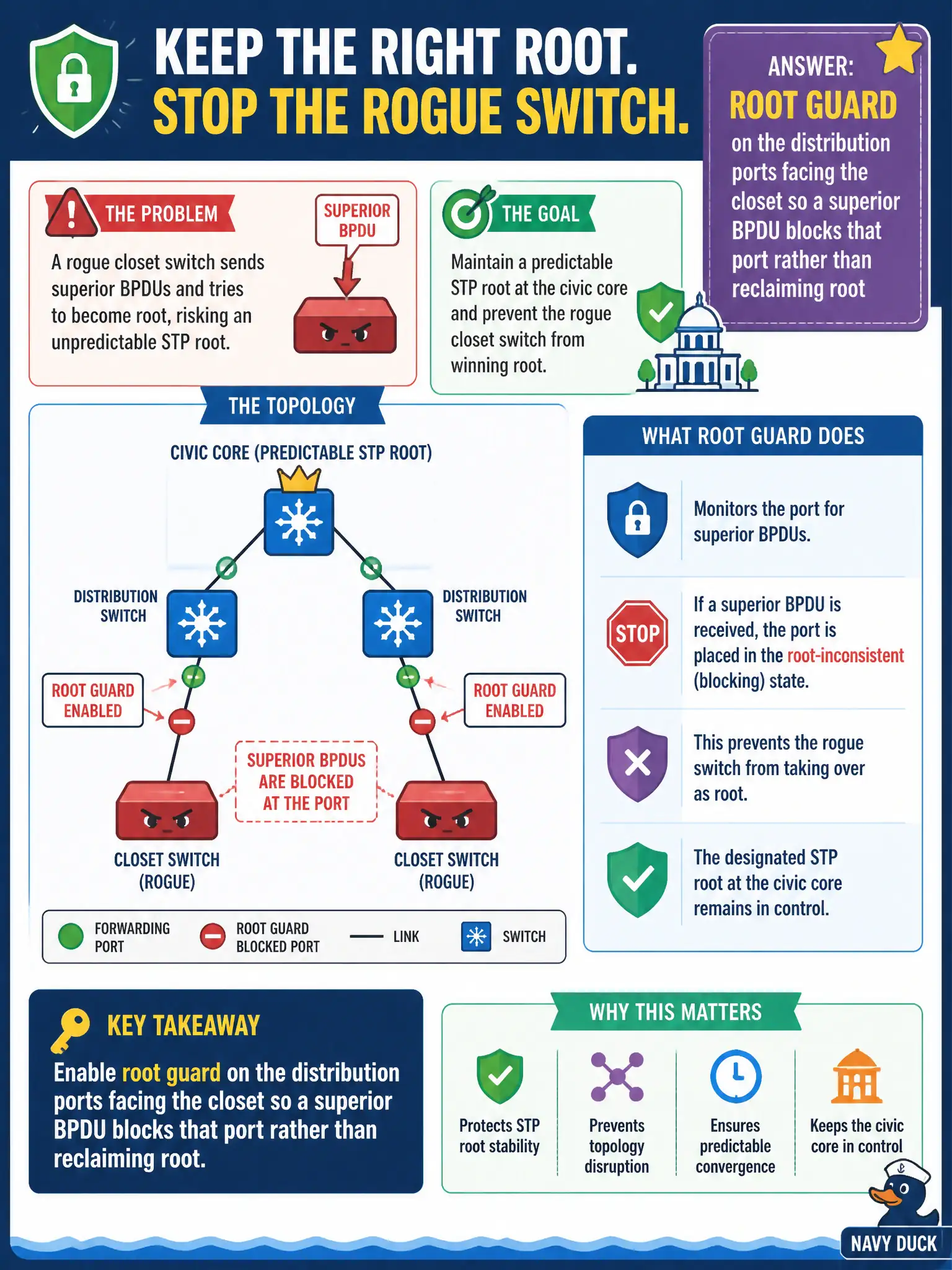
Short Explanation
Root guard is the bouncer at the civic core’s VIP door: a closet switch waving a better priority card gets stopped, not promoted. Put it on distribution ports facing untrusted closets so the planned root stays planned.
Full Explanation
Root guard is applied on ports where a superior BPDU should never be accepted; if one arrives, the port enters a root-inconsistent state instead of allowing the attached switch to become root. For a regional planning commission that needs a predictable STP root in the civic core, placing root guard on distribution ports facing untrusted closets stops a rogue or misconfigured closet switch from winning root with a better priority.
PortFast alone on the uplink would be inappropriate for an inter-switch link and does not protect root election; it is an edge-port optimization, not a root-protection feature. UDLD normal mode detects unidirectional links; it does not reject BPDUs with better bridge priority. VTP transparent mode affects VLAN database synchronization behavior and does not ignore superior BPDUs automatically.
Exam caveat: root guard protects designated ports from becoming root ports due to superior BPDUs; it is complementary to BPDU guard (which errdisables on any BPDU at edge ports) and to intentional root bridge priority design. Operational check: set core/distribution as root with appropriate priority, enable root guard on downlinks to closets, inject a superior BPDU in a lab and confirm root-inconsistent state rather than root takeover, then clear and restore.