
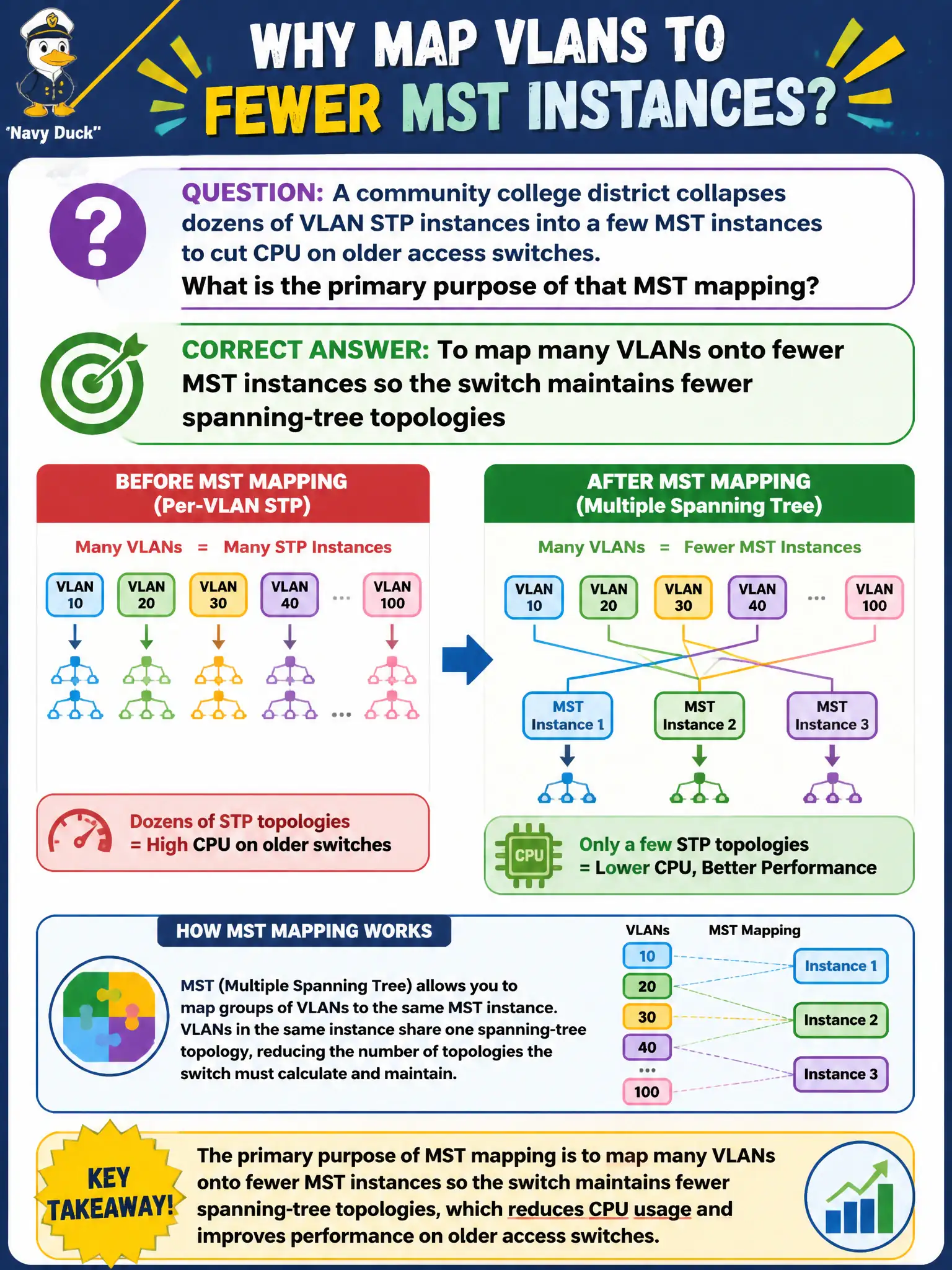
A community college district collapses dozens of VLAN STP instances into a few MST instances to cut CPU on older access switches. What is the primary purpose of that MST mapping?
Select an answer to reveal the explanation.
Short Explanation
Imagine running a separate traffic plan for every classroom hallway—that’s dozens of PVST instances. MST bundles many VLANs onto a handful of shared plans so old switches stop grinding CPU. Same loop protection, fewer topologies to compute.
Full Explanation
MST (802.1s) maps groups of VLANs to a small number of spanning-tree instances, reducing CPU and memory versus per-VLAN PVST or Rapid-PVST at scale. A community college district collapsing dozens of VLAN STP instances into a few MST instances does so primarily so older access switches maintain fewer spanning-tree topologies while still preventing loops. Instance mapping and region configuration must be consistent across the MST region.
Replacing all uplinks with LACP does not eliminate STP calculation; EtherChannel and STP coexist, and LACP is not the purpose of MST mapping. Forcing every VLAN to share a single root bridge MAC regardless of region misstates MST’s instance model—roots are per instance/region design, not a mandatory single campus-wide MAC for every VLAN. Converting the campus to PVST+ so each VLAN keeps an independent full topology calculation is the opposite of collapsing instance count.
Exam caveat: boundaries between MST and Rapid-PVST need careful interoperability design; mismatched region names or revision/instance maps split regions unexpectedly. Operational check: document VLAN-to-instance maps, verify consistent MST region configuration, monitor CPU on older access switches before and after, and confirm forwarding topology per instance matches the intended load-sharing design.