
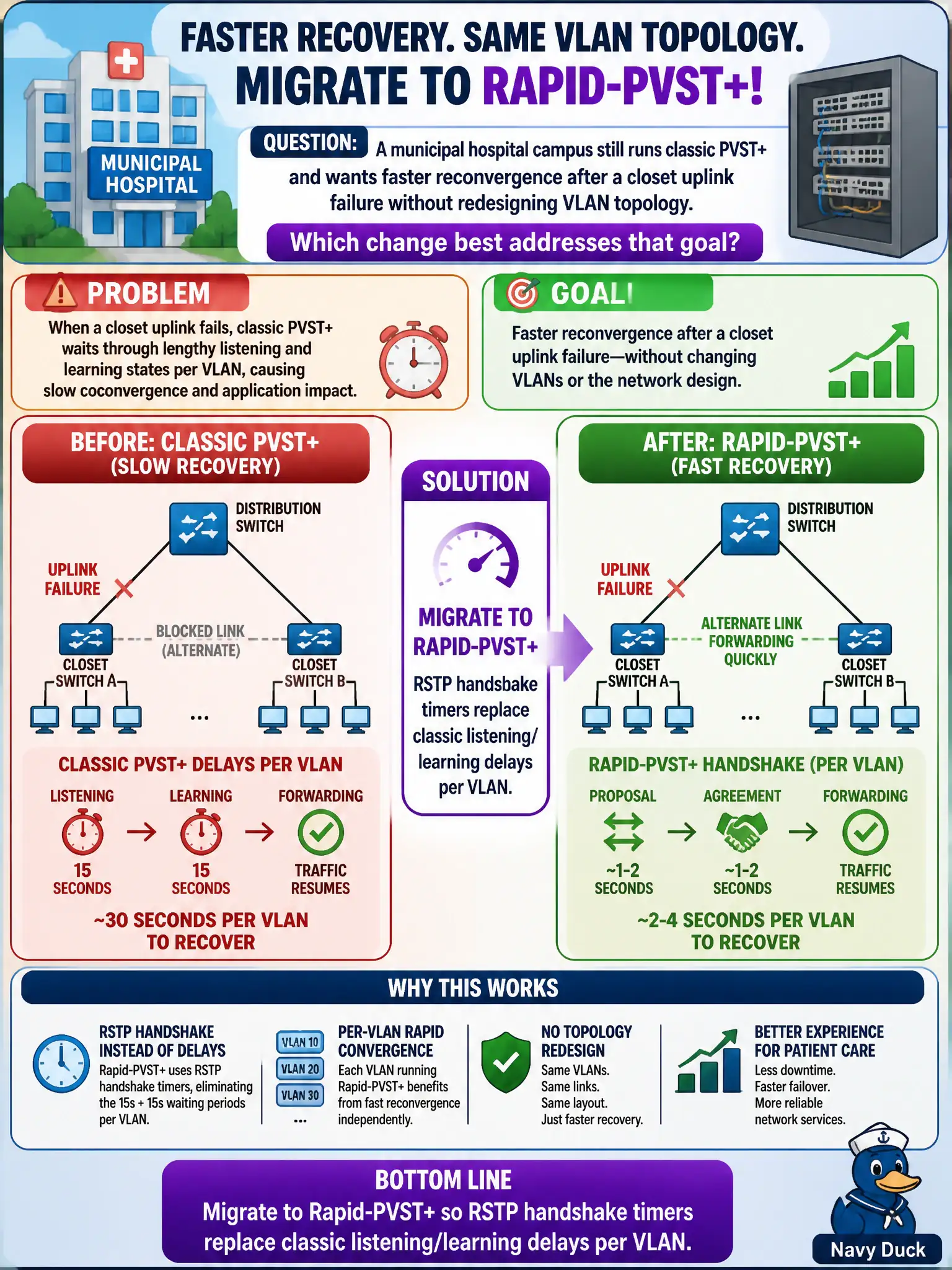
A municipal hospital campus still runs classic PVST+ and wants faster reconvergence after a closet uplink failure without redesigning VLAN topology. Which change best addresses that goal?
Select an answer to reveal the explanation.
Short Explanation
Classic PVST+ is the old traffic light with long yellows. Rapid-PVST+ shortens the wait with RSTP-style handshakes while keeping per-VLAN trees. That’s the upgrade path when the hospital wants faster closet failover without redrawing every VLAN.
Full Explanation
Rapid-PVST+ runs RSTP semantics on a per-VLAN basis, dramatically improving convergence versus classic PVST+ listening and learning delays after an uplink failure. For a municipal hospital campus that wants faster closet reconvergence without redesigning VLAN topology, migrating to Rapid-PVST+ preserves familiar per-VLAN root and path control while replacing slow timer-based transitions with handshake-driven RSTP behavior.
Disabling spanning tree on all access VLANs eliminates reconvergence delay only by removing loop protection—an unacceptable risk in any redundant L2 campus. Converting every access port to a routed port so STP is unused is a full Layer-3 access redesign, which violates the constraint of not redesigning VLAN topology. Enabling VTP pruning only reduces flooded VLAN traffic on trunks; it is not a substitute for faster STP failover.
Exam caveat: Rapid-PVST+ still requires sound root placement, uplink design, and features such as BPDU/root guard; faster protocol timers do not forgive Layer-2 loops. Operational check: migrate a nonprod closet first, measure reconvergence after uplink failure, confirm per-VLAN roots remain as designed, and validate that host ports still use PortFast/BPDU guard appropriately.