
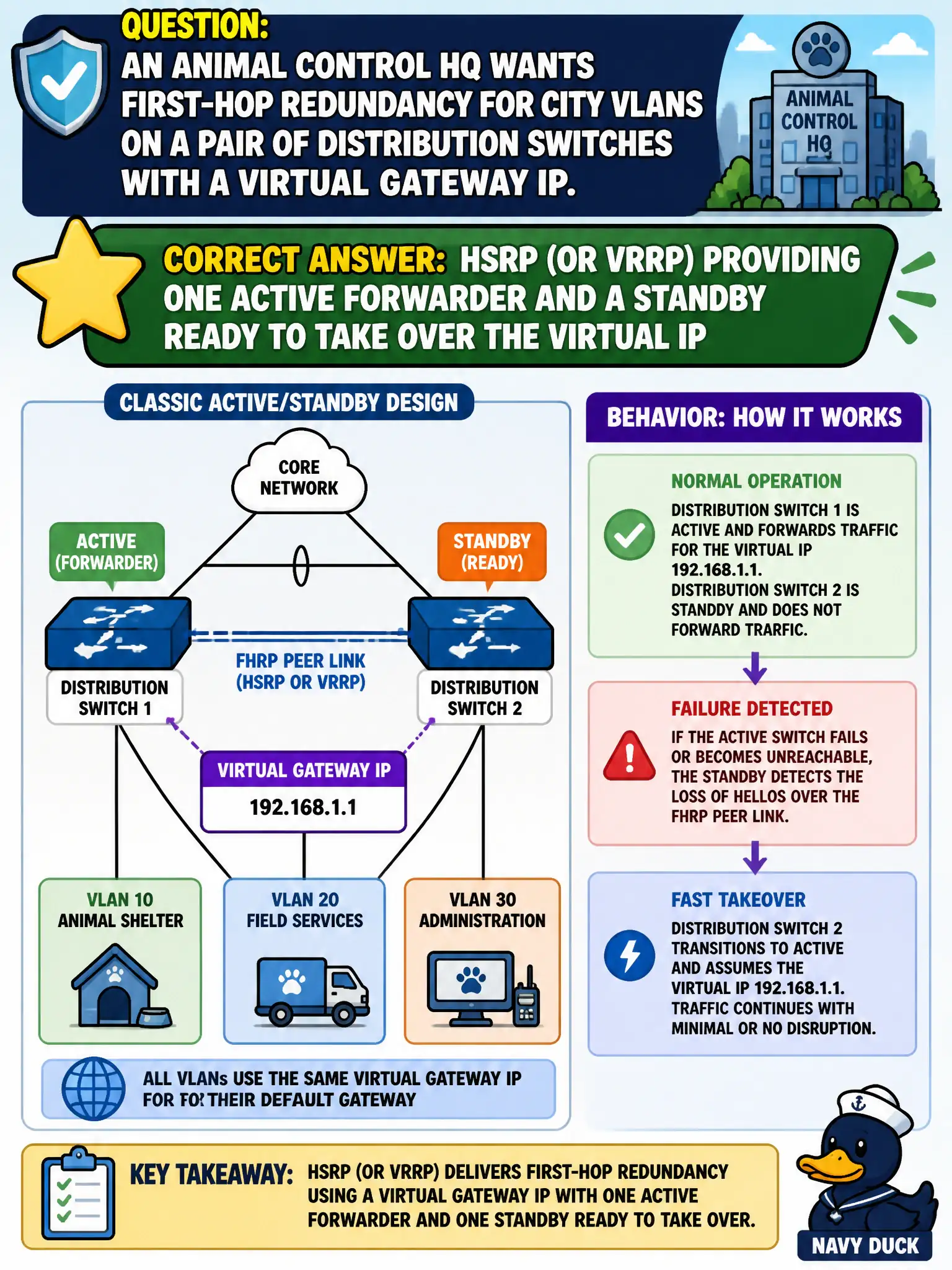
An animal control HQ wants first-hop redundancy for city VLANs on a pair of distribution switches with a virtual gateway IP. Which FHRP choice and behavior match a classic active/standby design?
Select an answer to reveal the explanation.
Short Explanation
Hosts need one friendly gateway address that survives a switch failing—like a shared desk phone number that rings whoever is on duty. HSRP (or VRRP) keeps an active forwarder and a hot standby on that virtual IP. That is the classic city-VLAN pattern.
Full Explanation
Animal-control first-hop redundancy on a pair of distribution switches with one virtual gateway IP is classic active/standby FHRP behavior. HSRP (or VRRP) provides one active forwarder and a standby ready to assume the virtual IP, so hosts keep a single default-gateway address across failure. That matches the stem’s active/standby virtual-gateway requirement.
Claiming only GLBP works because HSRP cannot present a virtual IP is false—HSRP’s purpose is a virtual IP/MAC. Pointing every host at both switches’ physical addresses without a VIP creates dual defaults and messy failure behavior. Disabling FHRP and renumbering DHCP gateways during failures is slow, error-prone, and unsuitable for civic VLAN continuity.
Exam caveat: GLBP offers active/active per-host load balancing with different mechanics; do not select it when the question asks for classic active/standby VIP behavior. Operational check: configure HSRP/VRRP with priorities and tracking, fail the active uplink or switch in a maintenance window, and verify hosts retain the VIP with failover timers acceptable to animal-control operations. Animal-control runbooks should record HSRP group numbers, priorities, and tracked interfaces so overnight failover is explainable to on-call staff.