
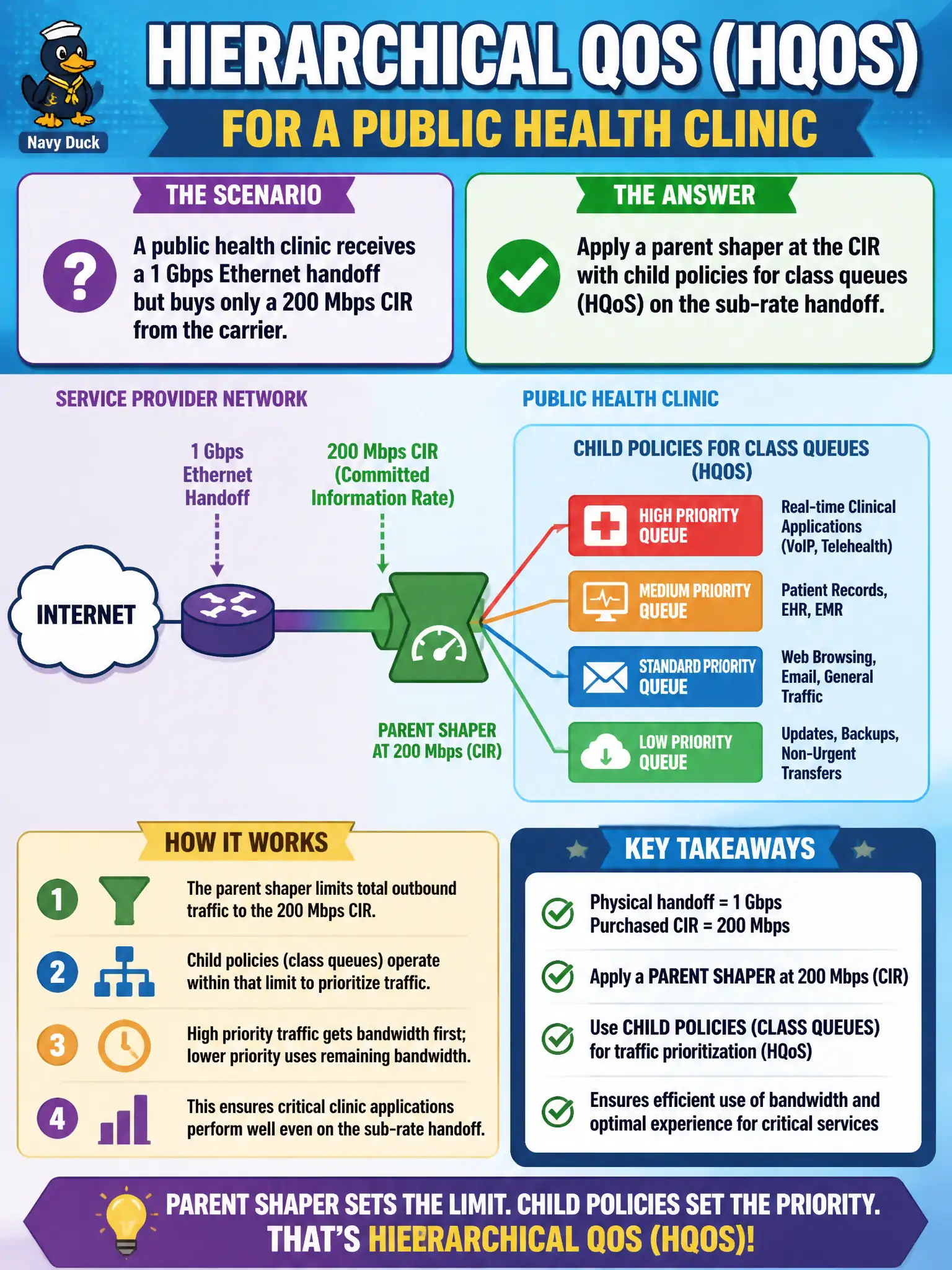
A public health clinic receives a 1 Gbps Ethernet handoff but buys only a 200 Mbps CIR from the carrier. How should hierarchical QoS typically be applied?
Select an answer to reveal the explanation.
Short Explanation
The fiber can sprint at a gig, but you only paid for a 200 Mbps jog. A parent shaper caps you at CIR, and child policies still sort voice from bulk underneath—that is hierarchical QoS. Without the parent, your classes race a track the carrier will police for you.
Full Explanation
A public-health clinic with a 1 Gbps Ethernet handoff but only a 200 Mbps purchased CIR needs hierarchical QoS: a parent shaper at the CIR with child policies for class queues. The parent prevents the router from transmitting above what the carrier accepts; child policies still differentiate voice and bulk inside that shaped rate. That HQoS pattern is the standard treatment for sub-rate Ethernet handoffs.
Shaping only at the carrier PE and leaving the clinic router without parent/child policies means the CE still bursts at 1 Gbps into a policed UNI, causing avoidable drops. Policing the physical interface to 1 Gbps does nothing useful when the problem is a 200 Mbps CIR. Marking packets but attaching no shaper assumes Ethernet always runs at purchased CIR, which is false for sub-rate services.
Exam caveat: parent shape rate should match the contracted CIR/Burst model negotiated with the carrier, not the physical NICspeed. Operational check: configure parent shape 200 Mbps with child LLQ/CBWFQ, verify with show policy-map interface that the parent shaper engages under load, and confirm carrier-side drops decline during clinic business hours. Clinic templates should encode the contracted CIR in the parent shaper and treat physical Gigabit capacity as irrelevant to the purchased rate.