
A museums and culture department needs first-hop redundancy for IPv6 clients that learn default routers from Router Advertisements. Which approach aligns with dual distribution switches?
Select an answer to reveal the explanation.
Short Explanation
IPv6 hosts listen for Router Advertisements the way tourists follow museum sandwich boards. If a switch dies, you still want a stable default-router story—HSRP for IPv6 (or similar) keeps that first hop alive. Do not leave two uncoordinated RA sources and call it done.
Full Explanation
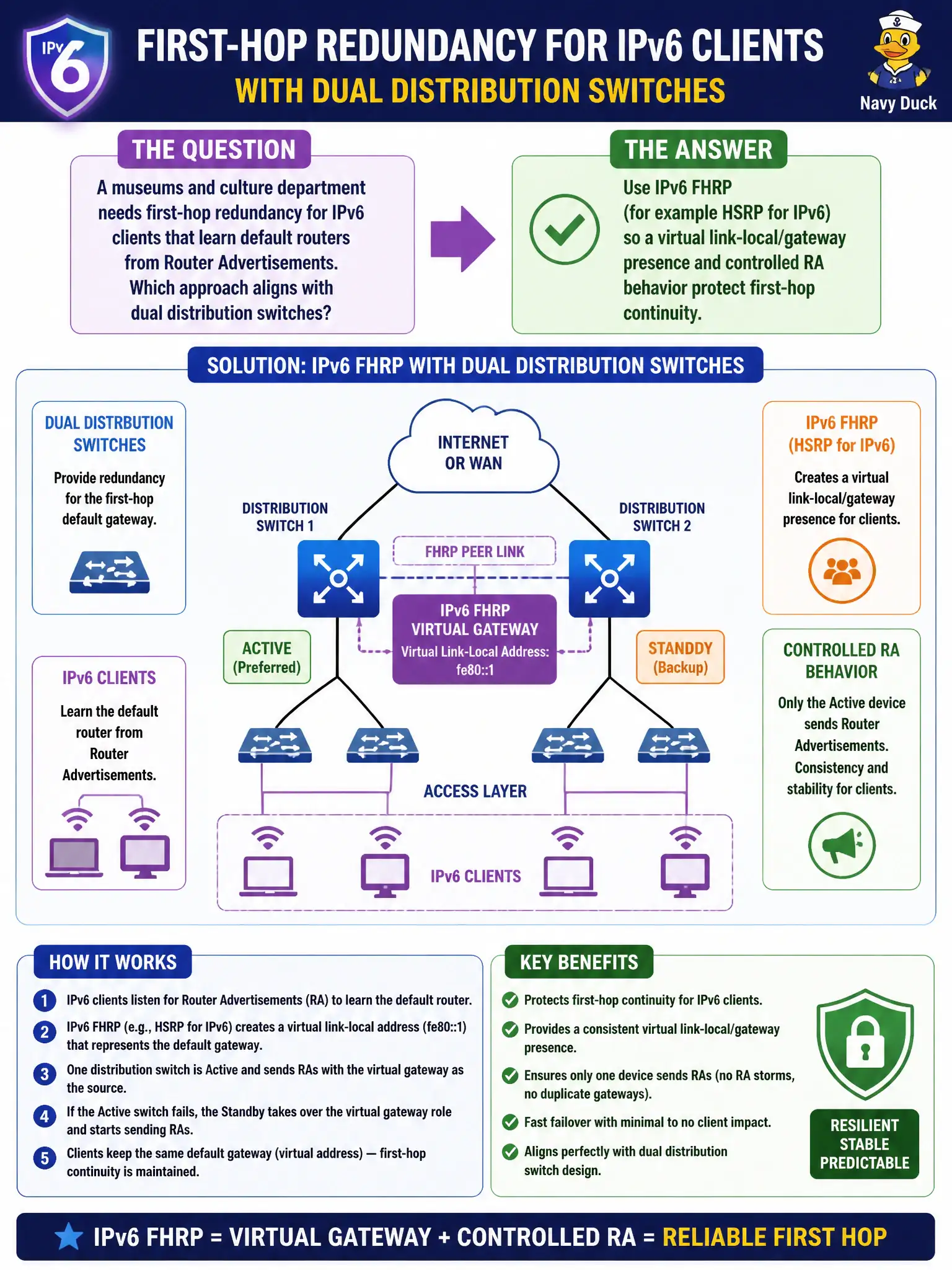
IPv6 clients learn default routers from Router Advertisements, so museums dual distribution switches need an IPv6 FHRP such as HSRP for IPv6. A virtual link-local/gateway presence with controlled RA behavior keeps first-hop continuity when one distribution switch fails. That approach aligns FHRP concepts with IPv6’s RA-based host discovery model.
Advertising identical RAs from both switches with no FHRP leaves hosts to pick randomly without coordinated failover semantics. Disabling RAs and hard-coding every host with both switches’ physical link-locals does not scale and fights how IPv6 hosts are meant to learn routers. Claiming IPv6 cannot use first-hop redundancy and must bridge to IPv4-only HSRP groups is incorrect.
Exam caveat: IPv6 FHRP and RA guard/timer coordination matter—misconfigured RAs can black-hole clients even when HSRP state looks fine. Operational check: enable HSRP for IPv6 on the dual SVIs, verify virtual link-local and RA behavior, fail one peer, and confirm clients retain default-router reachability without manual address changes. Museums IPv6 dual-stack cutovers should validate both RA intervals and FHRP hellos so clients do not cache a dead router longer than service SLAs allow.