
A transit monorepo configures several MCP servers. What should be true after connection-time discovery?
Select an answer to reveal the explanation.
Short Explanation
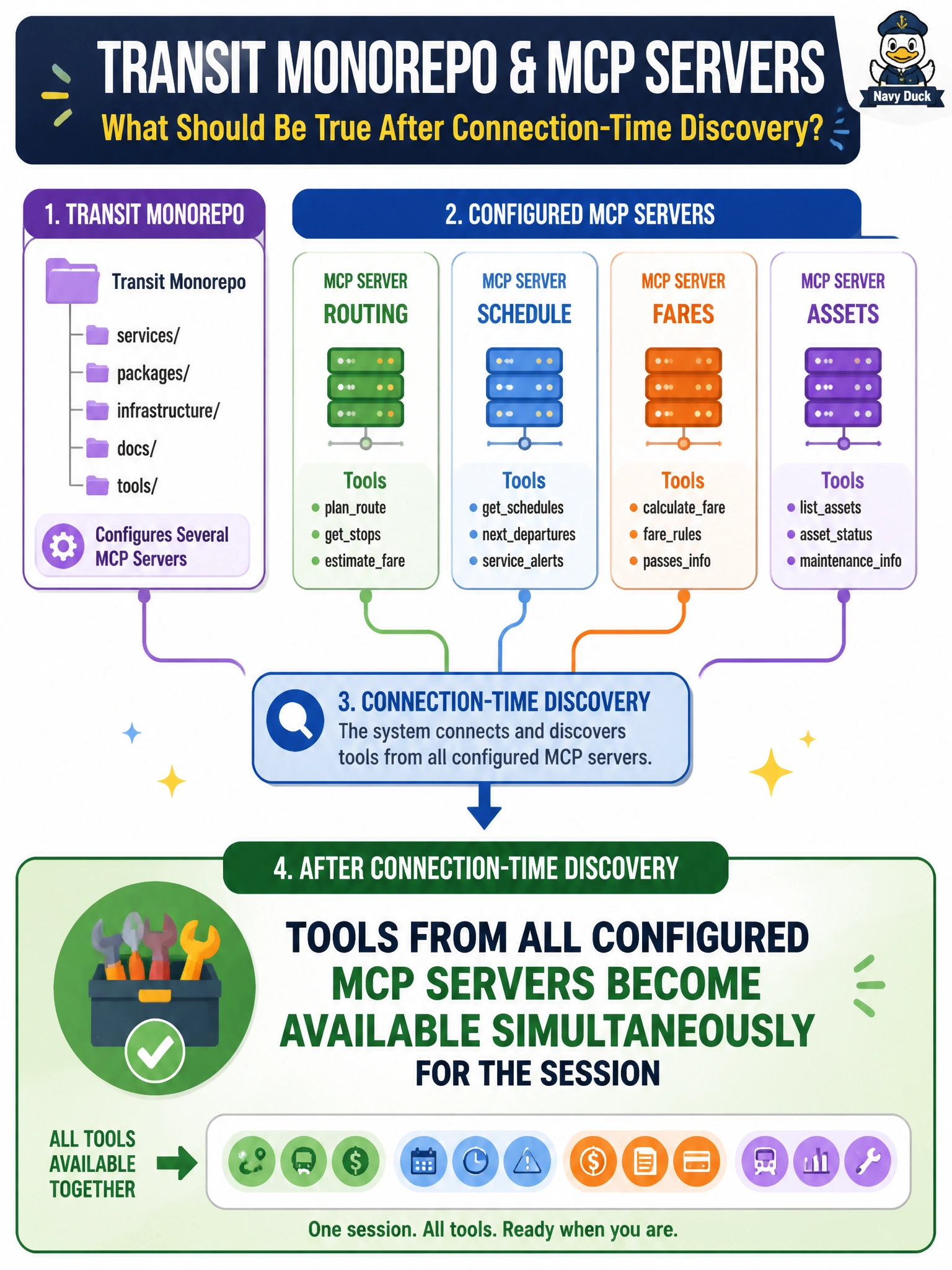
Hook up three transit MCP servers and discovery should put all their tools on the same tray—not just whoever shows up first in the alphabet.
Full Explanation
After connection-time discovery, a session that configures several MCP servers should see tools from all of those servers available simultaneously. In a transit monorepo that wires schedule, vehicle, and incident MCP servers, discovery aggregates their tool surfaces into one usable set for the agent—not a single winner and not a disabled pile.
Why the correct option works: MCP integration is multi-server by design. Each configured server advertises its tools; the client presents the union (subject to permissions and filters) to the model. Transit agents can therefore call get_schedule from one server and report_incident from another in the same session without reconfiguring between calls.
Why the other three fail by concept: claiming only the alphabetically first MCP server can ever expose tools invents a false exclusivity rule and would break multi-domain civic stacks. Saying MCP tools appear only after a human pastes each schema by hand ignores automated discovery. Asserting that configuring multiple servers always disables every tool contradicts the purpose of composing servers in one project.
Exam caveat: “available simultaneously” does not mean every tool must be invoked every turn—tool_choice and descriptions still govern selection. Operational check: configure two or more transit MCP servers, complete discovery, list tools, and verify names from each server appear together before running a multi-step ops prompt.