
A library catalog agent wastes calls exploring collection schemas. How can MCP resources help?
Select an answer to reveal the explanation.
Short Explanation
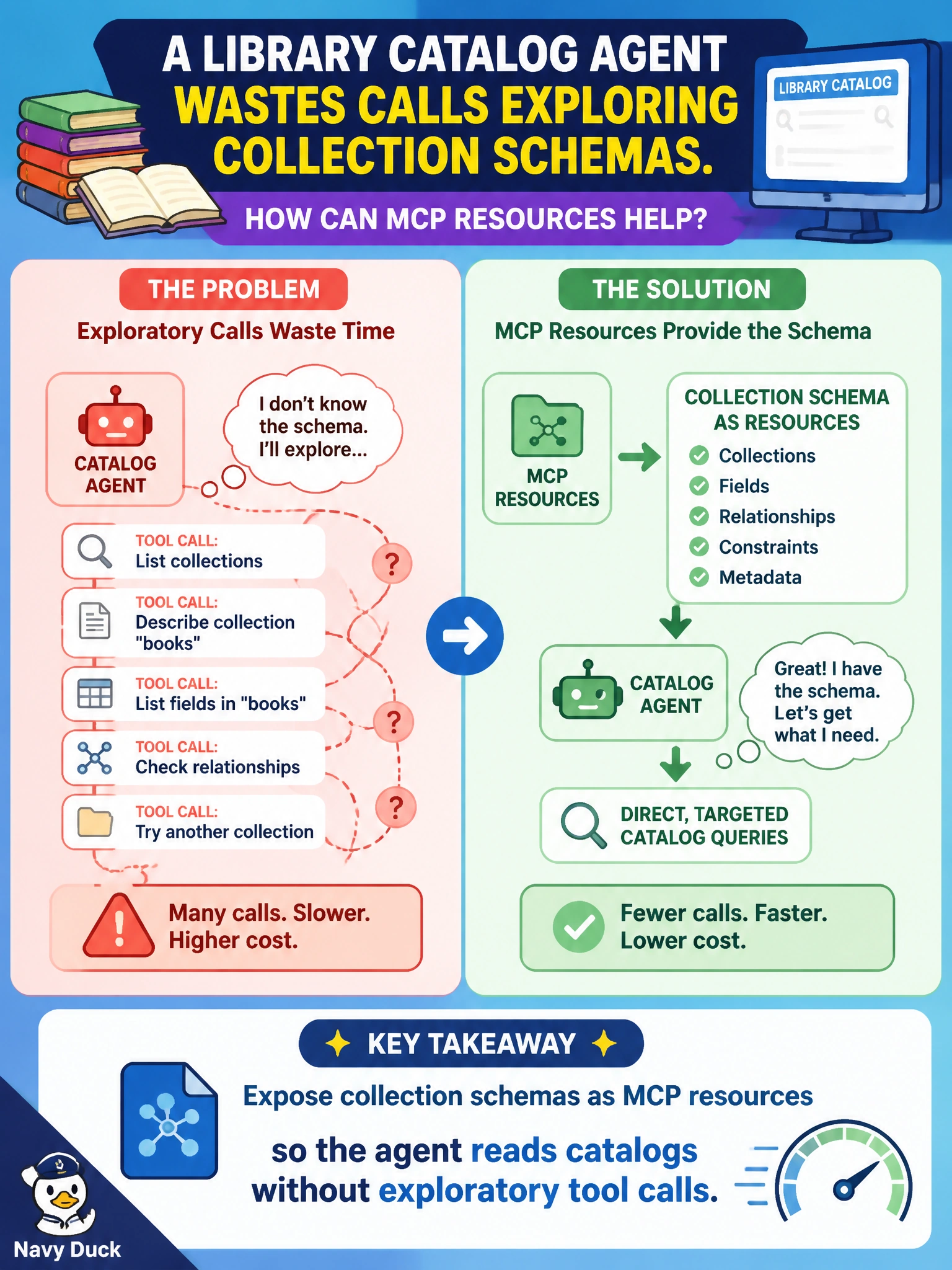
MCP resources are like putting the card catalog on the desk instead of making the agent rummage every drawer. Schemas as resources cut those exploratory fishing trips.
Full Explanation
MCP resources expose reference content—schemas, catalogs, specs—so agents can read them without burning exploratory tool calls. A library catalog agent that wastes calls probing collection schemas should instead receive those schemas as MCP resources, turning the catalog structure into directly addressable context rather than something to discover by trial and error.
Why the correct option works: resources act as a content catalog at connection time. The agent can fetch or list schema documents for collections, field definitions, and indexing rules, then call mutation or query tools with correct shapes. That reduces fishing expeditions, token waste, and incorrect tool arguments against the library systems.
Why the other three fail by concept: hiding all schemas and forcing blind trial-and-error tool calls maximizes failed calls and risk to production catalog APIs. Duplicating every schema into every user message without resources bloats prompts, drifts when schemas change, and ignores the MCP resource mechanism designed for this. Removing MCP and requiring librarians to paste schemas manually each time reintroduces human copy-paste as the integration layer and does not scale.
Exam caveat: resources are for readable reference material; tools are for actions. Do not treat “expose as resource” as “grant write tool.” Operational check: publish collection schemas as MCP resources, restart the library agent session, confirm schemas are discoverable without exploratory search tools, and measure a drop in schema-probing tool calls during typical catalog tasks.