
Treasury has unique levy calculation workflows no community server covers. When is a custom MCP justified?
Select an answer to reveal the explanation.
Short Explanation
Custom MCP is the specialty shop for weird levy math—not the factory for every boring CRUD endpoint. Use it when community servers leave a real gap.
Full Explanation
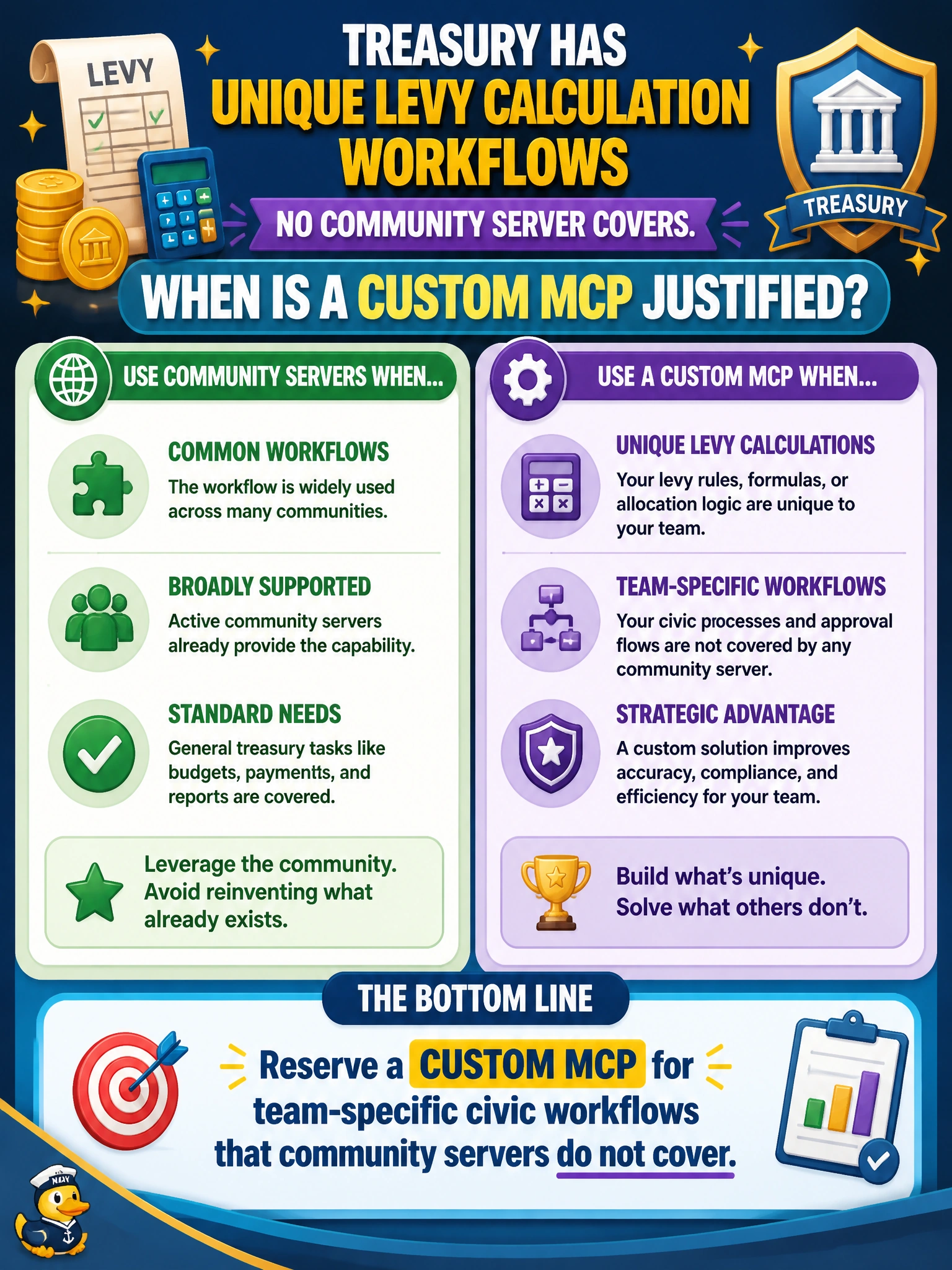
Custom MCP servers are justified when community options do not cover team-specific civic workflows. Treasury levy calculation pipelines—jurisdiction rules, exemption stacking, installment calendars—often have no adequate community server. In that gap, a custom MCP that exposes the real levy operations is appropriate engineering, not NIH vanity.
Why the correct option works: community-first still leaves a residual set of specialty domains. A custom server wraps the authoritative levy services with explicit tools, auth, and validation so agents call named civic operations instead of scraping or unconstrained Bash. Effort concentrates where differentiation exists.
Why the other three fail by concept: writing a custom MCP for every standard CRUD API, including trivial ones, multiplies maintenance for commodity surfaces better served by community servers. Never using custom MCP even when no community option exists leaves Treasury agents without a safe structured interface to levy systems. Replacing community servers with custom forks only to duplicate identical features burns staff time without adding capability.
Exam caveat: justification is coverage gap plus specificity—not “custom sounds more official.” Operational check: document required levy tools, search community registries, record gaps, then approve a custom MCP scoped to those gaps with least-privilege credentials and an ownership/runbook plan.