
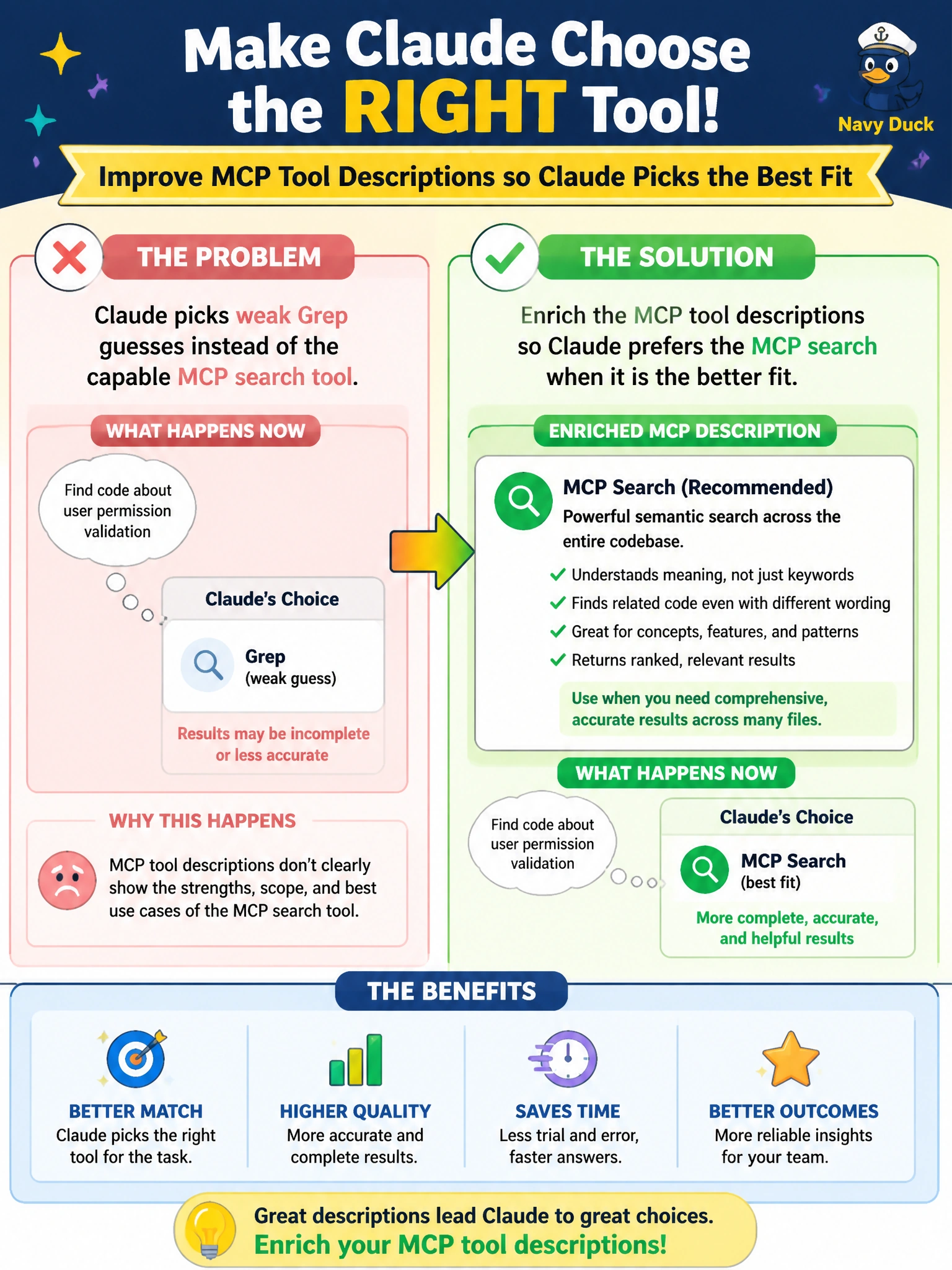
A permits team finds Claude picking weak Grep guesses instead of the capable MCP search tool. What should they improve?
Select an answer to reveal the explanation.
Short Explanation
If the MCP search tool whispers while Grep shouts, Claude may pick the wrong mic. Beef up those MCP descriptions so the agent hears which tool actually fits permits search.
Full Explanation
Claude selects among available tools largely from their descriptions and fitness to the task. When a permits team sees Claude prefer weak Grep guesses over a capable MCP search tool, the primary fix is to enrich the MCP tool descriptions so the model can recognize when the MCP search is the better fit for permit records, application IDs, or ordinance text indexes.
Why the correct option works: clear, specific MCP descriptions communicate capabilities, parameters, and when to use the tool versus built-ins. If MCP search can query structured permit indexes and Grep only scans local files, descriptions should say so. Better descriptions shift selection toward the stronger tool without deleting Grep, which remains useful for local source-code tasks.
Why the other three fail by concept: deleting the MCP search tool and relying only on Grep forever removes the capable path and locks the team into weaker search for permit data. Stripping all MCP descriptions so selection becomes random destroys the signal the model needs and worsens mis-selection. Disabling Grep globally, including for local source-code tasks, over-corrects—Grep is still the right built-in for many repo content searches and should not be banned wholesale.
Exam caveat: tool selection quality is often a description and naming problem, not proof that built-ins must be removed. Operational check: compare before/after traces on the same permits queries; after enriching MCP descriptions, confirm Claude invokes the MCP search for permit-index work while still using Grep for ordinary codebase content search.