
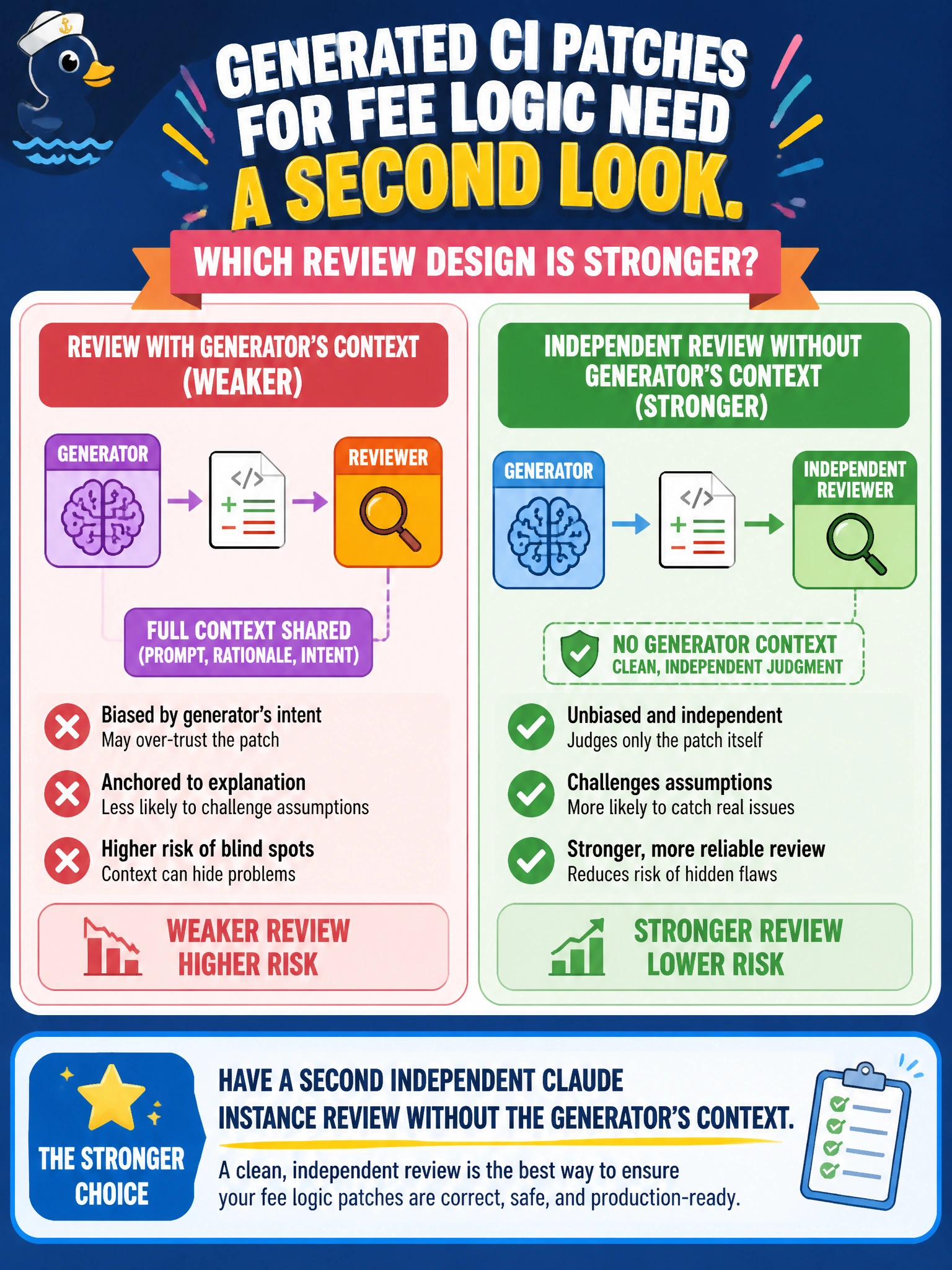
Generated CI patches for fee logic need a second look. Which review design is stronger?
Select an answer to reveal the explanation.
Short Explanation
Don't ask the author to grade their own homework with the scratch paper still out. A second independent instance without generator context catches more.
Full Explanation
Generated CI patches for municipal fee logic need a second look from a second independent Claude instance that does not carry the generator's reasoning context. Independence reduces the bias that makes a generating session defend its own choices and miss subtle fee, rounding, or authorization defects. Strong review architecture separates creation from critique. Asking the same generating session to praise its own patch without fresh context is self-grading with the scratch work still visible and systematically under-detects errors. Skipping review because generator confidence alone proves correctness confuses fluency with verification—especially dangerous for fee logic that touches resident charges. Merging patches before any review to maximize throughput optimizes for speed at the expense of production incidents in permitting or billing services. Exam caveat: independent instances improve critique quality but still need tests, schemas, and human ownership for high-impact civic changes. Operational check: wire CI so patch generation and review run as separate sessions or jobs, pass the diff without generator chain-of-thought into the reviewer, and block merge until review findings are addressed or explicitly waived.