
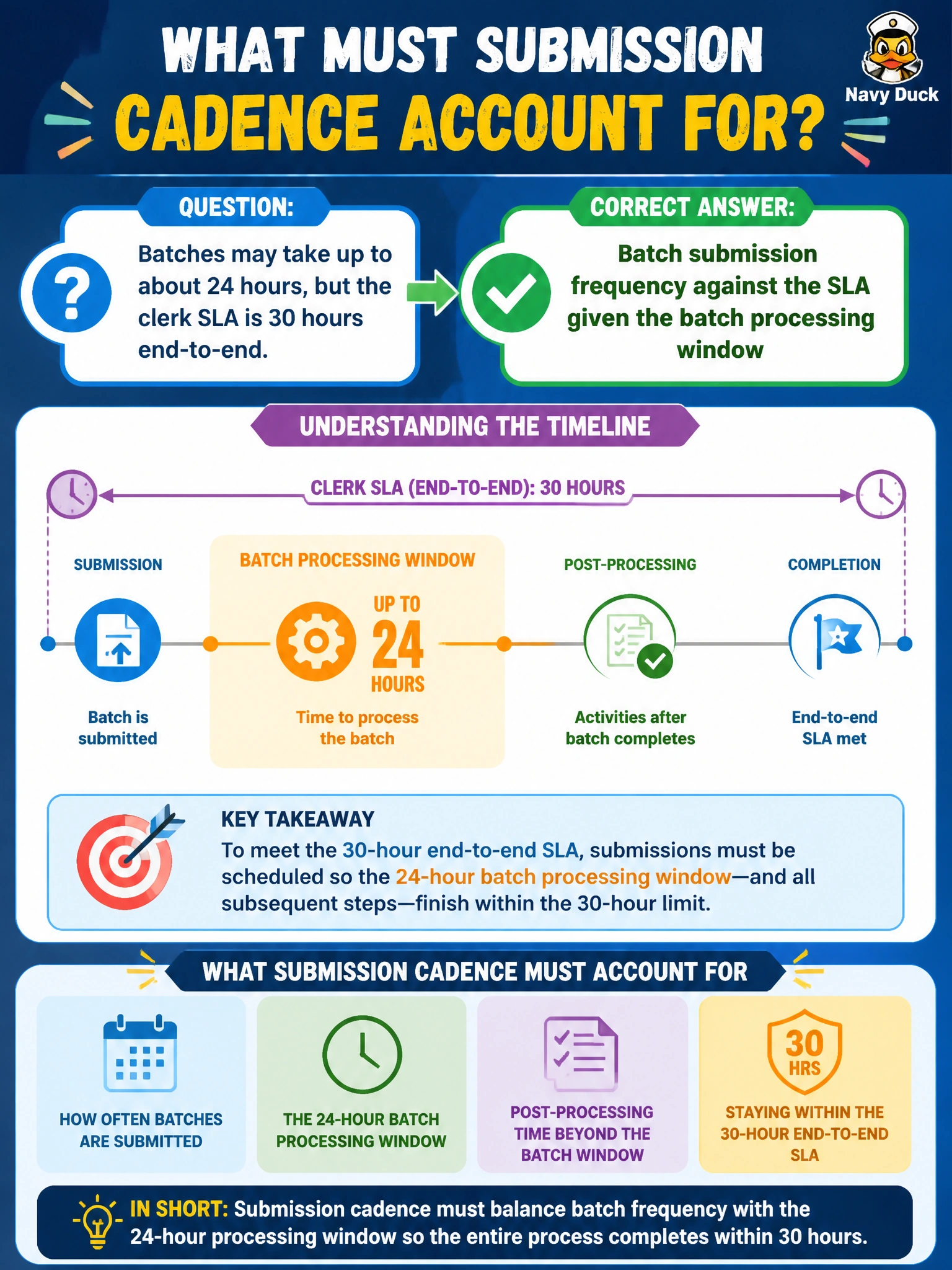
Batches may take up to about 24 hours, but the clerk SLA is 30 hours end-to-end. What must submission cadence account for?
Select an answer to reveal the explanation.
Short Explanation
If the sorter can take a day and clerks need results in 30 hours, you can't drop the whole pile at hour 29. Plan submission cadence against the batch window and SLA.
Full Explanation
Batches may take up to about twenty-four hours, while a clerk SLA of thirty hours end-to-end leaves limited slack. Submission cadence must therefore be planned against the SLA given the batch processing window: enqueue early enough that a worst-case window still leaves time for post-processing, exception handling, and clerk consumption. Treating the batch window as free latency ignores how close thirty hours sits to a full day of deferred compute. Submitting once per month regardless of the thirty-hour SLA abandons the service level entirely. Ignoring the batch window because SLAs never include processing time is operationally false—processing time is part of end-to-end delivery. Assuming every batch always returns in under one minute imports interactive expectations into a deferred API and produces late surprises when jobs run long. Exam caveat: SLA math should use the documented maximum window plus local queue and validation overhead, not optimistic medians alone. Operational check: back-calculate the latest safe submission time from clerk-needed-by minus max batch window minus reconciliation buffer, alert when enqueue slips past that cutoff, and keep an overflow interactive path for urgent packets.