
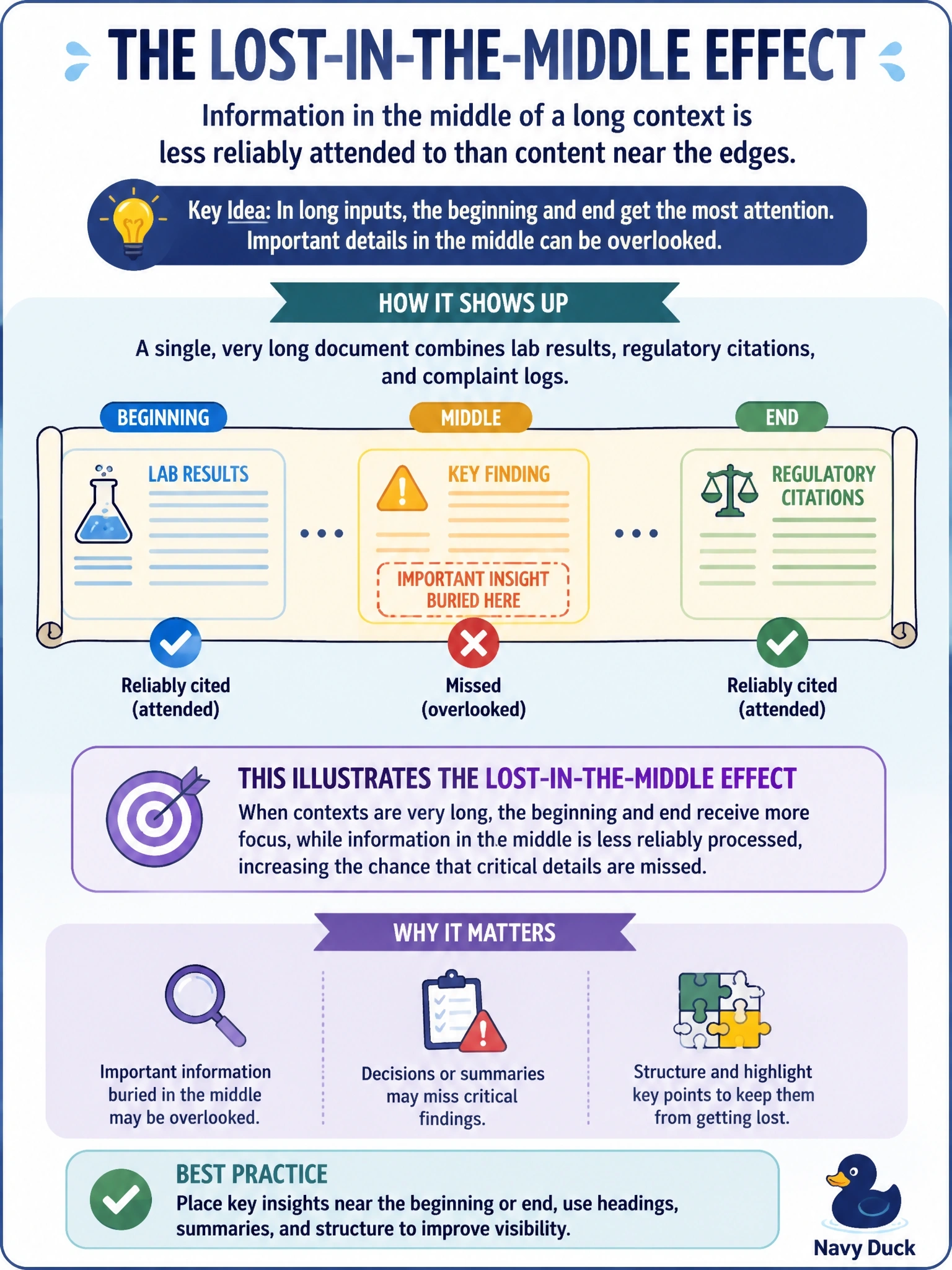
A water-quality research agent is given one very long combined document containing lab results, regulatory citations, and complaint logs, and it reliably cites content from the beginning and end but misses a key finding buried in the middle. What does this illustrate?
Select an answer to reveal the explanation.
Short Explanation
Skim a thick binder of lab reports and you keep the cover page and the closing section; the key result on page forty is the one that slips past.
Full Explanation
Attention across a long context is not uniform. Material near the beginning and the end of a large document is retrieved more reliably than material buried in the interior, and that is a positional property of long-context reading rather than a judgment about the content itself.
The water-quality agent's behavior matches that pattern exactly—confident citation from the opening and closing stretches of the combined document, and a missed finding sitting in the middle. Naming the effect points at the real remedies: split the combined document, retrieve only the relevant sections instead of pasting everything, or reposition critical findings toward the edges.
Claiming the model deliberately ignores complaint logs attributes the miss to document category when the described symptom is entirely about position. A hardware limitation specific to PDF files misattributes a context-length phenomenon to a file format and explains nothing about why the edges are cited reliably. Saying the finding fell outside the training data confuses training-time knowledge with in-context retrieval of a document supplied directly in the prompt.
Exam caveat: a larger context window reduces truncation, not this effect—more room to bury a finding is still room to bury it. Operational check: move the missed lab result to the top of the document and re-run the same query; if it is now cited, position was the cause.