
A parks master-plan agent needs to work through messy intermediate reasoning about trail-usage data before producing a clean final recommendation, and the session is starting to run long. Which combination of practices helps?
Select an answer to reveal the explanation.
Short Explanation
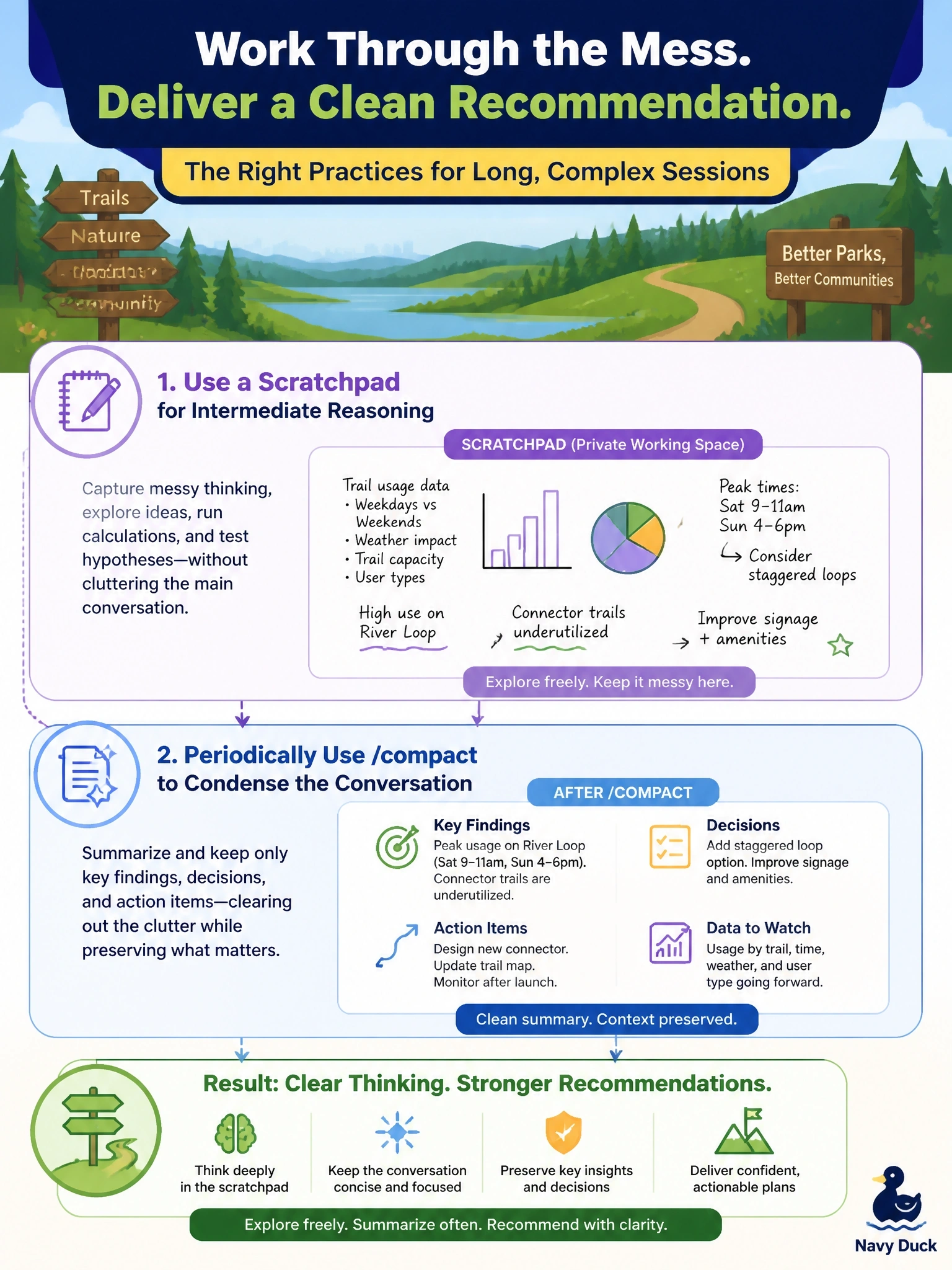
Think of the scratchpad as the planner's messy work table and /compact as clearing that table down to the sticky notes worth keeping. The report gets the conclusions, not the scribbles.
Full Explanation
Long agent sessions face two separate pressures: the deliverable gets polluted by exploratory reasoning, and the transcript grows past what the context window can usefully hold. A parks master-plan agent sorting messy trail-usage data needs an answer to each, and they are different answers.
A scratchpad gives intermediate reasoning somewhere to live outside the resident-facing recommendation, so the final document carries conclusions rather than the working. Running /compact periodically condenses the accumulated conversation into a summary that retains key findings, keeping the session usable as it lengthens. Together they hold the output clean and the context affordable.
Dumping all intermediate reasoning into the final recommendation confuses the work with the product, leaving residents to sift a planner's notes for a decision; refusing to ever compact treats compaction as pure deletion when its purpose is condensation with findings preserved, and the price of that refusal is hitting the window limit instead; abandoning scratchpads entirely forces every draft thought into the main answer, which is the first failure wearing a different hat.
Exam caveat: compaction is lossy by design—it preserves a summary, not the transcript—so anything that must survive verbatim belongs in a file the agent can re-read rather than in the conversation. Operational check: write current findings to the scratchpad file before compacting, then afterward ask the agent to restate the key trail-usage conclusions and confirm they still match the file.