
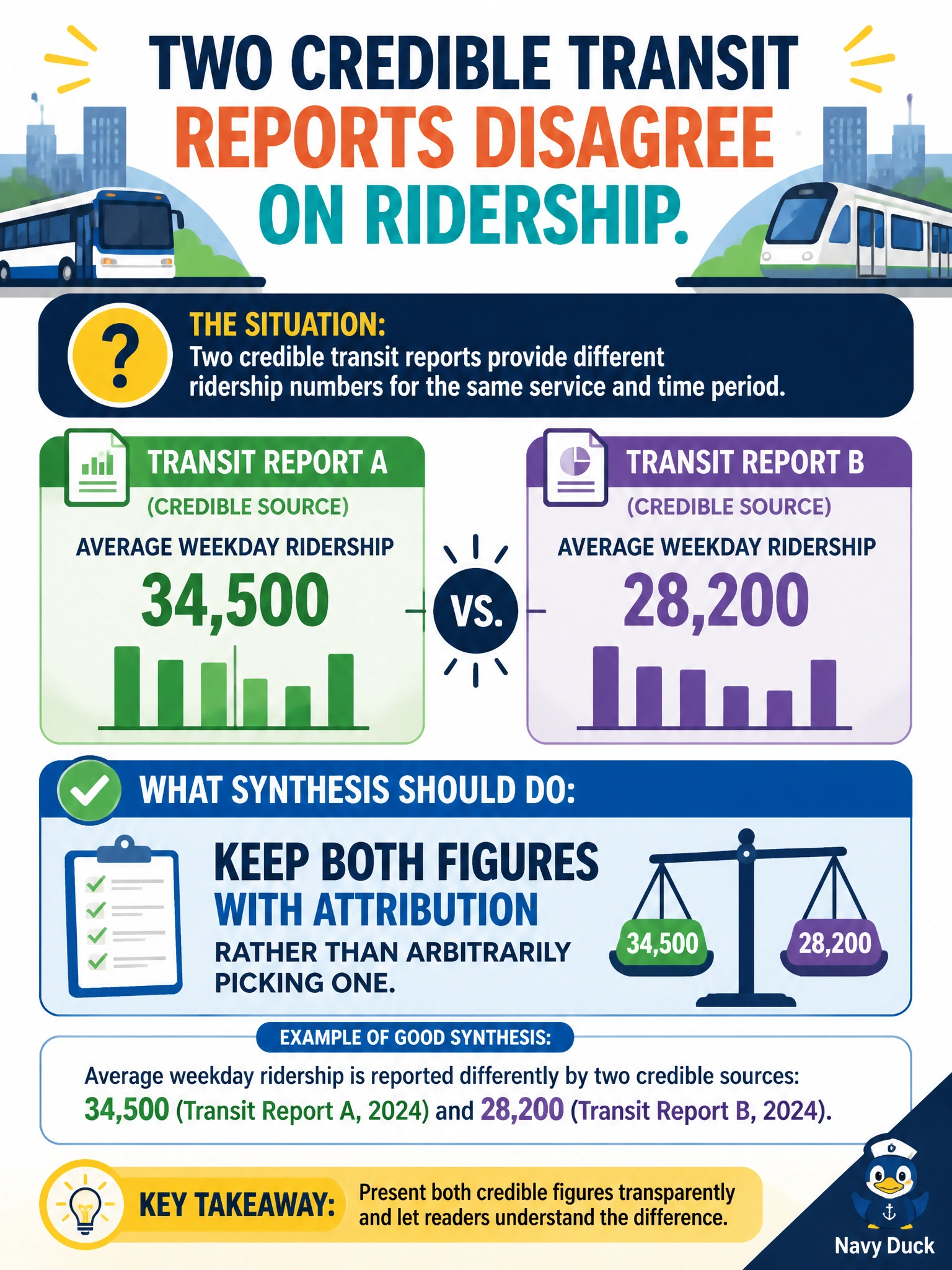
Two credible transit reports disagree on ridership. What should synthesis do?
Select an answer to reveal the explanation.
Short Explanation
When two good reports argue, show both with name tags—don't crown a winner in secret. Attribution beats arbitrary picks.
Full Explanation
When two credible transit reports disagree on ridership, synthesis should keep both figures with attribution rather than arbitrarily picking one. Municipal decision-makers need to see the disagreement, the publishers, and any methodological differences—not a single crowned number chosen for optics.
Retaining both with attribution works because credible conflicts are information: different years, fareboard versus APC counts, or service-area definitions may explain the gap. Attribution preserves the ability to dig deeper instead of laundering uncertainty into false precision for board or budget packets.
Picking the higher number to make the agency look stronger fails because it is advocacy, not analysis, and misleads budget or service decisions. Averaging them silently without naming either source fails because the mean may match neither method and hides provenance. Discarding both and inventing a compromise value fails because fabricated statistics have no evidentiary basis.
Exam caveat: if dates or methods differ, carry those too so the apparent conflict can be temporal or definitional rather than treated as pure factual warfare. Operational check: when ridership figures conflict, present both values with source names (and dates/methods if known) and note the unresolved discrepancy explicitly in the civic brief.