
Policy research subagents gather citations for a housing brief. What must synthesis preserve?
Select an answer to reveal the explanation.
Short Explanation
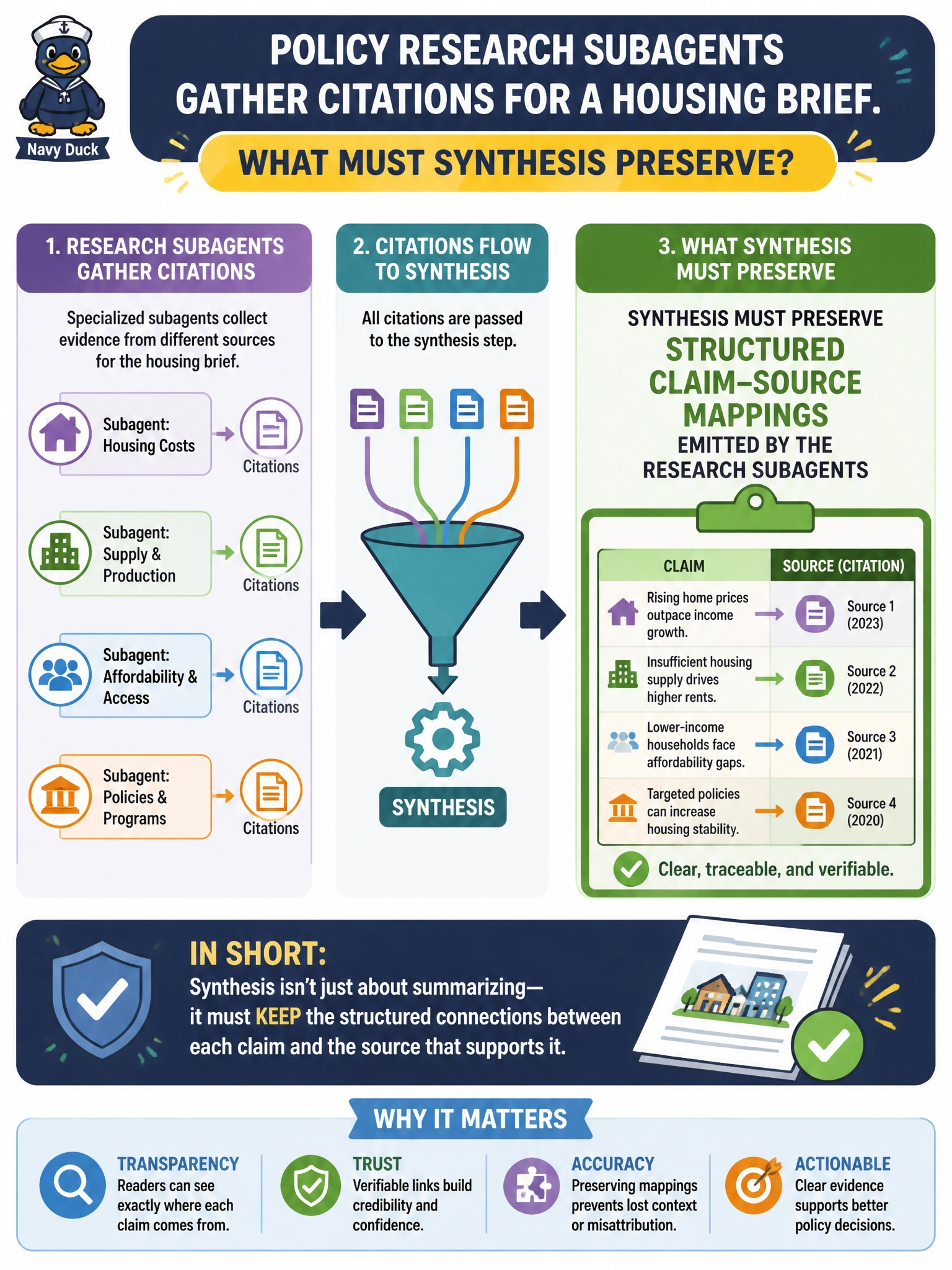
Every claim needs a tag back to where it came from—like footnotes that travel. Keep claim-source mappings through synthesis.
Full Explanation
When policy research subagents gather citations for a housing brief, synthesis must preserve the structured claim-source mappings those subagents emitted. Each claim should remain linked to the ordinance, report, or dataset that supports it so council readers and auditors can verify the trail.
Preserving mappings works because multi-agent research otherwise collapses into polished prose that cannot be checked. Structured links enable disagreement handling, date awareness, and later updates when a source is revised—core needs for municipal policy memos and housing strategy packets.
Keeping only polished prose with all sources stripped fails because unverifiable prose is not defensible civic research. Emitting a single unsourced summary paragraph fails for the same reason at even lower granularity. Rewriting claims without any link back to evidence fails because paraphrase without provenance breaks accountability.
Exam caveat: mappings are first-class data through synthesis—not optional footnotes added only if space remains. Operational check: require synthesis outputs to carry claim IDs with source IDs/URIs (and dates when available); reject drafts that present housing claims with sources removed or unlinked.