
When may a municipality safely reduce human review volume on automated extractions?
Select an answer to reveal the explanation.
Short Explanation
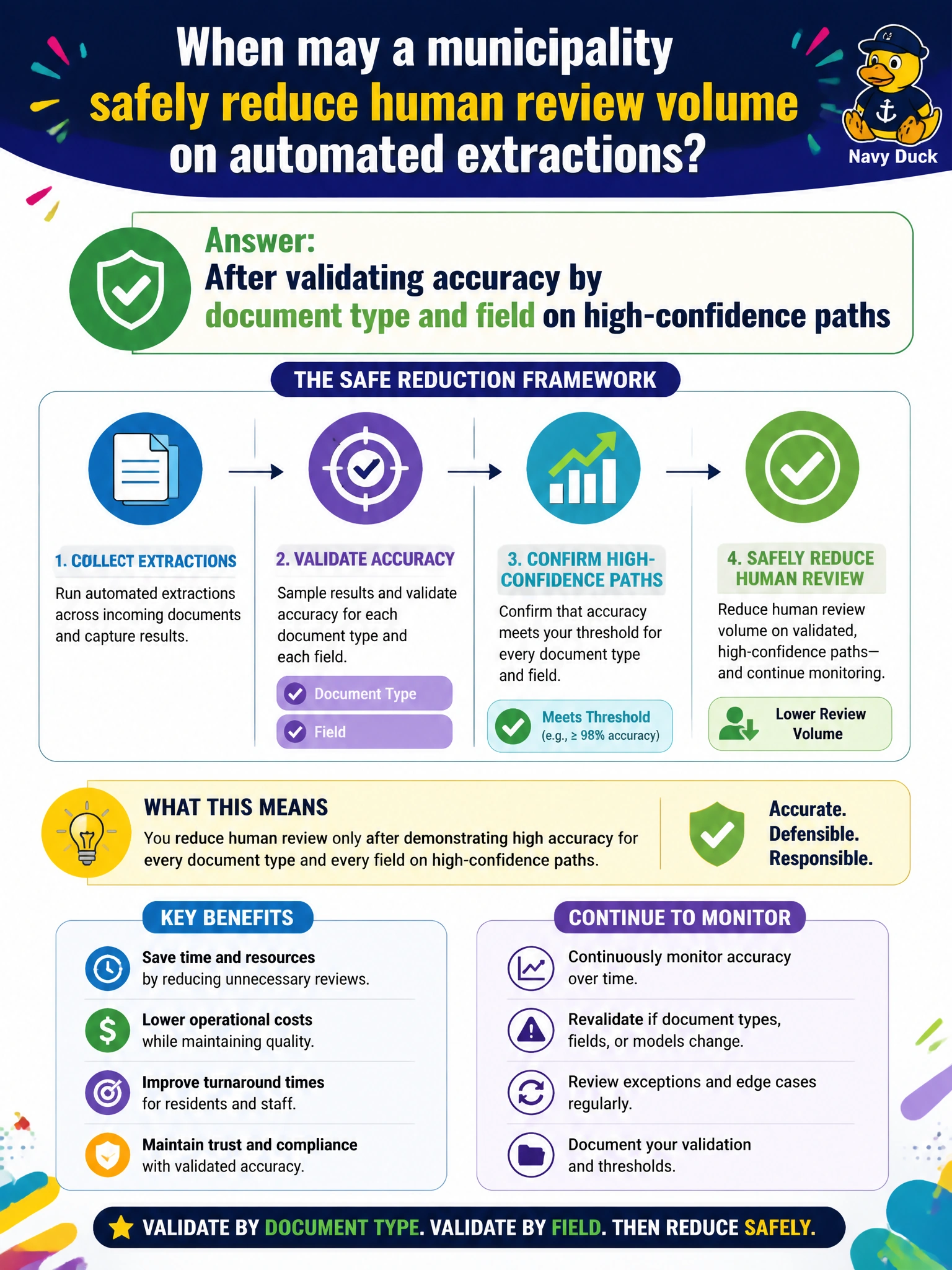
Don't cut clerk review until each document type and field earns its stripes. Segment-validated high-confidence paths come first.
Full Explanation
A municipality may safely reduce human review volume on automated extractions only after validating accuracy by document type and field on the high-confidence paths that would lose review. Segment-level proof, not a mood of overall success, is the gate for thinning clerk oversight.
That sequencing works because review reduction is a risk acceptance decision. Once high-confidence strata for each document type and critical field meet agreed error budgets under ongoing sampling, residual automation risk is known and governable.
Cutting review immediately after launch with no segment validation fails because early metrics are unstable and masks are unseen. Reducing whenever overall accuracy looks high for one week fails because short aggregates hide weak segments and seasonal form mixes. Reducing as soon as self-reported confidence averages above 90% fails because uncalibrated confidence is not validated accuracy.
Exam caveat: reduction is reversible—restore denser review if drift appears in stratified samples. Operational check: before lowering review rates, show validated accuracy by document type and field on high-confidence paths, plus a monitoring plan to detect regressions after the cut.