
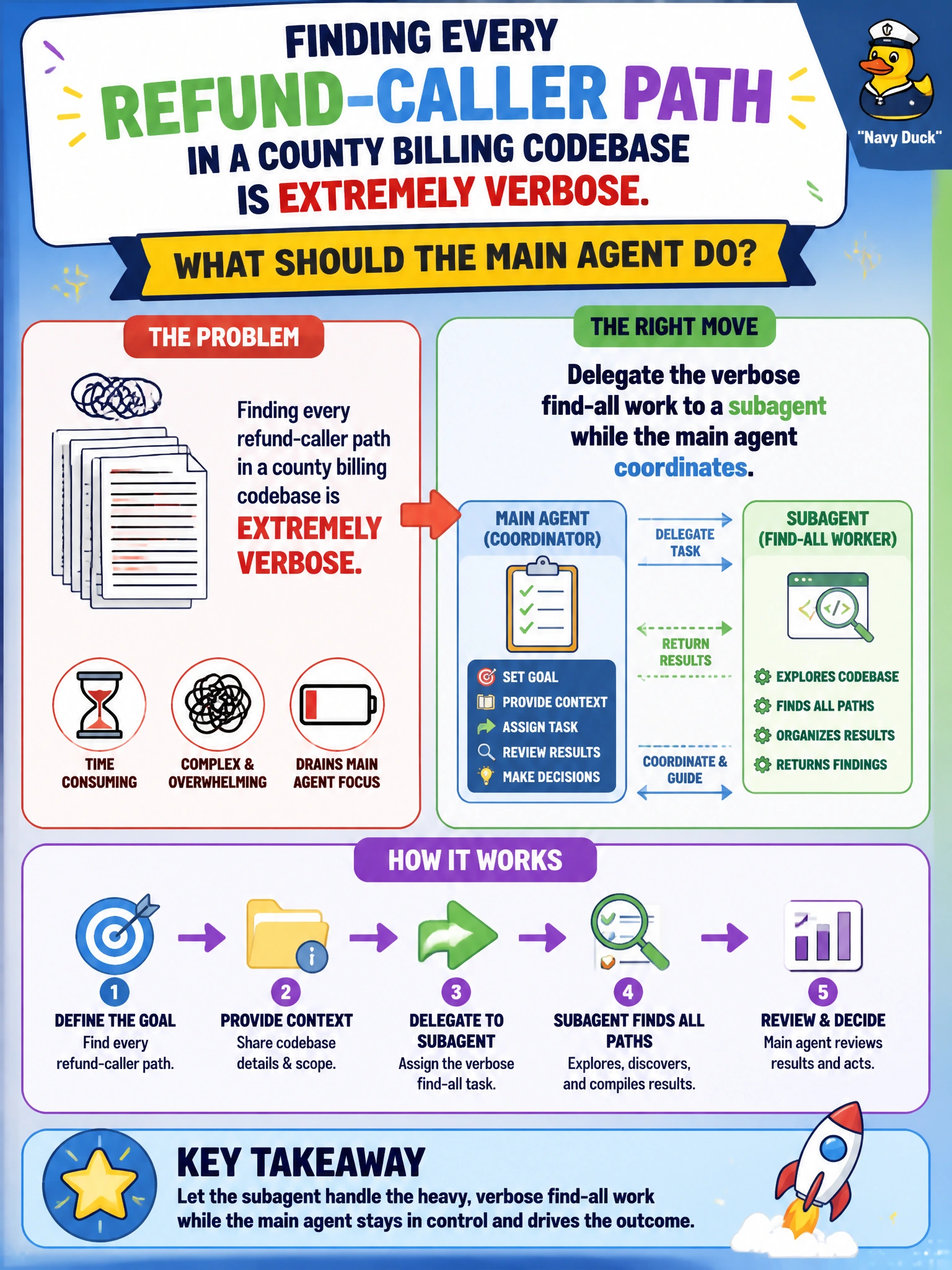
Finding every refund-caller path in a county billing codebase is extremely verbose. What should the main agent do?
Select an answer to reveal the explanation.
Short Explanation
Send the noisy treasure hunt to a helper while you stay at the map table. Subagent isolation keeps the coordinator's context clean.
Full Explanation
Finding every refund-caller path in a county billing codebase is an extremely verbose search. The main agent should delegate that find-all work to a subagent while it continues to coordinate strategy, prioritization, and synthesis. Delegation keeps the coordinator's context clean and uses a worker suited to noisy, exhaustive tool output.
Delegation works because call-graph enumeration produces long ripgrep dumps, many false positives, and file-by-file trails that would crowd out planning tokens in the main thread. A subagent can return a structured summary of confirmed callers, uncertain hits, and files still unchecked.
Pasting every caller dump into the main agent's full context fails because it causes context rot and buries decision-making under raw hits. Skipping exploration and guessing call sites from memory fails because billing refund paths are rarely obvious and guesses miss edge entry points. Disabling tools and asking the model to invent the call graph fails because invented graphs are not evidence and can miss production paths that affect resident refunds.
Exam caveat: the main agent still owns verification of the subagent's summary against policy-critical paths; delegation is not blind trust. Operational check: spawn a find-all subagent for verbose caller discovery, require a structured return (confirmed/uncertain/unreviewed), and keep only that summary in the coordinator context.