
A sprawling legacy student-information-system exploration keeps losing findings across long sessions. What helps?
Select an answer to reveal the explanation.
Short Explanation
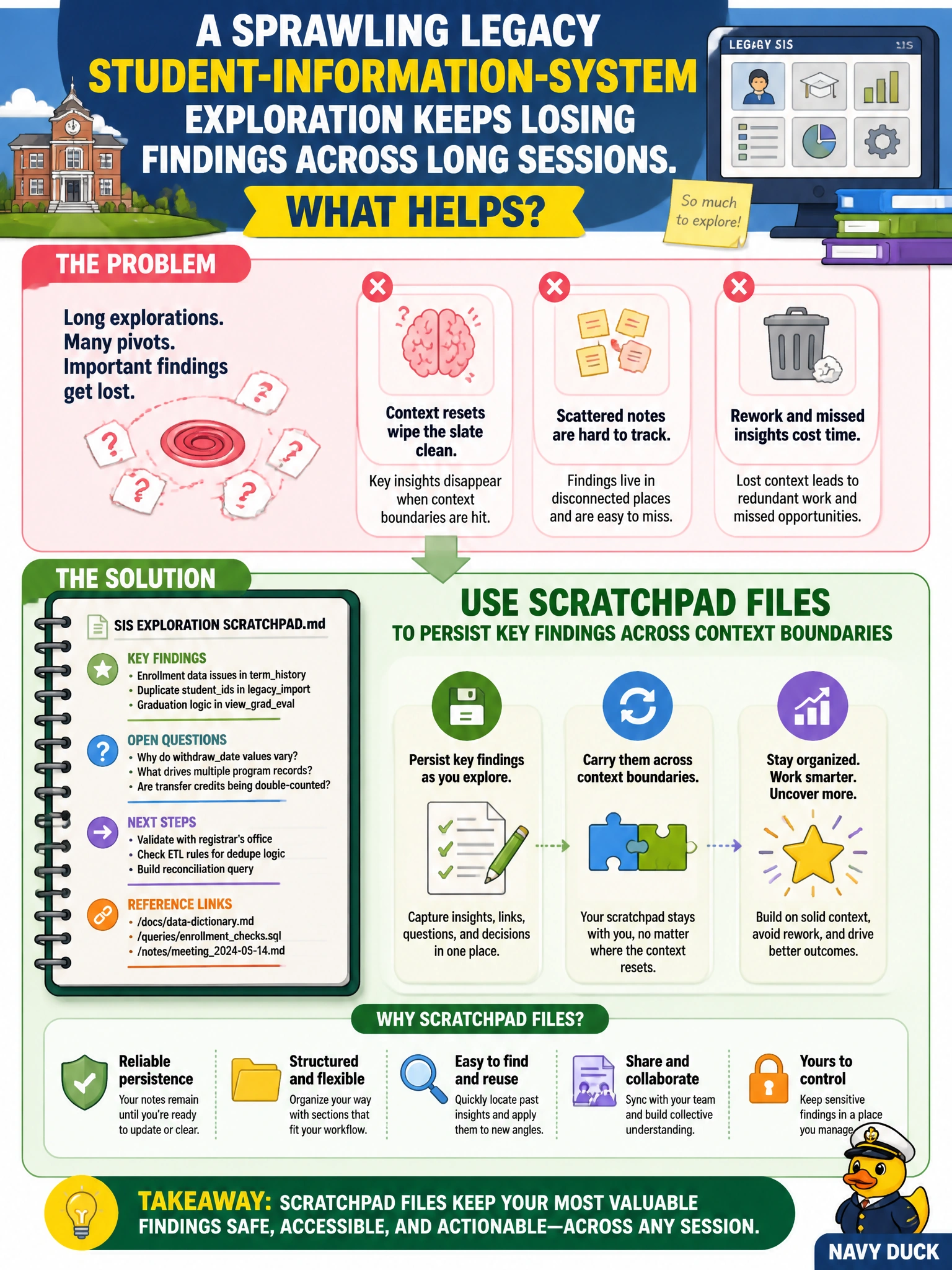
Park the gems in a scratchpad file so they survive the next context squeeze. Long SIS tours need durable notes, not just chat memory.
Full Explanation
Long exploration of a sprawling legacy student-information system (SIS) loses findings when everything lives only in a sliding chat window. The practice that helps is using scratchpad files to persist key findings across context boundaries—module maps, auth entry points, refund tables, and open questions written to durable notes the coordinator can reload.
Scratchpads work because municipal and education codebases are large; context windows fill with discovery noise while critical facts fall out of the prompt. Files survive compaction, crashes, and subagent handoffs, giving the next phase a grounded briefing instead of amnesia.
Keeping every raw file dump forever inside the live prompt fails because it burns tokens on noise and still hits context limits without a curated memory. Never writing findings down and relying only on short-term chat memory fails because long sessions will forget early discoveries. Deleting intermediate notes after each tool call fails because it throws away the very state needed to reconnect paths across hours of exploration.
Exam caveat: scratchpads store curated findings and pointers, not unbounded raw dumps—curate as you go. Operational check: during SIS tours, after each meaningful discovery, append a short note to a scratchpad manifest and reload that file after compact or crash recovery before spawning the next wave.