
Which multi-agent error patterns should a municipal architect reject?
Select an answer to reveal the explanation.
Short Explanation
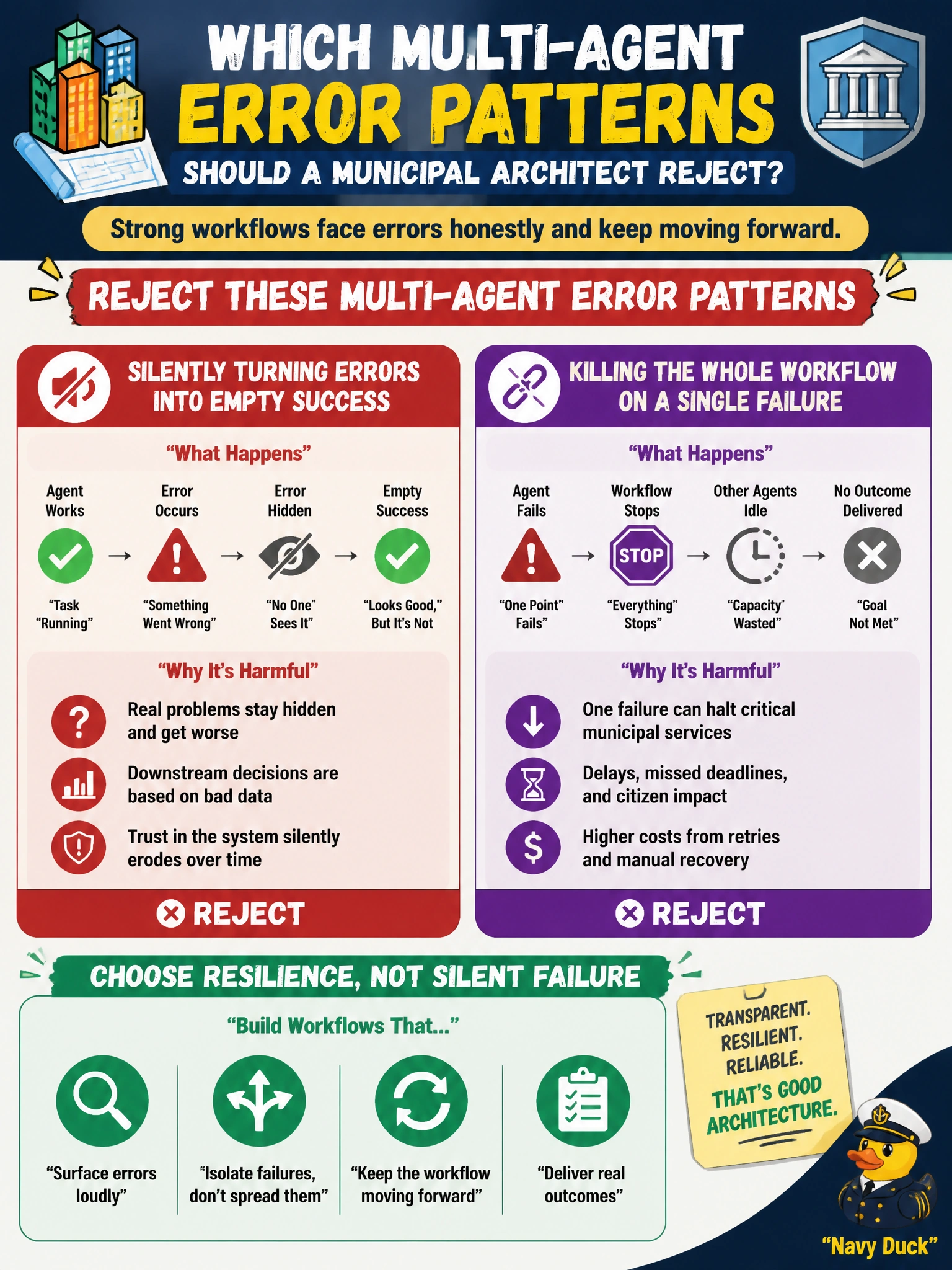
Don't paper over a failure as "success: nothing," and don't nuke the whole job for one bad tool. Those two habits wreck reliability.
Full Explanation
Municipal multi-agent architects should reject two destructive error patterns: silently turning errors into empty success, and killing the entire workflow because a single subagent failed. Those anti-patterns destroy recoverability and create false confidence in civic research and permitting pipelines.
Rejecting them works because healthy designs propagate structured errors with partials after local recovery, annotate synthesis gaps when sources are unavailable, and distinguish valid empty results from access failures. Those constructive patterns keep coordinators informed without pretending failure is success or that one bad tool means total abort.
Propagating structured errors with partials after local recovery is not an anti-pattern—it is preferred—so selecting it as something to reject would be wrong conceptually. Annotating synthesis gaps when a source is unavailable is likewise correct practice for honest briefs. Distinguishing valid empty results from access failures is required GIS/data hygiene, not something to reject. The patterns to reject are specifically error-suppression into empty success and single-failure total termination.
Exam caveat: "reject" questions ask for the anti-patterns, not the good ones—read carefully which option names the bad behaviors. Operational check: in failure-injection tests, verify errors never become empty success payloads and that one subagent failure leaves siblings and partials usable rather than aborting the whole municipal workflow.