
During multi-source civic synthesis, some topics lack support because sources failed. What should synthesis do?
Select an answer to reveal the explanation.
Short Explanation
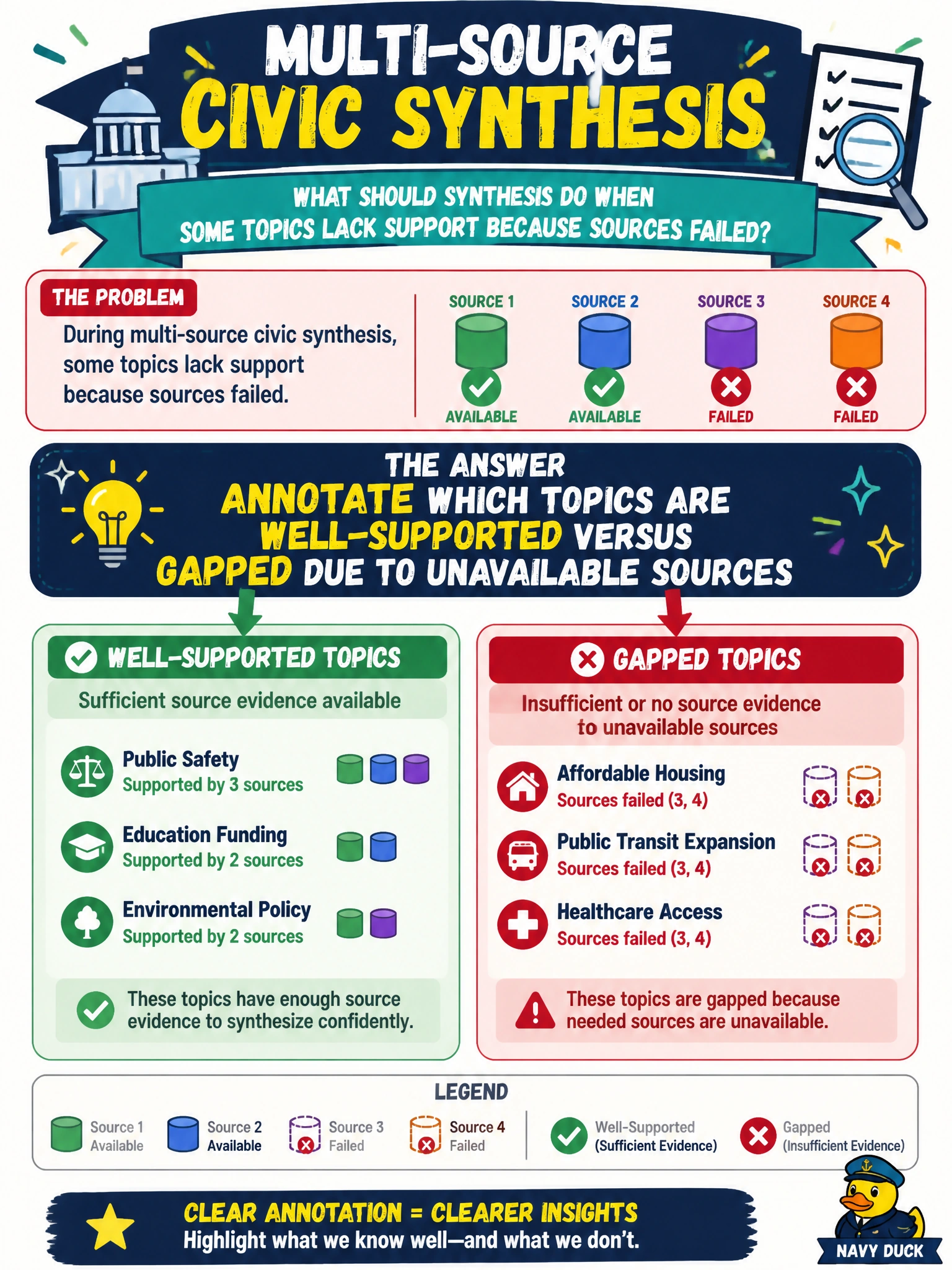
Mark the chapters that are solid and the ones with missing pages. Coverage annotations keep council briefs honest when sources drop out.
Full Explanation
During multi-source civic synthesis—council briefs, housing memos, parks packets—some topics may lack support because a source timed out or was unavailable. Synthesis must annotate which topics are well-supported versus gapped due to unavailable sources. Coverage honesty lets decision-makers weight the brief correctly instead of assuming uniform completeness.
Annotation works because municipal readers need to know whether a section rests on three corroborated datasets or on a single failed pull. Marking gaps preserves trust, guides follow-up data requests, and prevents overconfident policy recommendations where evidence never arrived.
Presenting all topics as equally complete regardless of gaps fails because it flattens evidence quality and invites decisions on hollow sections. Hiding failed sources and inventing supporting quotes fails because fabricated civic evidence is a integrity and public-trust violation. Omitting any mention of coverage so readers assume full support fails because silence about gaps is functionally the same as claiming completeness.
Exam caveat: gap annotation is about source availability and support strength, not about burying inconvenient findings that did retrieve successfully. Operational check: in the synthesis output, tag each topic with support status (well-supported / partial / gapped) and list which sources were unavailable for the gapped topics.