
A GIS search subagent fails during a zoning research workflow. What should it return to the coordinator?
Select an answer to reveal the explanation.
Short Explanation
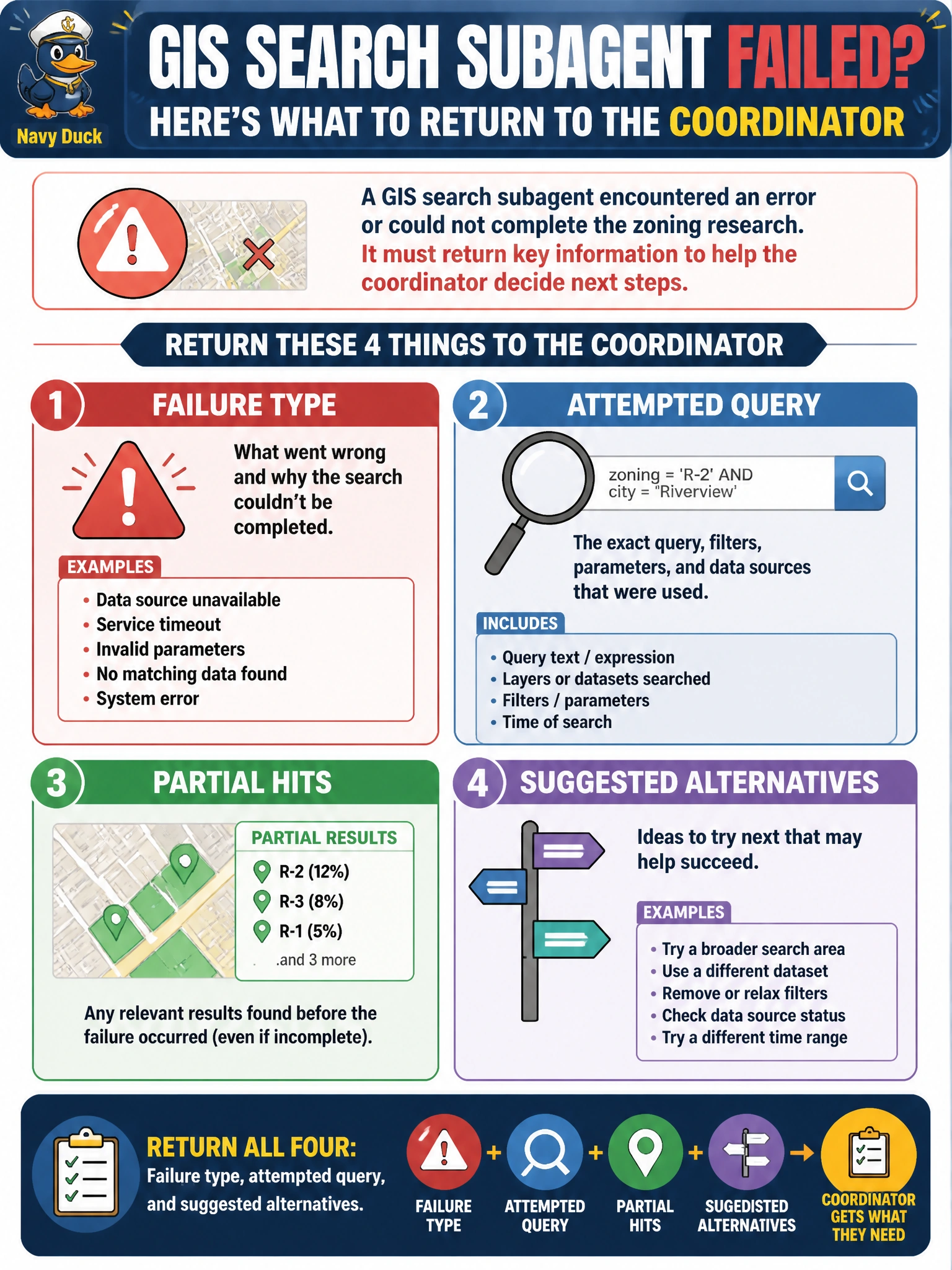
Don't just yell "error"—say what broke, what you tried, what you partly found, and what else to try. That package lets the coordinator recover intelligently.
Full Explanation
In a multi-agent zoning research workflow, a failed GIS search subagent must return structured failure context to the coordinator: failure type, attempted query, partial hits, and suggested alternatives. That package lets the coordinator retry smarter queries, switch data sources, or escalate with evidence instead of guessing what broke.
Structured error returns work because municipal GIS failures are diverse—timeouts, auth errors, malformed parcel keys, empty but valid extents—and recovery differs by type. Partial hits and alternatives preserve any useful geography already found and propose adjacent APNs, alternate layers, or address normalization next steps.
Returning only a bare "error" string fails because the coordinator cannot distinguish a bad query from an outage and wastes cycles on blind retries. Fabricating a complete result so the workflow keeps moving fails because invented parcels or zoning codes corrupt planning briefs and can mislead permitting decisions. Remaining silent until the coordinator times out fails because it converts a recoverable tool error into a global stall with no diagnostics.
Exam caveat: failure payloads are recovery inputs, not user-facing excuses—keep them structured for the coordinator while resident-facing copy stays accurate and non-fabricated. Operational check: when a GIS subagent fails, assert the return includes failure type, query attempted, any partial features, and concrete next-query suggestions before the coordinator decides retry, alternate source, or human escalate.